Arriving at Auckland Airport, having received an email from Qantas to be at the airport 4-hours before the flight, I checked in online and arrived at 0350hr to pick up the boarding pass. I went to the business class check in, got my boarding pass, and headed upstairs to go through security, only to find the grill to customs was down and the shops and cafes were all closed. MacDonalds was the only place open, with massive queues to order. There was a big sign saying nothing opens until 90mins before the first flight, which was mine to Sydney at 0600hr.
I stood around for a while, eventually spotting a seat to sit down, until the grill came up about 0430hrs. Luckily I am only 70, not 90 years old trying to find a seat.
I headed through to the lounge, the flight departing slightly late for Sydney, then headed to the gate for the flight to South Africa. I had reserved a window seat on the left hand side of the plane. Last time I did this flight in 2011 on a 747 there was a big westerly wind across Australia and when we headed south we got fantastic views of the Antarctic ice. Sometime into the flight I checked with one of the crew to see if we would see the ice, and the crew said the 787’s don’t head that far south, so we wouldn’t see them, so hard luck.
Between watching movies and listening to a very good book called Dictator Land on the various dictatorships that had ruined many prosperous countries in Africa I arrived in Johannesburg just after 4pm. I checked into the Intercontinental Hotel, adjacent to the airport. With lots of friendly staff, this hotel, which I have stayed at several times before, has fantastic service. Heading up to the room I made an effort to stay awake until 2200hr, but by 2030hr I was fading and hopped into bed. Of course I was wide awake at 0030hr.
Thursday 1 June 2023 – Johannesburg: Roger
My daughter Victoria and her partner Beau arrived at 0715hr. They had spent a few days in Singapore on their way here, which they thoroughly enjoyed. We enjoyed breakfast together and I organised a tour of Johannesburg and Soweto (known as South West of the Town). At 1000hrs we were picked up by a friendly, bubbly and delightful driver guide called Vuyo. Vuyo has a degree in political science and has been a guide since 2003. We headed southwest along a motorway, eventually driving through an area called Kensington, once a white only area, but now pretty derelict with many of the shops closed with iron grills on front and for lease. Most of the houses had barbed wire around their houses.
Next stop was Ellis Park, the famous rugby ground, with Emirates signs all over it. The surroundings of it are not very desirable, which you would not expect from what you see on TV. From there we headed to Hillbrow, a place known by the internet not to visit when you are a tourist. As we drove down the road, Vuyo pointed out the men on the corner primed to rob people or undertake their drug activity. Vuyo wound the window half way up, worried I would get my phone snatched. He says at night time, this is not a place to visit, especially with your Rolex watch and Louis Vuttion bag, as they may be borrowed and never returned. It was not a place for tourists. We then went to Constitution Hill, where the prisoners Nelson Mandela and Gandhi were held at various stages. At the time this was a white man only prison, but they didn’t want to send Mandela to a ‘black’ prison as he might influence people and establish an escape. This was before he was transferred to Robben Island.
We then headed to Braamfontein, a university area. Then we crossed the railway lines, with thousands of trains sitting stationary. Like many countries, South Africa got impacted hugely by covid. To stop the spread they stopped the use of train lines, and turned the power off to the overhead lines. Surprise, surprise, the local baddies went and stole the copper wire lines which run the trains. Consequently the trains are no longer running and the government has no money to pay for new lines.
It was interesting because on the way out we were having a great discussion with Vuyo about the power disruption in South Africa and he explained that at the end of the Apartheid the power was only supplied to 32% of the population. Because of the way Mandela came into power in 1991, many of the wealthy in South Africa left the country taking with them what little wealth they could out of the country. What was one of the wealthiest countries in the world is now struggling to recreate its economy with the highest crime rate in the world and over 30% of the population unemployed. According to Vuyo’s political studies, it will take another two generations from now for the country to reach the prosperity it once had.
We then headed to the old commercial district, now mostly closed. Then we headed to the Indian district and from there we went to Newtown. They have tried to spruce the place up, with pillars on the motorway with artwork and a museum. Then we jumped on a motorway and headed to Soweto. Passing large hills made of tailings (hills built from the left over spoils from the mines after gold extraction), which now have grass and plants on them.
Arriving at Soweto, expecting slums, we passed a rather nice school, with lots of kids standing around in nice school uniforms and headed down some rather nice streets. Observing very nice houses with double garages and brick walls, few topped with barbed wire, and what would be a rather nice part would be of any city of the world. Vuyo went on to explain that this was known as the upper class area of Soweto, populated with doctors, lawyers, and business people. We were somewhat surprised by how nice the area was. We then headed to the middle class area of Soweto. Although the streets and paving were a little rougher than the upper class part, there were lots of people out cleaning the footpaths and mowing the grass. In general the area was quite well kept. Vuyo explained that back in the 70’s they used to have a thing called ‘neckties’, where people that spoke or gave information to the police would have a car tyre put around their neck, filled with petrol and set on fire. Things have changed, and the car tyres we saw were being re-threaded and sold, as opposed to being used for ‘justice’. Nowadays there is little crime in Soweto, and if there was, there is mob culture where the community would assist and the police would not be involved.
We headed past what was an old coal power plant, with its large decorated chimneys, which you can now bungee jump off a ramp that is between the two. We then arrived at a little market place, and a cafe, Vilakazi Espresso, which had a generator running out the back. We enjoyed a coffee and a sandwich before being encouraged to have a look at the stalls, where we made a contribution to the local economy, Victoria more than others.
We then headed to the local museum, where no photos were allowed. This was full of various photos of demonstrations and riots that took place during the apartheid days. One in particular had all these high school children parading up a street all well dressed in their school uniforms to be later attacked by riot police. Many of the children arrested were unable to be tracked down by their families and the authorities never alerted parents of their children being arrested. There is a courtyard with bricks laid out with names of those who were killed during these demonstrations.
From the museum we drove past the house that Mandela occupied in Soweto with a couple of his four wives. We also drove past the house that Desmond Mpilo Tutu occupied at one stage. We then saw Chris Hani Baragwanath Hospital, a public hospital, which is the largest hospital in Africa and third largest in the world. There was a large nurse living quarters next to it for those from overseas to reside in.
Vuyo explained that through the 70’s and into the 80’s the apartheid rulers were gradually starting to integrate the black and white communities. Unfortunately when the ANC took power in 1991 many of the affluent business people left the country and with a combination of corruption amongst the politicians since then it will take generations for South Africa to recover to the affluent country it once was.
From there we headed to the lower class area of Soweto, which is a shanty town. To earn an honest living, people here go out and collect rubbish to be recycled. This is known as a lower class job and so these workers don’t embarrass their families they often wear full masks to hide their faces and identity as they roam the streets collecting plastics, bottles etc which are then separated and recycled.
Note this guy has his face covered so his kids who go to the local school won’t be embarrassed by the fact that their father does the lowest job in the community to support his kids through their education. There are a number of people in other countries that could learn a lesson or two from these hard working people.
These people live in huts and shacks, made from corrugated iron. Often 4 – 5 people live in one of these shacks. Some have electricity that is stolen from the local grid but there is no sewage or potable water supply. These days this area is minuscule compared with what it was years ago.
Soweto’s soccer stadium
Soweto’s hospital entrance. Formerly a military hospital, now the largest in the southern hemisphere.
We started heading back to our hotel, taking in more of the views of Johannesburg, seeing blokes in the back deck of utes and some people walking on the motorway. Returning to the hotel, it was a good time to sit down and relax at the restaurant for a drink and dinner to follow.
Local bus station
Sylvia and daughter arrived around 1630 followed by my daughter Kirstie and her friend Celeste at 2230, without their bags as the flight from Sydney to Dubai was late, their bags missing the connection. Also on that flight was Beka’s friend Katrina.
I was in Israel for a business trip and had the opportunity to do a couple of brief guided visits, one in Jaffa, the old port near Tel Aviv, (where I was staying), and one in Jerusalem.
Israel is a tiny country, steeped in history. Many of the cities have been built, destroyed and rebuilt time and time again over the years. The deeper you dig, the further back in history you go.
Jaffa
Jaffa is the oldest seaport in the world, existine for more than 4,000 years. It is known as the site that Jonah (the biblical Jonah of Jonah and the whale) set off from. It also features in the New Testament, with our guide explaining that christianity started in Jaffa when Paul received a vision in a room in the city.
The team in Israel had organised a fantastic guide to take us for a quick walking tour around the city one evening. We started at the clock tower that was built towards the end of the Ottoman Empire in 1903. Our guide regaled us with some interesting writings from visitors to Israel and Jaffa – it seems most were disappointed with Mark Twain in particular using some well crafted language to express his views “Of all the lands there are for dismal scenery, I think Palestine must be the prince… Can the curse of the Deity beautify a land? ”
We wandered through narrow cobblestoned streets down towards the port itself. Many of the streets now contain high-end art stores, many of hte artists having moved to the area a long time ago, before its current gentrified state. The streets often have zodiac signs on little painted tiles. If I had more time, I could have gone on a ‘treasure hunt’ to find them all.
In one spot we came across an orange tree, suspended and hanging – an art installation reflecting the many orange trees that used to grow in the area.
At the port itself we stopped to hear the story of Andromeda, Poseidon and Perseus – there is a rock formation in the harbour (that must make navigation treacherous) that is runoured to be the sea serpent of legend that Perseus turned into rock when saving Andromeda, by holding up the severed head of Medusa. It was a lovely evening – the photos really don’t do the place justice.
Jerusalem
I was able to take an afternoon and make a visit to Jerusalem, about an hour’s drive from Jaffa. I was met in the old city by Dorit, another fantastic and well-informed guide. Old Jerusalem itself is actually very small, only one-square-kilometre, and home to about 40,000 people – Muslim, Christian, Armeniam and Jewish – the city is divided into four quarters.
We started our visit in the old citadel in the Armenian quarter, near the Jaffa gate, which is the entrance from the road to Jaffa. The current walls of the old city were built in the 1530’s. (The city had walls before but the city was smaller). Apparently Suleiman, the Ottoman Sultan at the time the walls were built, had the two architects who designed the walls killed on their completion, because the meglected to include Mt Zion, the City of David, inside the walls.
We climbed to the top if the citadel for fantastic views across Old Jerusalem to Gethsemane and beyond. The Dome of the Rock (mosque) stands out with its huge gold dome, as do the domes on the churches in the Christiam quarter and the synagogues in the Jewish quarter. It is really impressive to be standing in a place so steeped in history and that has touched so many people over the years.
As we wandered down through the city we passed a small tattoo parlour that has been there since 1300. The current proprietor is the 27th generation of his family to maintain the tradition. Apparently many people want a permanent souvenir of their visit to the Holy Land. Dorit also told me about Jerusalem Syndrome, a recognised mental condition that can affect some visitors who become overwhelmed by the sacred space and end up with full blown psychoses, believing they are the messiah.
Many Christian visitors start their pilgimage in Gethsemane and follow the Via de la Rose to the Church of the Holy Sepulchre. This church has been built on the hill that once stood outside the city and was know as Golgotha, where Jesus was crucified. The church itself is now jointly managed by the Greek Orthodox, Armenian Orthodox, and Franciscan Order (Catholic). Apparently the Ethiopian Orthodox church is also involved. Each has its own separate area of the church and it takes quite some time to align on any changes, upgrades, maintenance etc.
Inside the church is the area that Jesus was crucified – people file past and are able to bend down under a small table to touch the rock. There is also a large stone slab believed to be where his body was laid after it was taken down from the cross. Many people were prostrate over this area, praying, crying and rubbing their belongings over the stone. There is also a small building that supposedly stands where the cave that Jesus was buried is. People queue to be able to enter the small space for a few minutes.I wish I would have had more time – just to sit and watch the people. Regardless of belief, there is no doubt that this is an incredibly sacred and meaningful journey for a lot of people.
After leaving the church we wandered through the bazaar area, and after stopping for some delicious houmus, salad and falafel, continued to wander down to the Jewish quarter. It was quite amazing as I had the sense of being in a completely different place altogether. It was quieter and calmer, with no bazaar, only some upscale stores selling Jewish arts and crafts. In places the old Roman roads have been excavated with their tall columns now proudly displayed. This part of the city was completely demolished prior to the 1967 war and so is much newer than the other parts we had been in. The large synagogue here has been rebuilt at least three times. Again, I would have loved to have more time to people watch with many men dressed in Orthodox Jewish fashion gathering in different places. The diversity and contrast in this place is quite impressive.
We finished our visit at the Western, or Wailing wall, at the base of the Temple Mount or Mount Moriah. This site is holy to the Jews and the Muslims having been the site of the Temple that Solomon built. Mount Moriah has been encased in what is almost a large box to create more space for people to gather, and now houses the Dome of the Rock. Jews gather at the western wall to pray as it is the closest they can get to the Temple site. Many write notes and prayers on pieces of paper and press them into the crevices between the stones. The area for prayer is separated into male and female areas. Again, there is an overwhelming sense of reverence from the people gathered. I was quite surprised when I reached out to touch the wall how smooth the rock has been worn over the years.
While I would have loved to have more time, I am definitely glad for the opportunity to visit this incredible place.
We attended the fun bull-fighting at Lunel last weekend, after being given tickets by Hadrien who owns the Le Cartel Restaurant at Vauvert and also runs the bull fighting. We popped along for a rather entertaining couple of hours. At this event no bulls die and the blokes in the ring with the bull are very agile and very quick to jump over the fence as the bull runs after them after they have tried to tag it with their hand between its horns. It can be best described by the short video below.
Thursday 10 November 2022
Late afternoon we drove to Lyon, about 3 hours north of us. We had decided to stop the night here to make a stop on the way to Strasbourg. We hit heavy traffic on the way into the city and somehow ended up driving through a bus depot on the way to the hotel L’ Abbaye in the old city. Once again the car parking was some 800m from the hotel. It is a comfortable boutique hotel with a two star Michelin restaurant, which we had not booked for.
Friday 11 November 2022
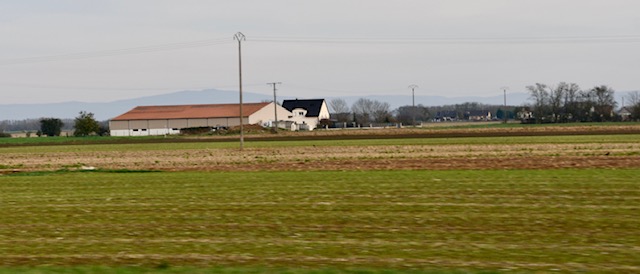
After what was definitely not a Michelin star breakfast at the hotel we headed off north to Strasbourg. Once again the the roads were great and as we headed north past Grenoble the land became very flat, opening out into a wide plain which was extensively farmed.
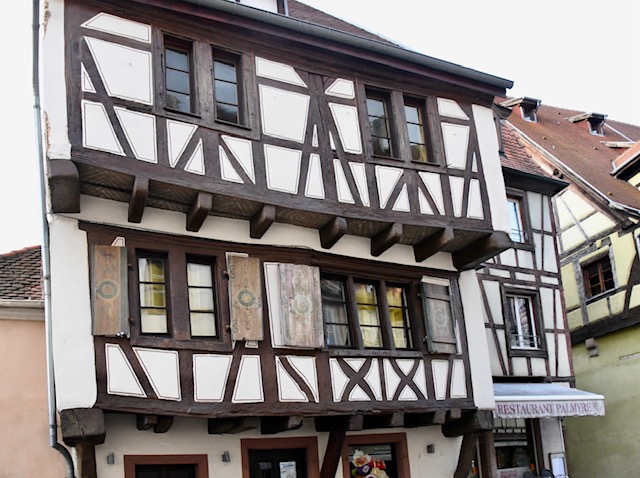
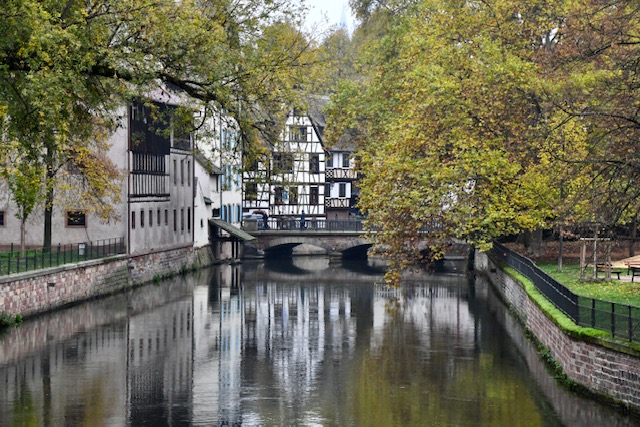
Our first stop was Colmar, a pretty little town just south of Strasbourg. It’s another place that just makes great photos, especially with its waterways and half-timbered buildings, some of which look like they have sagged a little over the years.
Arriving at Strasbourg we checked into Hotel Leonore in the old area – this time the car park was only 200m away. It’s quite a big hotel, at some stage converted from someone’s mansion.
Like all the old cities of Europe, Strasbourg dates back to pre Roman times, originally being a Celtic Village renamed Argentoratum by the Romans. In the 5th century, well after the Romans, it was captured by the Franks who called it Strateburgum. They held onto it for 300 odd years. In 842 Charles II of West Franks and Louis II of East Franks took an oath of alliance, the Serment of Strasbourg, the text of which is the oldest written document in Old French. In the Middle Ages it became a city of the Holy Roman Empire. It, like most places in Europe, went through the 30 year war of the 1618-48. In 1870 it was captured by the Germans and returned to France after WWI.
After checking in, we went for a wander into the town centre and enjoyed a drink and some people watching in the square by the cathedral. It was dark by 5pm and a mist settled over the city so we headed back to the hotel for a drink. The restaurant was booked out so we enjoyed a meal at the Sofitel Hotel’s restaurant behind the church across the road before settling in for an early night.
Saturday 12 November 2022
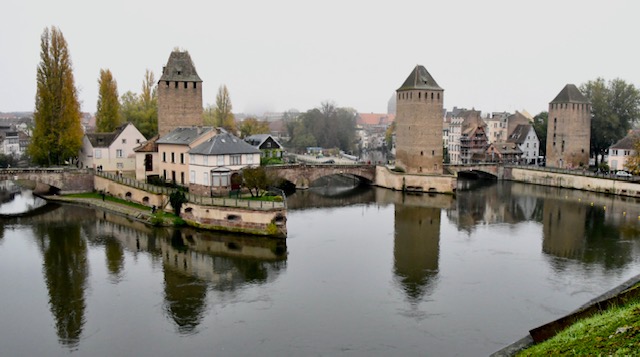
After a good breakfast at the hotel, we took a wander around the old city, heading first along one of the many canals to the area, known as Petite France, which still has some of the old towers standing. Originally there were some 30 of these surrounding the city in a defensive wall. Stone buttresses at the bottom of the towers had canon ports in them, just above the water level. The L’ILL River surrounds the old town making it into an island. They had also built a dam (barrage) that still exists, with some 17 gates that could be opened to flood the areas when under attack. Not only did this river make for a good barrier if the city was attacked but also the water was used to power much of the industry that sprung up in the town. Large tanneries, abattoirs and factories existed along the banks of the river. Like most old cities, many of the factories have been turned into accommodation and office buildings. We popped into the church of Notre Dame, with its large Pipe Organ, which blurted out something I think they call music but to me sounded more like a cat screaming when gripped tightly around the neck by a large dog. Bodies were buried in the floor plus in the odd cask sitting in alcoves.
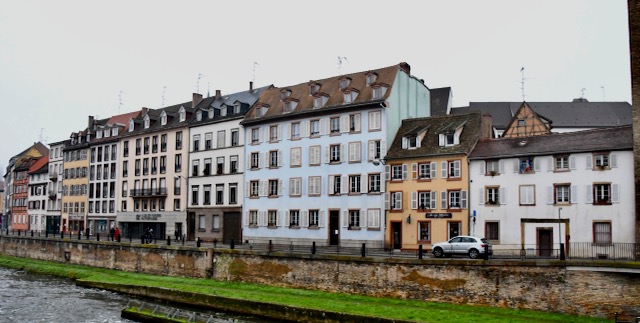
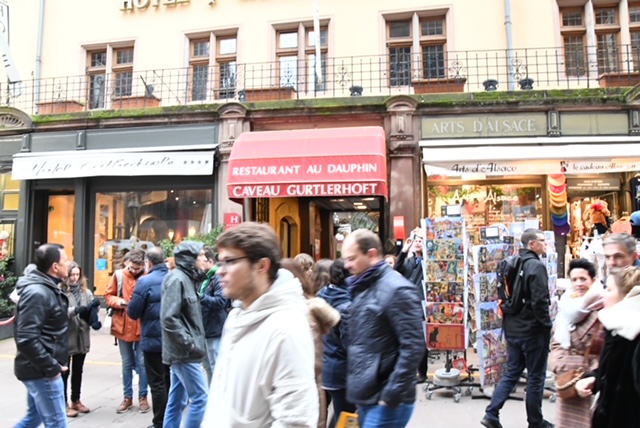
Arriving back at the main square, the spire of the cathedral was covered in fog on this wintry day when the still waters gave off reflections of the colourful buildings situated along the river and canals. We had arranged to meet Marlyn at the Gurtlerhoft, a restaurant situated in a basement,on the edge of the square. There we enjoyed a lovely lunch and a good chat. I had met Marlyn on a walking tour of Berlin in early 2020 while there watching my daughter race in the track cycling world champs. She lives in the nearby German city of Karlsruhe. Thanks for the lunch Marlyn we look forward to meeting again soon.
After lunch we headed down to the river to catch a boat cruise around the city. The boat headed up river to a lock not too far from the bund. Dozens of people watched as the gate opened and our boat headed in, the gate closing and the water flowing in until we reached the height of the upper river level. We then motored up to the bund then headed down the other side of the island after going through another lock to drop us back down to the river level. Passing the end of the island and the old city we headed a couple of kms down river, passing some nice old buildings with the commentary telling us about several of them as we went.
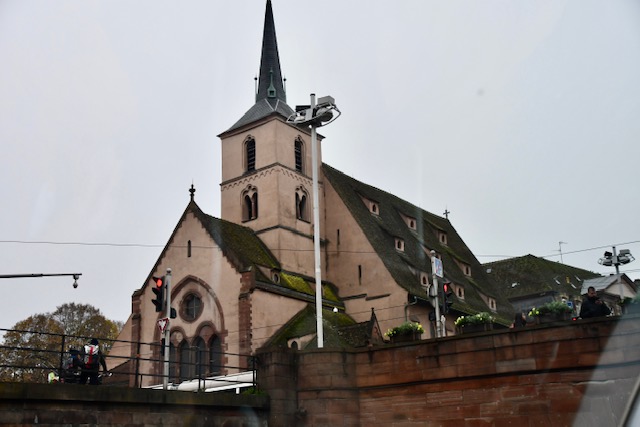
One included a large church, built to accomodate the 1300 soldiers of a previous army so they could pray together. Reaching a fork in the river, we were informed the a building on its bank was the home of the European Court of Human Rights along with some other administrative type buildings. Then we turned around and headed back to the start point. We had planned to do the climb up the cathedral spire but it was still clagged in with fog. We went into the main building which is very grand and also looked at the astronomical clock, situated down the back on the right-hand side. By this stage night was setting in so we wandered back to the hotel.
Sunday 13 November 2022
On the drive up we had spotted, on a rise near the motorway, what looked like a large old fort, which turned out to Belfort. The town is relatively young only occupied since Roman times. Once in Austrian possession, it was handed back to France as part of the treaty at the end of the 30 year war in 1648. After this the fortifications were extended, and in the 1870s it held out against the Franco-Prussians and survived a 3 month seige. The place is impressive with a moat and walls around the old town and the large hill to the to the east. With the Savoureuse River looping around the west side it was a pretty magnificent fort for its day. We had planned to stop in the fort cafe at the top of the structure but it was closed, as was the museum, despite Google saying it would be open. The whole town was covered in mist making it not a very good day for photos. After checking out the tunnels that were open and taking a look at the large lion sculpture on the side of the hill we continued on our journey home.
Having arrived back from Washington DC in the US yesterday, and with Tuesday being a holiday and Sylvia having today off, we decided to revisit Toulouse.
We set off early for the 250km drive to Toulouse following the toll roads for the 3+ hour journey.
Stopping at the old town fortress of Carcassonne for lunch, on what was a rather windy and overcast day, we tried the local dish, cassoulet, which we both decided would not go on our favourite list.
I know I have said it before, all the main roads here are smooth, wide and easy to drive on with the 130km/h speed limit only reducing at interchanges and for the odd patch of road works. When road works are being undertaken they paint the road markings with yellow paint and usually put up concrete barriers to protect the workers. Very few road cones are seen.
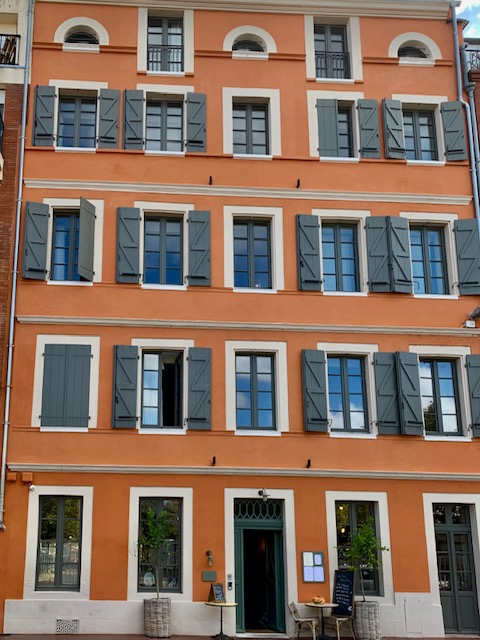
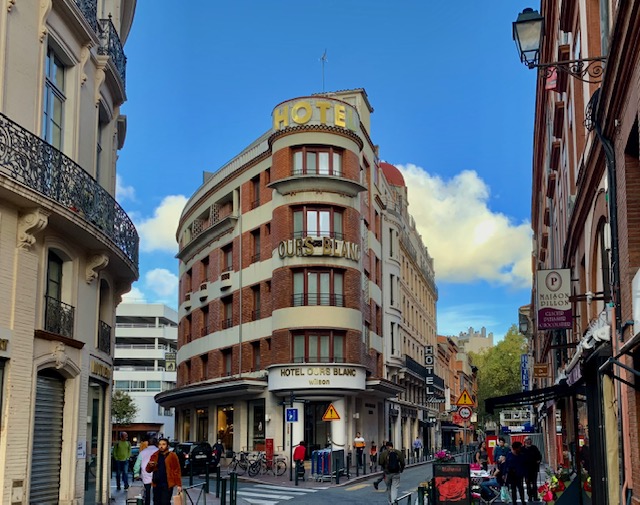
Arriving in Toulouse, we checked into the very nice Hotel Soclo, a short stroll from the town centre. Car parking is always a bit of a problem in these old town centres. The parking was some 800m from the hotel.
After settling in we took a stroll into the town centre. Toulouse is a very pretty city with mainly old red brick buildings. It dates back to well before the arrival of the Romans with the town being established around 800 BC. People originally settled in the hills around 9kms from today’s town centre. Originally called Tolosa, pre 200BC it was a trading post with access to the Atlantic, the Pyrenees and the Mediterranean. Occupied by the Romans for around 500 years from 118 BC; from then until 877 it was part of various kingdoms. In 877 it became the country of Toulouse. At the end of the 11th century Count Raymond IV headed off to the Crusades and wars of succession followed. In 1229 The Treaty of Paris introduced a university. For a time it was the capital of the south of France and in the 17th Century it came under the rule of the French King. Like just about every city in France it has survived many wars, plagues and famines, even being invaded by the British in 1814, just after Napoleon abdicated and headed off to Saint Helena for a long, and probably undeserved, holiday.
We had briefly called in here last year on the way home from a trip down the west coast of France and were struck by its beauty hence the return visit. After strolling around a few streets we took a seat in the square which was full of activity including a group dance competition, which seemed to go on forever. The local rugby team had a stand also in the square. As the sun set the square was nicely lit up and being Haloween lots of people were wearing costumes.
Toulouse City Hall
We wandered the 300 meters back to the hotel through the busy streets to for a quiet night.
Tuesday 1 November 2022
We headed down to an excellent late breakfast in the courtyard behind the hotel. This place is well set up with a nice outdoor are including a pool. It was good to relax as the week before we had been in Washington DC, where Sylvia attended a Mars Senior Leadership Meeting, plus she has been working really hard with her additional role as VP Enterprise Effectiveness.
Hotel Soclo
Breakfast over, we woadered the picturesque streets; this is a city where there is a photograph around every corner.
We headed into the Cathedral Saint-Etienne
Leaving the cathedral we headed back to the square, passing Saint Sernin which is quite deceptive from the street, with a narrow tower perched above what look like the normal street buildings with a large church hall behind it.
We headed through the square as there is another square behind City Hall, which has a row of nice tents set up in it as a market selling a great variety of food from pork to cheeses.
As we carried on wandering the streets we admired the variety of buildings and the way they have been built in various shapes to fit every spare piece of land. There is even a reasonably new carpark building looking like a ship. There are many more churches and administration type buildings along with some very well presented retail shops. The Garonne River runs through the town with a number of house boats parked up in places.
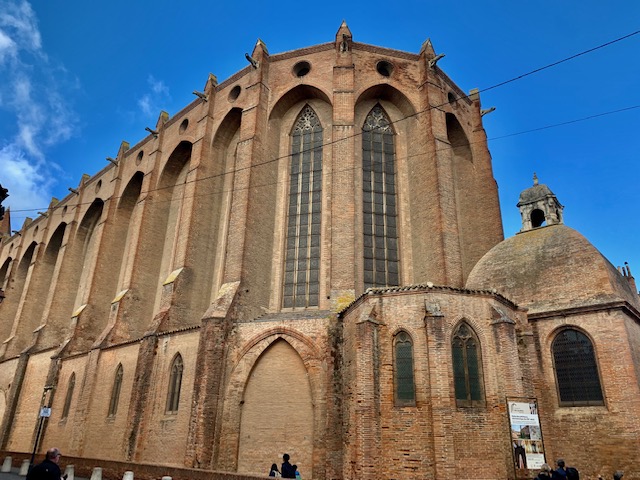
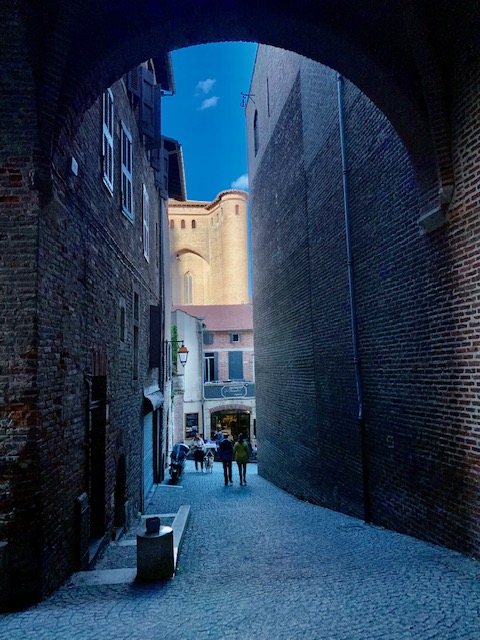
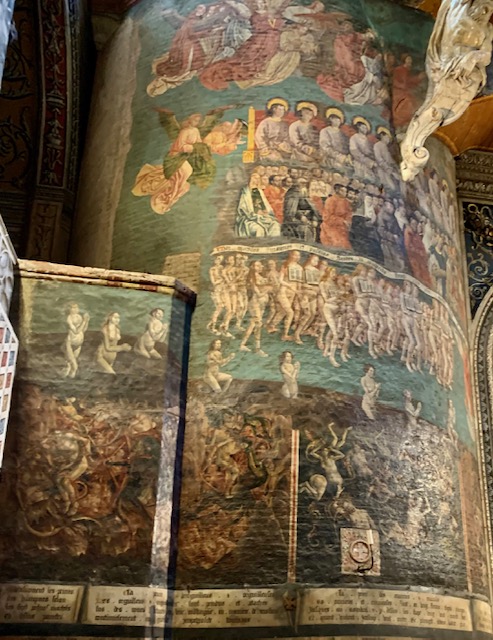
The city tour over we checked out of the hotel and got on the road, taking the long way home through the pretty farmland of south central France. Even though we are away from the toll roads the surfaces are smooth and the lanes wide. We made our way northwest, soon arriving at the city of Albi, another old city with evidence of human habitation dating back to 3000 BC. It was fought over by various clans and religions over the centuries and hit by plagues and other tragedies. In 1282 the Palace de la Berbie was completed, looking more like a fort than a palace. Bishop Castanent started work on the Cathedral of Saint-Cecile. From a distance it almost looks like a grain silo with its rounded walls, each of which houses a crypt of to the side of the main church hall. We parked and wandered into the central square which houses shops, the palace and cathedral.
We lunched at the La Boussole restaurant, which with its slow service, tough streak and bad wine I can highly not recommend. We then wandered through the palace grounds as the building itself was closed. The grounds are impressive with views over the Tarn river holding the reflections of the surrounding buildings on this clear blue sky calm day. Here even the rubbish bins have imitation stone like wrapping on them, which looked good. The rest can only be described through photos.
The drive home was an uneventful one through more farmland and crossing the Millau Viaduct over the river Tarn, until, reaching more arid lands as we approached Montpellier.
We took the Grey route to Toulouse and the blue rout back.
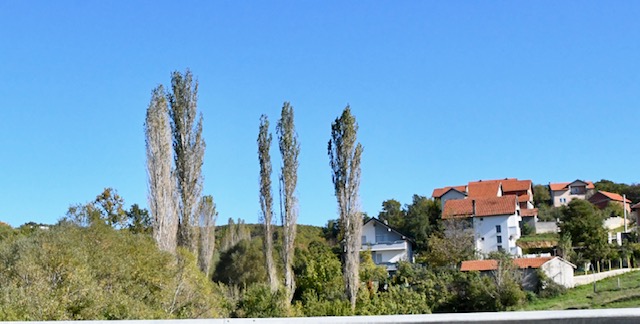
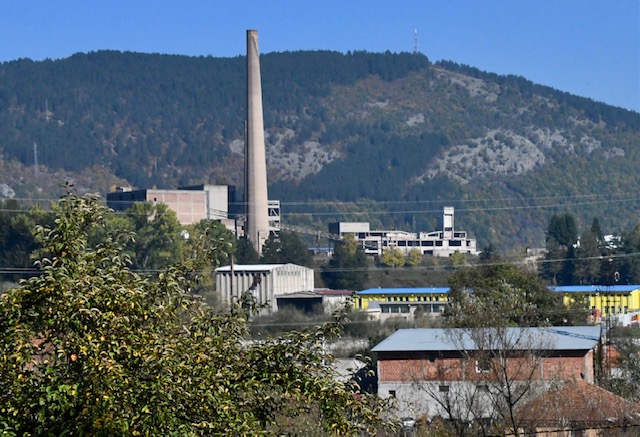
There was a clear blue sky as I headed out of Tirana, with the misty haze in the distance. There were some nice buildings along the way, plus what looked like a large gas processing plant up on the hill. Albania has gas and oil reserves in the Caspian Sea. The road was quite good and two lanes each way; often people stood on the side of the motorway like they were waiting for a bus. One thing I have noticed in this part of the world are a large number of dogs wandering the streets and roads; one had been run over recently. The road made its way alongside a river with some nice houses alongside. As we headed up into the hills the road had been cut into the hard rock. Eventually it turned into a toll road with a five euro fee at the gate. Eventually the motorway headed alongside the huge Black Drin Lake, which has a power station at the lower end and was covered in mist. The motorway had a gap in it at one point, where a bit is still under construction with a massive steel structure set up as part of the construction. The motorway cut through rock and, rising through the hills, carried on up to the Kosovo border, where the crossing was easy. The whole trip on this road I had not seen one truck.
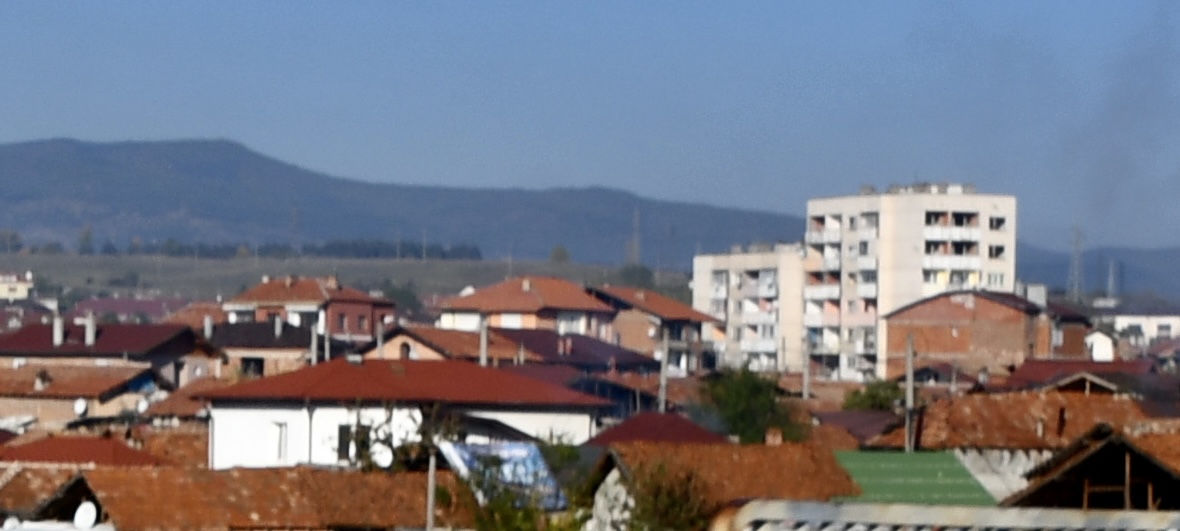
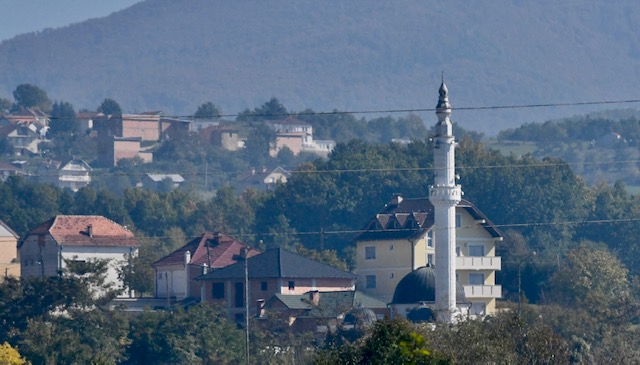
Entering Kosovo the road dropped down into a large basin, which was almost like a different world, having a wealthy feel about it with nice houses and green fields, despite there being lots of small, old tractors around.
Speed, as in how fast one should be going, is a bit hard to work out here especially as google maps doesn’t show the speed. At one point I was cruising down a double lane highway at 120 kph and must have missed a 60kph sign. Heading over a hill under an overpass and bugger, there were two cops there with their radar gun. Pulling over, they showed me the speed 121kph. Their English was just better than my French. I said ‘that’s only 1km over the limit; they explained that this was a 60kph area and you lose your licence for 6 months for going twice the speed limit. They asked where I was from and where I was going and why. I explained that I was from NZ and just swanning around checking out their nice country. I gave them each one of our little ‘going places’ cards. They told me that Kosovo people are very nice and friendly. I can vouch for that as they sent me on my way with a smile and not even a fine.
As I headed towards the hills of Montenegro, I stopped at a cafe attached to a petrol station for a coffee. The guy behind the counter had not a word of english, then out of nowhere a kid of about 8 appeared and did the interpretation. He had been sitting outside with his father. More friendly Kosovo people.
There were lots of stalls selling stones in this area. As I headed through the village there were lots of little tractors about. The road then wound its way up the hill on a switchback road to the border checkpoint, where the friendly guy said the Montenegro border is 8kms further on. I presume the bit in between is no-man’s land. There were good views back over Kosovo, blurred by the mist or smog.
The crossing at the border was easy and the winding road headed down into a valley, then wound through valleys with lots of small villages then up over hills. It is a pretty country with lots of rocky hills and colourful bush. Here and there are lots of little tractors and in places bigger machines were parked up in people’s front yards. In several places there was a guy with a wheelbarrow clearing out the gutters on the roadside; no cones just some high vis gear.
I stopped for a bite to eat at a roadside restaurant on a cliff above a river. The woman got out a gas burner to brew my coffee and make me an omelet. Despite the lack of facilities, there were quite a few people sitting around outside, drinking beer. Just about every town has cops with speed detectors pulling drivers over. People were in the fields hand raking cut grass to stack to feed stock in the winter. In spite of it looking like a place of subsistence farming, the houses are nice and it looks like the people have a good standard of living. A couple of towns had old abandoned factories but I never saw any evidence of manufacturing. There were more colourful beehives on display in front of houses. The road wound up a valley alongside a railway line, then up a hill. Driving through a medium sized village, I arrived at the Bianca Resort, which is a rustic type hotel with side by sides for hire and lots of old stuff on display. After enjoying a wine, I headed to the restaurant, where laid out on a large table was one of the best smorgasbord meals I have ever seen. At 130.00 NZD for the night, including breakfast it is good value.
Tuesday 18 October 2022
There is ice on the car windows as I reach the carpark ready to set off on today’s journey. Heading back down the valley, visibility is impaired by thick mist. Heading up a hill takes me above it for a while, then it is back down into the gorges as the road cut into the rock winds its way up to the border with Serbia.
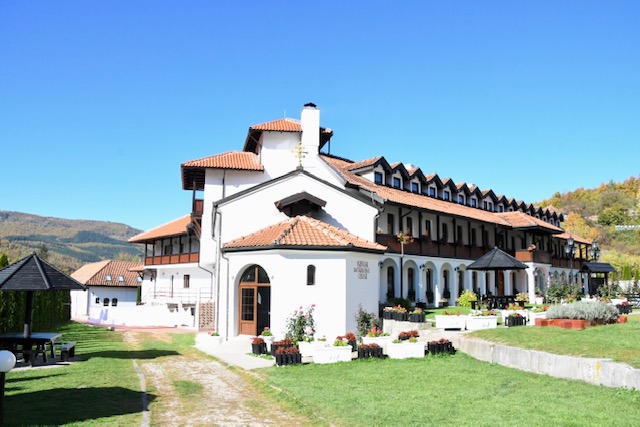
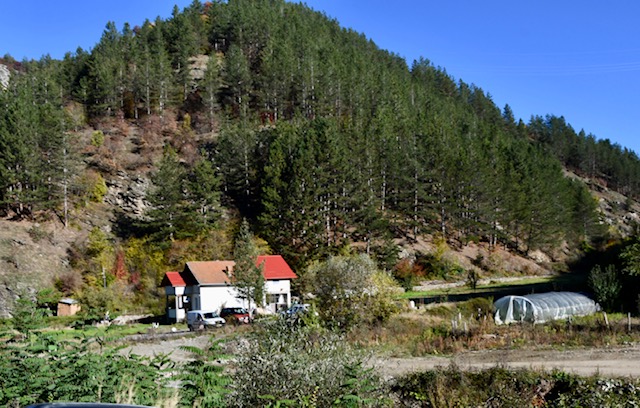
The border crossing is easy and the road winds its way down the gully into a narrow valley. As the road headed alongside the river I stopped for a coffee at a log-house place alongside the river. The rather gruff guy sent me around the back after I had explained what sort of coffee I wanted. Around the back there were a few tables with a couple of women sitting at one of them. I said hello and they asked me to join them. Kristina and her daughter Mia were on their way to an event Kristina, an event organiser, was running. Mia, an architect student, was tagging along for the three day event. We chatted about the economy in Montenegro; I had said how the parts I had seen looked like they were quite well off. Kristina explained that all the people in the country basically make most of their living off the land in an almost subsistence farming manner, selling off the little they can produce, a lot of it on the roadside. Kristina said they were going to stop at a 13th century monastery about 20 mins off the main road and invited me to join them. I said yes and followed along arriving at this beautiful complex; apparently people can come and stay there a bit like a hotel. We entered the chapel with the white angel, which is quite renown in this area, painted on one wall. After the chapel, we looked around the grounds, then to the gift shop, where they brought me some gifts for Sylvia. After that we headed on our respective journeys.
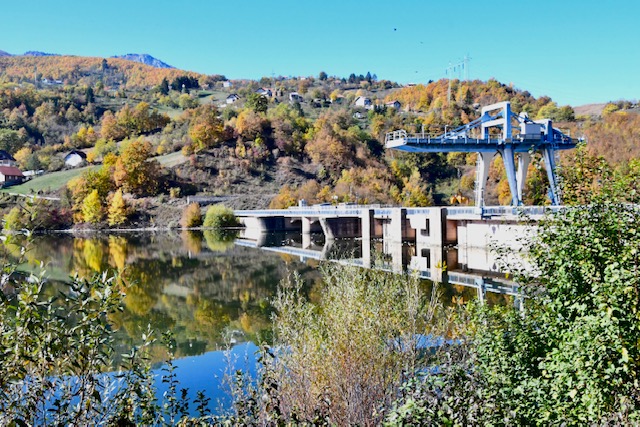
A railway line ran along the rocky face above the road, with many tunnels punching out through the rock. There was a water point on the side of the road; in other places I have often seen people queueing to get water at these. The road took me along a valley to a hydro-power plant then on to the town of Priboj, with what was once the largest truck factory in Yugoslavia, employing 8,000 people. Not sure what it is making now but from what I can gather it is struggling. From there, the road continued to the Bosnian Border.
Crossing the border, the road wound up a valley with farm houses spread through it. Heading over the top it was down another valley. This went on for a while until finally the land opened out into a plain with fenced paddocks and stock in the fields. I love the way everyone in this part of the world stacks their firewood; some people were even working on log splitters, splitting and stacking the recently delivered logs. The last stretch towards Sarajevo was through a gorge with lots of tunnels cut through the rock. Over the past week I have seen many steel nets draped over the rocky cliffs with concrete weights at the bottom, I presume to stop them lifting in the wind.
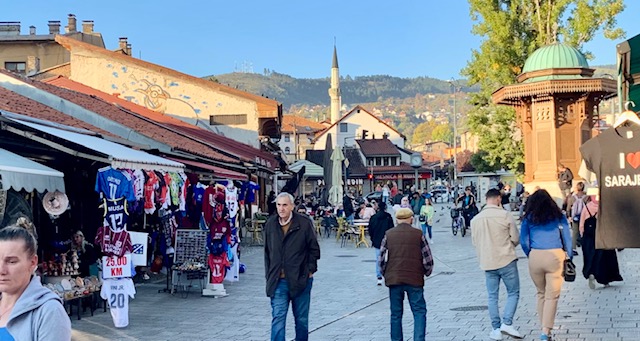
Arriving in the town I managed to park the car and find the not-too-flash Old Sarajevo Hotel, with poor wifi but a very helpful receptionist. A wander around the town revealed a large area dedicated to tourists with lots of souvenir shops, bars and restaurants. People sat in many bars puffing on sheesha, men and woman included. There are quite a few woman here in the full faced niqaab. I enjoyed a good streak at a local restaurant and sampled some local wine, which was quite nice.
Some friends of mine were here during the war in the late 90’s; one described the place as basically a bomb-hole, with terrible coffee. There is now no obvious sign that a war took place as it has all been rebuilt. Something the poor people of eastern Ukraine will have to undergo some time in the future.
Bianca Resort Montenegro to Sarajevo
Wednesday 19 October 2022
The traffic was light as I left Sarajevo; the city is quite spread out with farmland, commercial buildings, houses and apartments intermingled.
I hit a mist covered motorway, which ran for around 100kms north, at a town with what looked like a large coal-powered electrical generation plant and some other factories. The road then led through various valleys with the new motorway still under construction. There is lots of farming here similar to the other countries in this part of the world.
Then finally it was onto another motorway and then to a small town and through some back streets to the border. The crossing into Croatia was uneventful and a secondary road lead to the motorway that ran all the way to the Slovenian border. There, there were hundreds of trucks queueing up, stretching out over 2 plus kilometres. The motorway continued right through Slovenia with the turn off only 3 kms from my destination.
Checking into the Hotel Centre in the town of Postojna I took a stroll down to Costilna Pizzeria, where I enjoyed a great pizza and a couple of glasses of the local wine. Strolling back to the hotel afterwards, I saw a barber shop still open and popped in to see if I could get a bit unscruffy. The guy said he was finishing after the customer he had, could I come back in the morning. I said no and then he said Ava (a young woman there) could do the job but does not speak english. I said ok and Ava got a haircut underway, plus I was offered a glass of whiskey, which was a new experience during a haircut. Luca explained that this was the oldest barber shop in Slovenia, having opened in 1926. They were friendly and nice people and as I was leaving he showed me the little museum out the back, displaying the history of the shop.
Sarajevo to Postojna Solivena
Thursday 20 October 2022
After breakfast I headed out to take a look at the Predjama Castle, which is about 10kms from the town. The knees not liking stairs very much just now, I just had a look from the outside. This place has been there for around 800 years. In the maze of tunnels behind the castle, Knight Earzem of Predjama used to store his plunder, uplifted from raids he carried out from the castle. In a cave under the castle is a colony of bats.
Heading back to town I joined the tour of the Predjama caves. People queued up by signs with the language they wanted the tour done in: English, Dutch, German, Italian, Slovak and a few more. We were then lead through to the station. Yep! they run trains into the caves. In 1868 Thomas Cook, while visiting the caves, said they were big enough to have rail tracks laid in them. Four years later 1500m of railway tracks were laid with 2 seater carriages called pheatons, being pushed along by the cave guides. Back then, the cave was lit by some 17,000 candles – the richest man in town was the local candle maker. During WWI Russian POWs were used to do work in the caves, including building a bridge between two different caves. Italian miners also dug various connecting tunnels through the rock and limestone. In 1925 the tracks were redone and a gasoline engine was used to tow the carriages. Over the years more modifications have been done. The English group was eventually called forward and we headed to the rail platform and mounted the many carriages, now powered by a battery-powered loco. The place is double tracked as as we journeyed the 3.7km into the cave. The sights were really spectacular with thousands of stalactites, stalacmites and columns above us and to the left and right. Eventually we stopped at a platform, then followed the guide up a 40m concrete path incline. He stopped every now and then and took a microphone from a stainless steel post and gave us a run down on the caves. There are 3 layers that the Pivka river has carved out over millions of years. We are on the second layer and the current third layer is where the river now runs. The river pops out of the ground by the cave entrance and eventually becomes the Sava river that runs through Ljubljana (the capital of Slovenia), through Croatia Bosnia and Serbia, where it then joins the Danube, which eventually flows through Ukraine into the Black Sea.
The tour took us on a 1.5km walk through caverns and tunnels, across a bridge, then through more caverns with lots of different formations, some looking like blinds others like spaghetti. Then we got to see some salamander housed in a kind of fish tank; there are a few thousand of these living in the caves. Finally we got to a big cavern that has an amazing echo. We then hopped on another train and were driven out of the caves.
After a sandwich and a coffee at one of the many cafe’s around the cave entrance, I hit the road to Turin. Joining a motorway not far from the caves I basically stayed on the same road for the next 500 plus kms. There is no hard border between Slovenia and Italy, just a road toll gate. There were two tolls on this stretch of road totalling about 60 euros. For the whole journey I averaged 108kph, never exceeding the speed limit of 130kph I hope.
It was dark when I arrived into Turin and checked into the Hotel Gran Mogol in the old city. Parking was a bit of a problem so I parked in a driveway and went to the reception, who said their parking was full and sent me to a private carpark just down the road, where a very friendly chap took the car and stored it overnight for me. Having checked into the hotel I found a nearby restaurant and enjoyed a nice Italian steak dinner.
Predjama Slovenia to Turin Italy
Friday 21 October 2022
I woke up at 0100 hrs sweating to discover the air conditioning was not going. Playing around with the switches, I could not get it to spark up. After breakfast I asked about it at reception and was told it is the law here now – they are not allowed to use it unless it gets over 25 degrees. Bloody Putin!!!
I took a stroll around the old town on a rather grey morning and was impressed by the size of the buildings and the covered footpaths with huge columns holding up the building above. Even in the rain you could walk all around the city without getting wet. Everything is huge and chunky in this town and with the normal statues, museums, university and government administrations buildings. Large squares are full of tables and chairs serviced by the local cafes and restaurants as are the many tables and chairs in the streets. The Po river runs around the edge of the old city making its way across the top of Italy into the Adriatic Sea. With a population of around 900,000 I was surprised at how light the traffic was as I exited the city. Even out towards the edge of town they have maintained the same style of buildings.
On the drive home I struck really heavy rain most of the way. Most of the journey was on toll roads with the traffic only slowing a little under the 130 kpm speed limit in spite of the rain. Arriving home, I checked the odometer to find since leaving Cassis, nearly 3 weeks ago, the car had traveled 8,125 kilometres with a driving time of 110 hours. It has been a really interesting trip, checking out what was once part of the USSR and to see how the countries in the north and west of Europe are definitely better off than those in the southeast. In saying that though, they all look like they are making progress with new roads and infrastructure underway. The drive through the former Yugoslavia gave a good appreciation of how countries can recover and rebuild after a devastating conflict like the one there just over 20 years ago. Katrina and her daughter, who I met in Serbia, told me how their borders in Montenegro were closed for more than 10 years during the conflict. All the way through the journey the people were nice and friendly and full marks go to the two cops from Kosovo who let me off what could have been a very difficult speeding ticket.
Turin to Home in Francethe old Yugoslavia Eastern Europe trip
Rising early, I headed to the rather basic gym and then a rather good breakfast. I caught the local tram the seven or so kms into town and opted for a coffee while I waited for the Information centre to open. There I was able to purchase a day pass for the public transport and get some directions on things to do. I headed up to the Spanish Horse Stables to book a look at a training session for tomorrow morning. The buildings around town are quite outstanding. Statues: well I thought Budapest had a lot but Vienna has outdone them by far. Horses and big strong men feature predominantly. Stone masons and sculptures must have made a fortune when they built this place.
From the stables I took a stroll down to the Danube River, which, with its high, man-made narrow sides, is flowing very fast. There are a bunch of boats parked up just below a bridge, some of which will eventually make their way to Amsterdam.
Looking at the brochure the nice lady at the information office has given me I saw the Sigmund Freud museum was close by. Pushing the boundaries and getting outside my comfort zone I decided to take a look. A 20 minute walk later I arrived at the door to find it was closed due to sickness. I strolled up the hill and caught the number one tram back towards town. Not far along the route we passed pretty magnificent looking building so I dismounted to investigate. It was in actual fact the local parliament building, closed to the public but covered with massive statues and other ornaments. The road was busy with trams, cars and the odd horse and carriage.
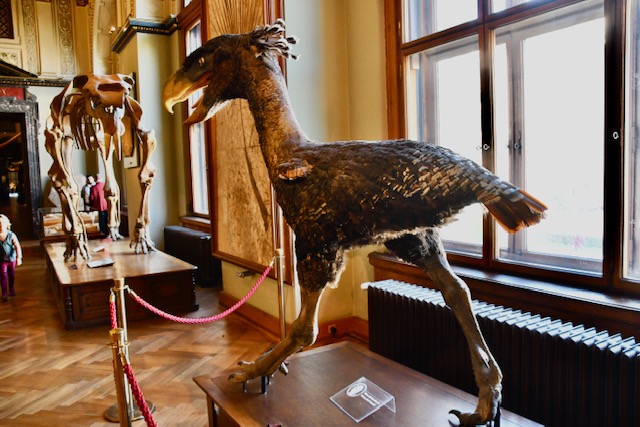
Back on the tram we passed another large building. Once again I dismounted to investigate. It turned out to be the Museum of Natural History. As I entered there was a Ukrainian family getting tickets. I asked them how they were getting on to be informed that their town, near the western Polish border had been rocked this morning. The museum was as good as I have seen with a large area on the first floor dedicated to geology including some rocks from the moon. The next floor was full of prehistoric creatures, including the largest petrified turtle ever found. There are a huge amount of dinosaurs and other strange creatures from the past including the not too long extinct moas from New Zealand. One recreated dinosaur-type monster started moving and growling every now and again to the great amusement especially of the children.
Moon Rocks
Boarding the tram again, I ended up back in the city centre and enjoyed a bite to eat and a glass of wine in the street seating of the Sluka Restaurant, established 1891. As I sat there hundreds of people passed by and the service was excelent.
Finally I decided to check out the Albertina Museum, which turned out to be an art gallery, some parts with large rooms sparsely but expensively furnished with large chandeliers and parquas floors. Other parts were full of various art objects in many different styles. The lower floor was dedicated to graffiti. I have trued to capture some of what I saw but the photos don’t do it justice.
After a great day out in Vienna, I took the tram back to the hotel to plan out the next few days of travel. Last night I had looked and marked a hotel to stay at tomorrow night in Kosice, Slovakia, not too far from the border of Ukraine. Looking again tonight every hotel in that town, and the towns around it, are booked out. Looks like Putin has caused another mass exodus from Ukraine.
Tuesday 11 October 2022
I enjoyed another good breakfast at the hotel, despite the lights not working, apparently a common problem. Funny thing, when I got back last night I asked what time the bar opened; the receptionist said “soon”. I said ‘how soon’, thinking I might come down for a drink; ’maybe a couple of weeks’ was the reply.
I drove into town, finding a carpark near the Spanish riding stables and headed to the show, where I had a seat in the front row at one end of the stadium. I got seated next to a nice US couple from Pennsylvania to be told by the woman seating me “no photos allowed while the horses are in the arena”. Bugger, it did not say that in the info when I researched the place. The show got underway as six strong stallions and there male riders entered the stadium. They put the horses through their, for want of a better word, dance moves. Normally a horse has four gaits: walking, trotting, cantering and galloping. These had added many into their repertoire which are a little hard to describe. The riders, from time to time, reached into the back of their jackets to produce a sugar cube as a reward for their excellent footwork. They were kept on a tight rein with the neck bent so the top of the head (the pole) was below the neck, something my father hated me doing with my horse when I was a kid. After 30 minutes the horses lined up, the riders dismounted and orderlies came in and put halters on the horses and lead them out as the riders wandered off, job done. The next five stallions entered, four mounted by women riders, one in a helmet rather than the Spanish hats the other’s wore; she was a trainee. There are no instructors as such in the school as the skills are passed on from rider to rider. We did not get to see the horses rear up like you see in the movies; apparently that stuff is kept for the real show. The horsmanship and the condition of the horses was impressive; at one stage one of the stallions shied at something, jumping sideways – the rider, unphased, didn’t even move in the saddle.
The show over, I headed to a local restaurant for some lunch before hitting the road. Checking out the history of Austria I discovered that from 1945 to 1955 it was mostly controlled by the USSR with some 450 german companies owned by the germans and taken over by the Russians. Most went broke giving the Austrians the opportunity to to exit the USSR and become independent and aligned to Western Europe. It certainly now has the feeling of a very wealthy country.
Heading southeast out of the city, the traffic was light and on one side of the motorway was a large curved wall, which I have seen a lot in this part of the world, to stop the sound of the traffic upsetting the locals. As I headed further east towards the border with Slovakia the land was flat and farmed like so much of this part of the world. There were areas of large wind farms with their red and white tipped blades, a few turning in the wind and some under construction. Crossing the border and heading to Bratislava, I expected the motorway to go around the city but it went through the centre at 120kpm speed limit. I was lucky, as now heading for Demonava instead of Kosice a little further east and south, the road took me into the hills. Still a magnificent E (European road funded by the EU) road, it was an easy drive. At one point I encountered a 100-plus vehicle convoy of military trucks, fortunately heading in the opposite direction.
Eventually leaving the E road, I headed up into the mountains on an ordinary road in excellent repair. Again I was surprised by the number of large factories situated near small, remote towns. At one point I could see the evaporating towers of the Elektraren Nuclear power plant. Arriving at the top of a pass I encountered a large, I presume, ski resort with cable cars heading up into the surrounding hills. Heading down the other side I eventually arrived at the industrial town of Rozomberok with large steam pipes running along side of the road to power a massive minerals factory called Mondi SCP. There I struck a traffic jam. Fortunately a truck driver let me in and we headed along the single lane, to find 10kms of mainly trucks waiting on the other side of the road to get through.
After heading alongside Lake Lptovska I finally reached the turn off to Demanova. It too had a large manufacturing plant and some Russian style appartments on the west side. The town is now mainly a resort town with lots of nice houses and tidy streets. Checking into the Hotel Demanova, which is only a couple of years old, I was very pleasantly surprised – at 125NZD I wasn’t expecting much. The place is outstanding. From the receptionist, who welcomed me with perfect english (learnt at school), to the very comfortable cigar bar and restaurant with great food and wine, it has to be the best value for money place I have ever encountered.
Wednesday 12 October 2022
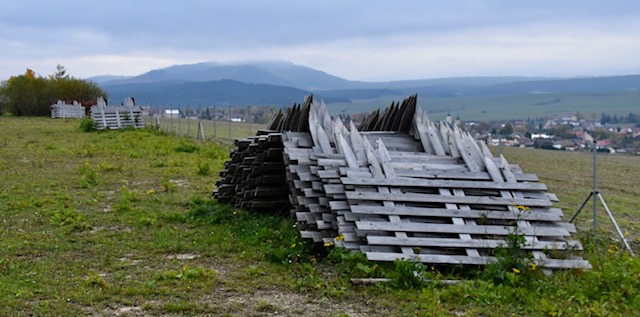
Departing the hotel at 0800 I headed southeast towards Kosice, which is which is about 80kms from Ukraine. From there the road took me southwest past a castle under restoration and though some nice farmland. Snow drift fencing is stacked next to the road and in places already up to protect the road from snow drifts come winter. They must take it down for the summer so the farmers can tend the paddocks.
Crossing the border into Hungary and on to Miskclc, then southeast to the border of Roumania. This was a manned boarder. I pulled up to the kiosk and handed over my passport, which the guy had for a while then took it to the next booth where another guy and a woman asked for the car registration. Handing those over they asked where I was heading and were a little surprised when I told them. They were all friendly and wished me a good journey.
As I headed south on the still 3 lane each way E road with a kilometre plus of trucks waiting to go north across the border, I am quite glad I am not driving a truck here. I was curious as to why why google maps was telling me it was going to take 4-hours to cover the remaining 200kms and soon found out as the E road ended and it was onto a well-patched two way country road. It was a bit like going back in time, especially after spending the last 10 or so days in what felt like really wealthy countries with great roads, big tractors and nice houses. Here, the tractors are much older and smaller; they still use horses to tow carts and cultivate in places and the houses are nowhere near as smart.
The road took me up into some small hills, which are not something one experiences in the plains of Hungary, then down and alongside Lacul (lake) de Acumulare Lugasu, part of which has a long dam wall running in a large horseshoe and a small hydro power plant. The road improved a little from here, but was still one lane each way but in better condition and called highway 1, passing through lots of small towns, one with a number of almost chateau-style houses that have not been finished. In one valley there were hand-stacked hay stacks and, alongside the run down houses, some nice looking restaurants; of course all the churches were in good repair. In places stock grazed in the fields, something I have not seen much of in this part of the world.
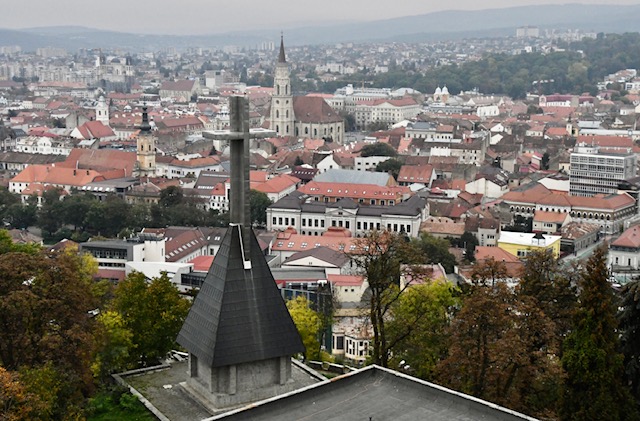
Finally reaching Cluj-Napoca, a city of some four hundred thousand and dating back to the Roman days. I was not too impressed as I drove along alongside the river, lined with old soviet styled apartments. Eventually, arriving at the hotel on top of a hill in the middle of a park, I checked in. It looked a bit rough from the outside and old but tidy on the inside. The room is okay with clean linen and a great view from the 6th floor. I dropped my bags and headed down to the restaurant but the lights were not on. The friendly maitre’d said ‘come in, we are open’. I decided to have a drink in the bar first and was presented the worst glass of wine ever. I couldn’t finish it and went to the reception and asked if there were any good restaurants in town. After, with stops, nearly 9 hours on the road I was thirsty. She said ‘lots, just follow the steps down through the park’. Arriving at the bottom of the hill I was pleasantly surprised to find a stunning old city, bustling with people and lots of bars and restaurants. I popped into a busy bar and enjoyed a couple of glasses of very nice Romanian Chardonnay, after which I headed to a restaurant close by. There were three people sitting at the next table conversing in English. I asked them where they were from and it turned out they were here at medical school, training to be doctors, two from Germany and one from France. We had a nice chat and I enjoyed a very nice New York style steak. It had rained when I first got down to the old city but luckily it had stopped as I went back up the hill to the hotel.
Thursday 13 October 2022
I woke to heavy rain, which fortunately had eased as I got on the road at 0800. The traffic wasn’t too bad on the way out of town and soon the route took me onto a good motorway with the traffic steady at 130km/h. Passing lots of farmland and every now and again a large factory or distribution centre in the middle of nowhere, there were a large number of huge, high-voltage powerlines running across this country often with sub stations in the middle of nowhere.
The motorway ended after a couple of hundred kms and it was back onto a one lane each way road that lead into some really nice hill country running alongside a river. There were lots of hold ups as the retaining wall on the river bank was being replaced and the road was down to one lane. There are lots of rather derelict looking buildings through the valley and, in places, large areas of still water held back by dams, of which there were many along this (I think) Prahova Piver. At one point, a couple of fishermen squatted at the edge of the water trying their luck. Shops often had their wares displayed on the footpath in well-presented displays. Another thing I have seen a lot here are the old style kilometre markers on the road side. Every now and again there was a nice resort-type town with nice apartments and, in some cases, high-rise buildings. At one point there was a large, I think, conference centre, built of brick in the shape of large oil tanks. In places the mist hung low in the hills but the rain held off. I was glad the motorway does not go all the way as this was really nice country and a good change from the flat and sometimes rolling farm land.
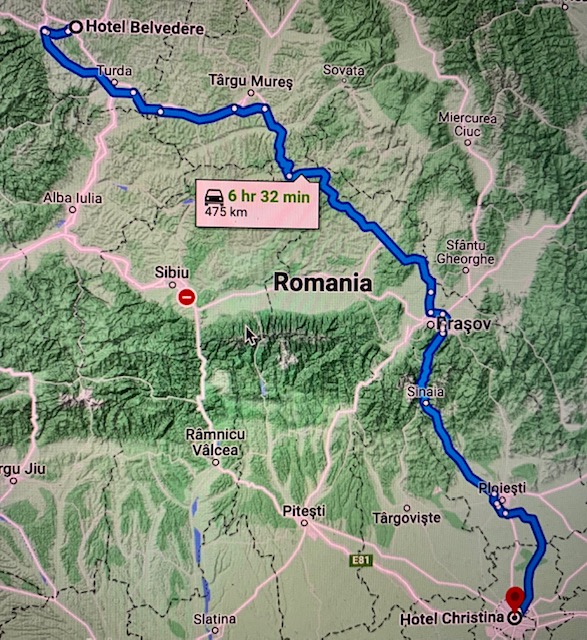
Leaving the hills the road lead onto another 130kph motorway. Closing on Bucharest there are large distribution centres on the roadside and many factories, all serviced by this nice road. The motorway ended and the last 20 odd kms were through the city, where the traffic mostly flowed well. Arriving at the rough-on-the-outside but nice-on-the-inside Christina Hotel, the street was packed with cars. I turned down a dead-end side street and a woman parked on the foot path on the corner vacated so I took her spot. Heading in to the hotel I asked the very helpful good English-speaking guy if it was ok to park there – he came and took a look and said it would be fine.
After settling into the room I took a stroll into the old town, a couple of kms away, with a large tree-lined avenue leading to it. Not as nice as the area in Cluj-Napoca, it was a lot more spread out with the many streets lined with tables and chairs and lots of people around. There was a big police presence, all armed with pistols and big pepper-spray canisters. There was a group of soccer type fans in town but I am not sure if this was the reason or whether it was just normal. I stopped at Beer O’clock and enjoyed a local IPA before wandering on and stopping for a Romanian Steak at one of the many restaurants. The Romanian steak turned out to be exactly the same as the New York steak I had had last night, even served on the same style wooden board. The service was great, as was the food and wine. A good end to another long but interesting day of driving.
Cluj-Napoca to Bucharest
Friday 14 October 2022
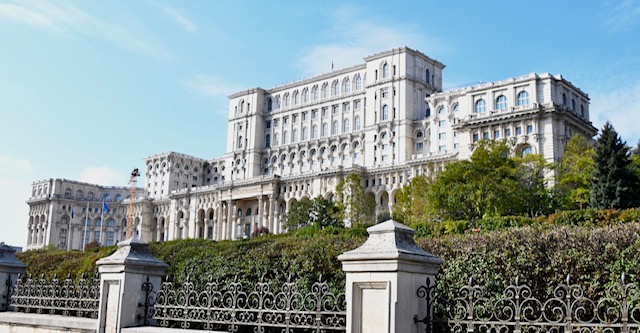
After a bit later than usual start and a good breakfast at the hotel, I headed down the road, purchased a day pass for the metro at 8 locals (2.84 NZD) and headed off to the Parliament Buildings. I had read about these a couple of years ago – they were built between 1984 and 1997. Construction was ordered by Nicolae Ceausescu, the second of two long-ruling heads of state since WWII, who was executed after the uprising in 1989. Reaching a height of 84 meters with a floor area of 365000 sqm and weighing in at 409,850,000 kgs it is the heaviest building in the world. I think also after the Pentagon it is the second largest. It is the largest and most expensive admin building in the world, valued recently at 4B Euros. Arriving at the gate a friendly young policeman said it was closed for a conference this month. He also told me that when it is open there are only parts of two floors open to visitors. He said to walk around the outside and have a look at the large church at the back. I bet, looking at the size of the place, there are bureaucrats that have occupied the same office since it was built and nobody knows who they are or what they do.
Across the road to the east are large apartment buildings that mirror each other. To the south is a large Academic building. I strolled the almost 2km along the south wall to the entrance to the church on the west side. It too was closed, by the look of it, for a rebuild. There was a small crypt part that was open, where priests moved around and people lit candles and prayed. By the look of the concrete rot in the surrounding walls it looks like there will be some hefty maintenance bills coming up sometime soon.
That part over I headed back on the metro to the old city and enjoyed a nice cottage pie lunch at Kilkenny’s Bar – yes there is an Irish bar in just about every place I have been. The staff were very friendly and I enjoyed a couple of local Grivita IPA beres (local spelling). Back on the train, I headed to Primaverii Palace. This was the home of Nicolae Ceausescu. His pad is still pretty much in its original state, complete with peacocks, which are descendants of the original ones donated by the Japanese emperor back in the 70s. I arrived just in time to be added to a guided tour that was about to take place. Joanna, the very informative guide, took us from room to room, but not all of them as there are some 88 rooms in this 4500 sqm mansion, with lots of carved walnut walls. From the eldest son’s apartment we went through the main rooms used for meetings and other stuff. Then to the wife’s day room, then their apartment, complete with gold bathroom, reported some years ago as solid gold but that was not the case. Apparently the marble in the passage way from India cost much more than the gold used in the palace. There were lots of tapestries and ornaments gifted by just about every world leader at the time. Then came the winter garden complete with mosaics. We looked in the dress-making room and the wardrobe with its collection of dozens of animal skins such as foxes, lynx , sable and more. Then it was down some stairs to the 3m deep and 14m long pool complete with wave machine, heating etc. A million plus peace mosaics covered the walls, completed by local artists over 3 years.
Back in the day no-one knew how they lived as the place was totally off limits to the people. As Joanne said, they lived in this while the rest of the people lived in apartments smaller than their bathrooms. In a corridor, as we exited, there were pictures of all the world leaders in meetings with Ceausescu during their visits to this place. All the leaders of the time are pictured there.
Tour over, I headed back to the hotel and then off to the old city for some dinner and a drink. The place was rather busy and as I wandered about looking for something different to eat it became obvious that in spite of their being hundreds of restaurants they pretty much all sell the same stuff. I settled on salmon and salad in the end, which came out with chips and no salad and a rather bad glass on wine.
Saturday 15 October 2022
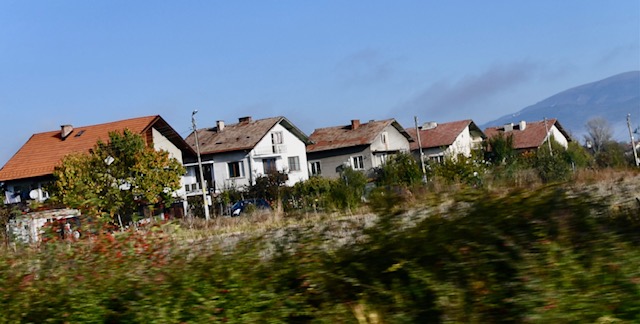
Heading out of town at around 0800, the traffic was light as I headed southwest to the border. Prior to reaching the border, which runs down the centre of the Danube River, there is the Romanian border control. The process was efficient and quick and shortly I crossed the bridge by the Bulgarian city of Ruse Pyce, a small industrial city with a large power plant and other industry. Reaching the Bulgarian check point there was a large queue, but after about 90 minutes I reached the booth and had my passport stamped and car ownership papers checked and was on my way south. The land was mainly flat and rolling for the first 150kms, then there were some bush covered hills. I passed another industrial type city and a few villages here and there. The tractors and farm machinery were bigger and newer than in Romania but the roads were a bit basic most of the way – all sealed but one lane each way and a little rough in lots of places. The last 80ks into Sofia was a double lane highway with a good surface. Entering the city the traffic was light with quite a few new, large commercial buildings along the roadside.
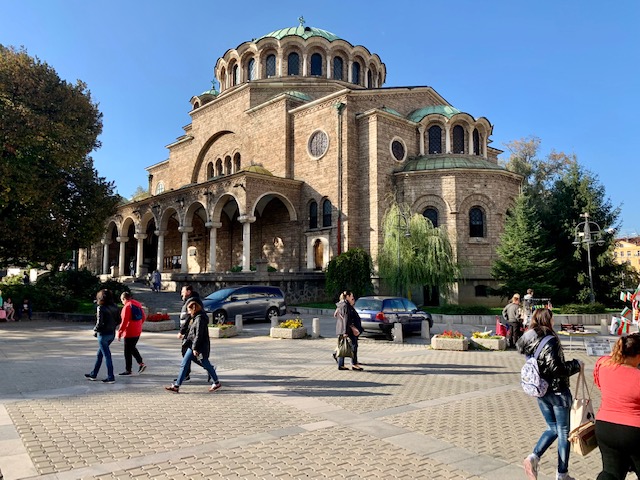
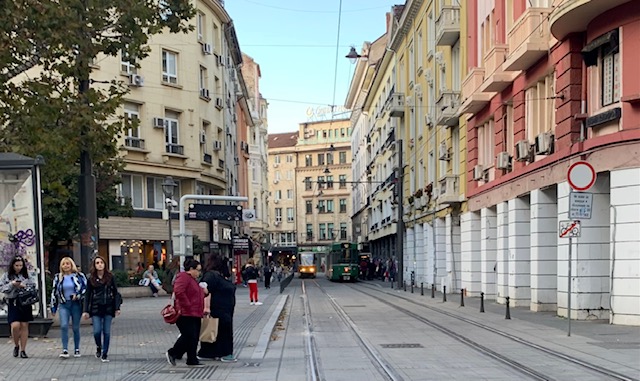
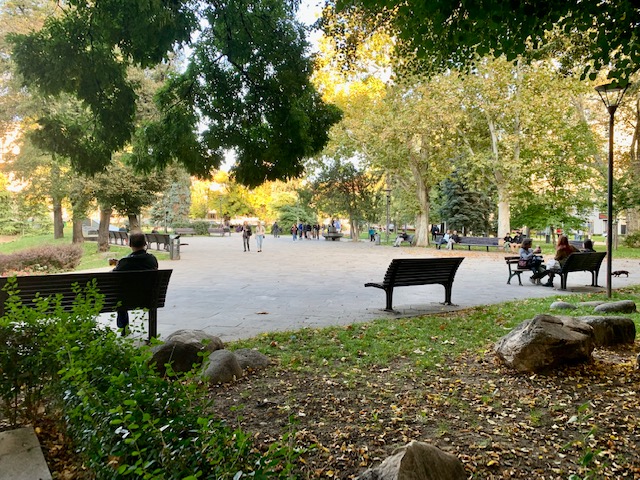
I checked into the COOP Xoten Hotel, which is a little old but ok. From there I took a wander into the old city centre. The footpaths along the way were quite rough. Reaching the centre square there are a couple of large buildings facing each other. A tall Saint Sofia Statue is at one end, some steps take one down into what looks like an old archaeological area. From there an under pass goes under the road and leads eventually to a large mall area with lots of shops and eating areas. There are many large restored buildings around the area and some nice parks and a fountain. Eventually I spotted a Thai massage place called Arsanta and wandered in. I was greeted by a really friendly Bulgarian lady behind the counter and had a massage by a lady called Sudani, who had moved here from Bali. It turned out she and the lady from the reception had set the place up a year ago. I had one of the better Thai massages I have had, especially after having stiffened up from the many days of driving.
Bucharest to Sofia Bulgeria
Sunday 16 October 2022
As I left town the traffic was quiet as I drove through the main square, past the statue of Sofia. There are lots of old Soviet-style apartments along the way plus some new and better looking ones. Heading out on to a not-too bad motorway, I passed a couple of large manufacturing towns and a coal fired power station. The scenery was nice especially as I approached the border.
There I pulled up to a booth but no one appeared so I started to back up when I heard a whistle. A rather rotund guy had come out of the booth, asked for my documents and wanted to look in the boot. When I lifted the boot he spotted a open shopping type bag I had some food in and rummaged through it. He pulled out an open box of energy bars asking if they were nice. I said “a bit average” as he slipped one into his palm. “You can have one if you want’ I smiled as he did. He then went off and stamped my passport. I then moved to the North Macedonia booth where things were pretty straight forward.
Heading down a gorge, which was pretty rough going, a new road is under construction to one side. The countryside was quite nice with lots of small villages and people selling stuff on the side of the road, including the motorway, grapes in one area, then honey in another. As I passed Skopje Ckonge (the capital) cops were there giving out speeding tickets. I missed out this time, having being warned that they make tourists pay cash and I didn’t have any locals on me. There are lots of mosques throughout this country, although at one point the mosques stopped and churches were present, then it went back to mosques. Heading up over some nice hills on my right there is a new motorway being constructed with massage earthworks going high up the hills in the form of retaining walls, some impressive engineering. Further down a valley the motorway was sort of half finished with two-way traffic using one side.
Heading out into a large valley to Lake Mavrovo the road runs on around the lake and up to the Albanian border, where another of the, often-seen, large North Macedonia flags flew on a tall pole.
Something I have forgotten to mention, is the almost smog-like mist that I have experienced right through eastern Europe – it’s quite hard to define exactly what it is.
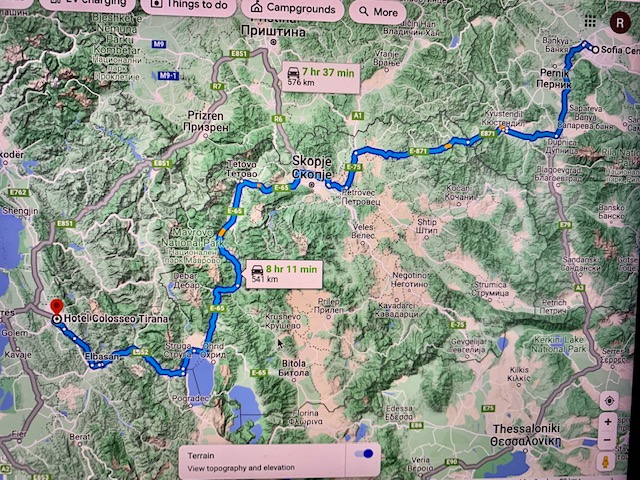
The border crossing was pretty easy with a bit of a queue. The road went along a ridge and then down a valley to a small city that had lots of piles of bricks on the roadside, even though the local, once brick factory, looked like it had been closed for some time. At one point a large truck, some distance in front of me, just stopped, the driver disembarking and going into a local shop to get some food. The traffic just waited until he came out and got going again. The road wound its way through a valley with a rail line to the right. Passing through lots of villages, many with roadside stalls, I eventually arrived on the outskirts of Tirana. It is quite a pretty city with lots of striking white buildings. As I drove into town the traffic was quite light, which made things easy, especially as Google maps had the hotel on the other side of the road and way further down the street. As Vodafone doesn’t have a deal in this country I had my data turned off, hence one can put the map in and use it for directions but you can’t put in any new routes, hence it can be a bit tricky. There is lots of high rise construction going on around the city centre.
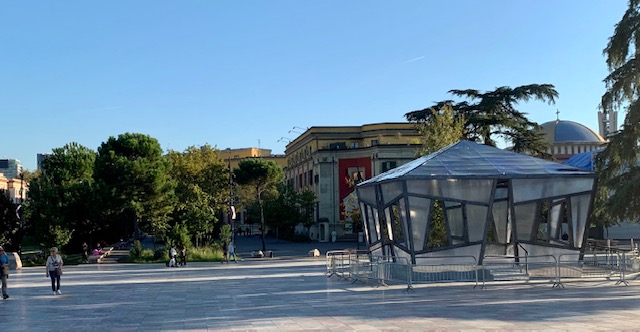
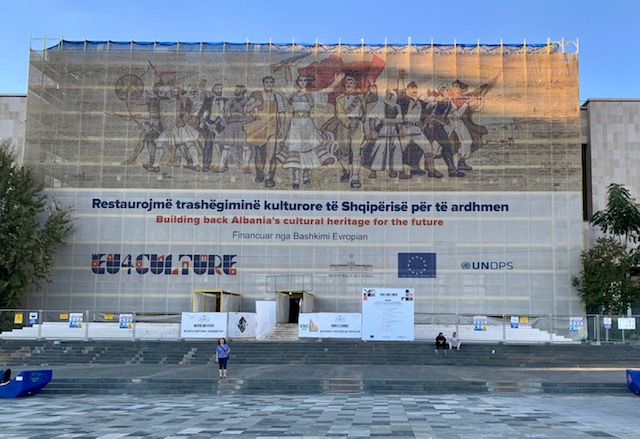
Beside the Hotel Colosseo is a barricade to a private street, manned by a guy with a pistol. I pulled up and said I was going to stay at the hotel and he went and got the concierge, who came out and showed me where to park. Checking in to the hotel, I then headed down to the local square to check it out. What struck me was on the street leading to the square most shops were closed being a Sunday I presume, but over the next 500m there were some 15+ cell phone shops ,some selling E scooters as well, all open and trading. In the Square, where lots of people gathered, many were sitting glued to their Phones. I was amused by three blokes, obviously mates, sitting together all engrossed in their phones, maybe they were chatting by phone!!
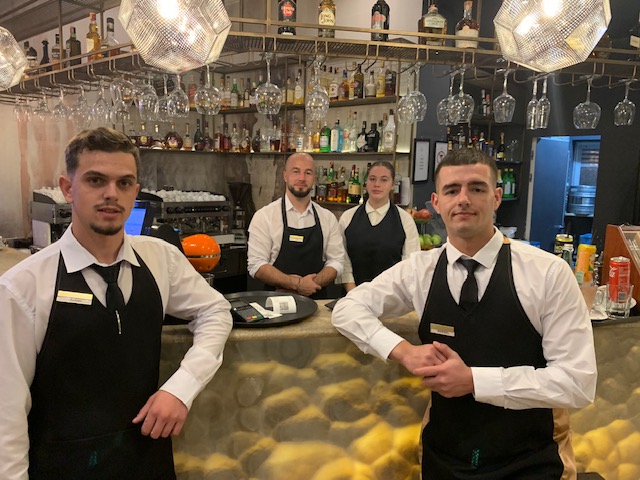
Heading back to the hotel, I enjoyed some nice wine before heading to the restaurant for a meal of sea bass, which the waiter not only brought to the table, but also removed all the bones for me. The service here is top notch and the staff really friendly.
Two years ago my friend Steve and I were supposed to head to Vienna, then through Slovakia, Ukraine, Moldova and a few other countries in that area, then along came Covid and put paid to that idea. With what’s going on in Ukraine just now, one wonders what will happen over the next year or so. Hence its time to go take a look, although not at Ukraine. Sylvia and I headed to, Cassis a nice little town just east of Marseille. Arriving around midday, we headed to the rather picturesque harbour, full of small boats and surrounded by restaurants. We wandered around to the northeast side of the port and enjoyed a snack and a bit of rather relaxing people watching before heading up to the La Demeure Insoupconnee, a B&B place we had booked for a couple of nights. It turned out to be a really nice place with great views of the Sliabh Liag cliffs, the highest sea cliffs in Europe. After settling in we headed back down to the town and enjoyed a meal at one of the many wharf-side restaurants.
Sunday 2 October 2022
After watching the sun rise over the cliffs, and enjoying a nice french breakfast, we headed over to Sainte-Maxime, from there following the coast around as much as we could. In this part of France all the beaches are shingle with some having the luxury of imported sand, often held in place by sea walls to stop the sea washing it away.
Arriving at Bandol we strolled around the corner away from the main, rather busy harbour area, where we discovered a restaurant overlooking the beach. There we sat and chatted, enjoying some great food and the local wine. The service was, in good French style, a little slow and inaccurate but that was well and truly offset by the location.
After a long lunch we headed up to the cliff tops, enjoying the view from the windy road along the way. Lots of people are out and about enjoying the weather and the views, many on motorbikes. There are also some on push bikes and the odd classic car.
The day nearly gone, Sylvia headed back to Nimes to ready herself for a busy week of work. I stopped another night, ready for an early start for the 800km drive northeast to Liechtenstein in the morning.
Monday 3 October 2022
I was on the road at 6am. Having seen most of the country around here on previous trips, heading off in the dark was not a problem. The first hour of the journey along the coast went well until I hit the morning traffic which slowed to a crawl. Once past Nice things sped up again. Crossing into Italy, I was impressed with the roading as they have built the road not far back off the coast and it consists of continuous bridges over the valleys and tunnels through the ridges. Towns fill the gullies and are often built up into the hills. One area had many glasshouses scattered along the hillsides. They certainly are good at getting buildings to stick to rock. Little towns, all with a church steeple, are perched up in the hills.
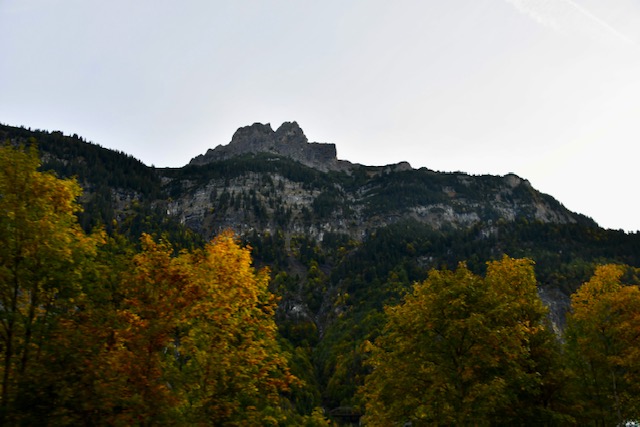
At Genoa the road headed north, eventually by-passing Milano, and then up the east side of Como and then leading up a valley to the San Bernardino Tunnel, which is 6596 meters long. The road winds sharply on the way up with many bridges and avalanche shelters along the way. There are the remains of a castle along the way with churches and monuments stuck on hills, where one wouldn’t expect them. The traffic was very slow over the last 150kms of the journey stretching the trip out to 10.5 hours to cover around 800kms. The reward of the scenery in the Swiss hills was well worth it, with little huts and towns dotted high in the rather green hills.
Arriving in Liechtenstein I checked into the Kommond Hotel, where the service is great and the food tasty. Liechtenstein is the fourth smallest country in Europe with a population of around 38 thousand people. At 25km long and some 160 square km in area, there is not a whole lot of room left to run around, although one does not get that impression when driving through it.
Tuesday 4 October 2022
Last night, while planning todays route, initially google maps suggested I head to Graz in Austria via Munich and Salzburg, places I will be going later on in the week when I pick Sylvia up in Munich and head to Salzburg for the weekend. When I first joined the army at 16 we had two corporals as our barrack commanders – to us they were really old (probably 22). Both Bob and Wally had been to Vietnam and were great instructors, very willing and eager to pass on their knowledge and experience to us. One of the lessons I remember Bob giving us was on planning a route. He had us in hysterics, and without going into detail, one thing he enphasied was to break the route down into sections and look at the detail. Bob went on to become the Regimental Sergeant Major of the Army and is now the patron of the Regular Force Cadet Association. I have a theory that Google is in bed with the oil companies and alway adds a bit to the route.
Up early, I headed off at first light, driving south back through part of Liechtenstein to get a feel for the place before turning north and heading across the boarder into Switzerland. It looks like a wealthy country with nice homes and well-kept streets. The barman last night was telling me how they sell off citizenships on a ballot basis, where some 20,000 people pay 10,000 euros to go into a draw for a dozen or so places. If you miss out hard luck – no money back. Apart from that 45% of their income is from manufacturing, 54% is from financial services, agriculture accounts for a small amount as do other bits and pieces. The average income is around $72k USD per annum.
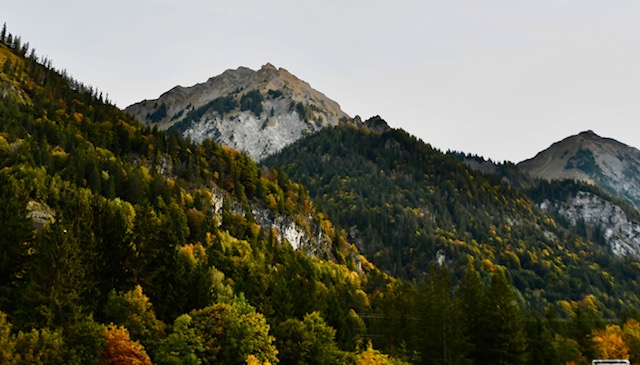
Heading east down a valley, as the sun rose lots of little villages came into view with farm houses high in the hills all surrounded by green fields. Some of the paddocks are so steep the sheep dogs must wear spikes on their feet to muster the stock. The roads are really smooth and none of them wind there way up and down steep hills – they have avoided that by just digging a tunnel from one valley to the next. One tunnel I passed through was over 10kms long and many over 5. Most are two lanes in the same direction with a separate tunnel for the traffic going the other way. Large rocky faces were present in places along with churches and statues situated way up high in places they just don’t belong. There must have been some very fit and strong disciples back in the day. Nowadays all the priest has to do is recruit the local helo pilot.
As the autumn gold and copper colours are just starting to appear, the sun is shining and it’s still shorts and t-shirt weather. The other impressive thing I see here are the large number of manufacturing plants along the way. Often just one in a medium sized town, obviously providing employment and a good standard of living for the people in the town. There is also lots of farming including cropping and horticulture. At one point I was glad that I wasn’t going west as there were over a hundred trucks in a jam.
Heading through the town of Natz-schabs and continuing east I crossed into Austria at Oberpirkack, not that one would know as there is no sign of any border or check point anymore. The countryside and the buildings were very similar and towns still had their manufacturing plants although there seemed to be a bit more farming activity. Churches and monuments were still on the high ground. There is a large castle on the high ground above Lake Ossiach near the town of Landskron. At one stage I pulled over to at an SOS rest area to take some photos when a road patrol vehicle pulled in behind me to see if I was broken down. I checked into the Amedia Hotel, near the Graz Airport, (to be greeted by a very friendly guy on the reception and bar) a bit after 4pm and over 650km of really enjoyable driving and taking in the spectacular views along the way.
Wednesday 5 October 2022
Once again I was on the road early, heading east into the sunrise and the wild skies criss-crossed with jet streams. The roads are good, all two or three lanes in each direction. As the dawn lightened up I got to appreciate the vast farmlands stretching as far as the eye could see were well tended fields with a variety of crops and some grasslands with patches of bush here and there. On most of the trip the traffic flowed freely making for an easy drive. I stopped at a couple of road side service stations for coffee and fuel. Most of the staff had enough command of english, assisted with a bit of point and pay, that there was never a problem when it came to buying fuel and coffee. They were all friendly and helpful.
Arriving in Budapest I headed to the Danubius Hotel Helia, up river from the city centre and opposite argit-Sziget, an island in the middle of the Danube River. At 1000hrs it was too early to check in so I asked the staff if I could leave the car in the carpark and go for a wander. They were friendly and ok with my request. Strolling up the river I crossed over to the island on the Arpad bridge. The island is big with a few buildings, sports grounds, statues and concrete paths running through the trees. One can hire pedal cars to get around on and there are a number of food stalls and coffee stands. At the bottom end, near where the Margaret bridge crosses the river and and adjoins the island, there is a large fountain. This bridge carries trams, cars and pedestrians. Large blocks of apartments line the sides of the river in places among the many old buildings. There are many boats tied up along the river bank. Some years ago Sylvia and her family took a boat from here to Amsterdam. Buda is on the east side of the river and Pest on the west hence the name Budapest.
Budapest is famous for its Statues and Parliament buildings which are situated on the Pest side of the river. I am sure I haven’t seen all the statues but I have lumped the ones I have seen together along with the parliament buildings.
Crossing to the Buda (west) side, I strolled along the riverbank until I found a Metro line. There I bought a day pass for the public transport and caught the red line up to Magyar Jakobinosok, the end of the line. Taking a tram a few stops, I ended up on the hill behind the Buda Castle. I strolled through some back streets, then through a tunnel ending up at the river below the castle. I found some steps and headed up, soon crossing a bridge across to the castle. Looking over the bridge I discovered a cable car that ran up to the castle, which I made a mental note to take back down as the knees don’t like steps too much these days. The castle is now an art gallery and museum. First built in 1265, but like most of these things rebuilt, and the site as it stands was built between 1749 and 1769. It was mostly demolished in WWII and rebuilt in a simplified Stalinist Baroque style during the Kadar era. Kadar was the first secretary of the Hungarian working peoples party during the USSR days. On the north side of the castle there is a large white building with an orange tiled roof. I could not establish what it is; the doors were closed and a couple of soldiers stood on duty outside. There are great views from up here across the river to the Pest side. There are also some nice houses set in the hills to the southeast.
Catching the red train under the river, I ended up in the nicest part of town with lots of bars, restaurants and little town squares. I wandered around looking at the sights, eventually settling in a chair outside Rick’s Restaurant, where I enjoyed a couple of wines and a cigar. A very friendly waitress called Krisztina had a great eye for detail as every time someone walked past and dropped a credit card receipt on the pavement she raced over and picked it up depositing it in the bin. With a Hungarian mother and a Russian father she was born in Budapest. She maintains to this day that the people were much better off under the old USSR system as she says that back then they all got looked after. At 40 years old she must have been about 10 when it all ended so I could not quite figure out where she was coming from. As the light was fading I headed down the road and caught the train on the yellow line a few stops then walked the last couple of kms back to the hotel. They still run trolley buses here and my pass allowed me to catch one but after a few days of sitting in the car I needed the walk. It was nearing 7pm when I walked past some workmen still hard at it, sorting out the local foot path.
Thursday 6 October 2022
Having had a good look at the city, I thought a train trip southeast to look at the countryside would be a good thing to do. I headed down to the gym on the ground floor, which lead me through a long passage full of rooms with people sitting in them – it all looked like doctor or medical stuff. They even have an indoor pool and the gym wasn’t too bad either. Exercise complete, I want down to the local train station to find that it was closed. There was a bus running in its place so headed into town and then found another train that took me to another bus and eventually took me to the Budapest Nyugati Railway Station. Finding a ticket machine that had an english button I set out to buy a ticket to Cegled, a town about 65k southeast of here. All went well until the screen went blank. Roger and technology! I moved to the next machine to find they had all gone blank. The station is quite big with 20-odd platforms. I typed into Google translate what I wanted and headed to the counter. A very nice lady said in perfect english with a big smile ”this is a government office, go around the corner to the ticket office”. I headed around the corner and queued up. Arriving at the counter I held up my phone with the translation; the woman, somewhat less friendly, waved her hands around and said something like I cant help you! Back to the ticket machine, which was working again, I managed to purchase a ticket and found they even have a reduced fair for antiques over 65. Tickets in hand I boarded the train, which was at the platform but not leaving for an hour. Eventually underway we traveled through the city suburbs then into the countryside. Trees and hedges along the rail corridor blocked a lot of the view but I got a good feel for the place with its very flat land, no fences and most of the ground cultivated, growing crops and various vegetables. The train stopped at every little platform along the way. The line was double tracked and lots of freight trains passed us heading into the city. The housing in the villages all looked tidy and in good repair. Each station had its own ticket machine. Even though the odd train looks pretty old, the one I was on was a double-decker and all the rail is electric. The place looks very prosperous.
Arriving at Cegled there were some 12 platforms and an old steam engine on display. A town of around 38,000, it’s quite tidy. I strolled down a nice tree-lined avenue, passing parks and the odd shop amongst the mainly one-storey dwellings with the odd multi-storey Soviet-styled apartment. A couple of kms later I arrived at the town centre with a nice park, a couple of churches and the odd statue. On the edge of the square is the Delibab Kavezo, a restaurant with a friendly chap standing at the door. He spoke really good english, which he said he had learned at school. There I enjoyed a coffee and a caesar salad before strolling back to the station. There are a number of buildings being restored in the town and a number of new apartment buildings under construction.
I managed to get a more direct train back to Budapest, which was a lot older and the window cleaner had not got around to cleaning the windows so I couldn’t take any photos on the way back. Arriving back in town I got the bus back into the city and headed to Rick’s cafe for a wine and some goulash soup and a rather tasty Hungarian steak. I had a chat to an old bloke from Norway that sat opposite me, who at 79 was here on holiday with his wife, who had gone shopping. Krisztina was there greeting all the customers. A young guy called Josh was also working there. Originally from Iran, he is trying to move to Germany as it is impossible to get citizenship in Hungary.
Dinner over, I wandered the busy streets bustling with bikes, scooters and even a kid in a toy car mingling amongst the pedestrians. I caught the bus back to the hotel, battery almost flat as I followed the route on the map but for some reason it didn’t stop at the stop near the hotel and carried on for a km or so, which made for a nice evening stroll. I have to give them full marks for the public transport here as it is easy to use and runs at convenient intervals.
Friday 7 October 2022
At 0700 hrs I departed the hotel for Munich. The traffic out of Budapest was light and the motorway heading to Austria well maintained and mostly three lanes in each direction. Continuous convoys of trucks headed south towards Budapest, almost in places looking like a a train of trucks. A smoggy like mist hung over the valleys, sometimes reducing visibility to a couple of hundred meters.
Arriving at the Austrian border the traffic slowed to a crawl as it proceeded through what once was border control. As I proceeded through the once checkpoint there were a couple of woman standing on the side of the road in high vis jackets. I waved to them and one of the woman put her hand out in what I interpreted to be a low wave. As I drove through their expressions changed to a rather aggressive look, oops maybe that wave was meant to be a stop signal. I drove past the deserted booth and pulled over as one of the woman ran after me ,hand on pistol. I lowered the window and smiled. She held her hand out in the wave position and said this means stop. “Passport!” I said its in the boot and got out and produced my passport, apologising for the misunderstanding. Checking the passport out, she said “you can go now” in a very serious manner. I got the message “don’t mess with us, we are the police”
Having travelled through the flat northern parts of Hungary, the Austrian countryside had a bit of form to it with rolling hills and lots of cropping, with each little town having a large manufacturing plant. At one point there was a huge monastery-type building on the edge of a village, which looked like it could accomodate hundreds of people. The road cut to the south of Vienna. I stopped every few hundred kms at a roadside service centre, where I found the people very friendly and tolerating of my point and pay with a smile. In a couple of places they spoke good english and enquired as to where I was from and were very chatty. For part of the journey the road, not a motorway, took me through some stunning farmland with large sheds alongside the houses to accomodate the stock in the harsh winters. There are many large rivers flowing through the lands and lots of harvesting of the many crops along the way.
At one point I passed a convoy of military amphibious armoured vehicles.
Sylvia had booked us into the Munich Airport Hilton for the night as she is flying in to join me. Arriving at the check in and showing the booking number to the rather serious guy at the check in, he said I had to wait until Sylvia arrived to check in as I need her consent to check in. Sylvia was at the Marseille airport waiting for her flight so I rang her and she spoke to Mr Serious and all was sorted. After having sorted that I headed out to find a carwash to clean my rather dirty car. Along the way I spotted an Aircraft museum with a Junkers Ju 88 on display. Unfortunately it closed before I had time to take a look. Next time! There is a rather unique coffee cart at the airport outside the terminal.
Saturday 8 October 2022
After a leisurely breakfast we headed up the Autobahn in the direction of Salzburg. In this part of the country there are speed limits on the road varying from 80km during roadworks to 130km in places, but they are not consistent and one has to concentrate as they change often. As we neared the border of Austria Sylvia said we had better check out the toll road rules. She discovered that one was supposed to display a toll sticker on the windscreen or one can collect a 120 euro fine. We pulled into a service station and got one. Crossing the boarder into Austria, we turned off the motorway not far down the road to be confronted by a roadblock where the guys were checking toll stickers. Well done Sylvia! Bit of luck that I had driven a lot of Austria over the past few days without one and not got caught. Along the way the scenery had been really nice with colourful houses and stock sheds amongst the green fields.
Not far up the road we crossed back into Germany, following a green, glacier-fed river for a while before heading up the hill to the bus station below the Eagle’s Nest. High on the hill above, one could make out the building that was built for Hitler in 1938. Three thousand eight hundred workers built the narrow, winding road up to the carpark below the building, built the 300m long tunnel, the 124m vertical elevator shaft and constructed the building on top over an 18-month period. A cable car system was put in place to bring the heavy materials up the side of the hill but many workers perished as they fell off the side of the mountain. At a cost of 30 million Reichsmark, this was funded by the royalties from the sale of Hitler’s book, Mein Kampf. (It must be quite good to write a book and then make it a compulsory purchase for most of the population).
Boarding one of three buses, we headed in convoy up the road, passing through the five tunnels built by the workers back in the day. The road is pretty much one-way all the way and only these buses are allowed to transport people up to the carpark. Arriving at the carpark, we dismounted and walked through the 300m tunnel into the dome room and joined the queue waiting for the brass-lined elevator, which was much bigger than expected – but felt pretty small with about 30 people crammed into it – for the 124m journey to the building above. Around the area there used to be several other buildings including homes for Hitler, Goerring, Boerman and others, but these were all destroyed at the end of the war.
Hitler only visited the Eagle’s Nest 14 times – one drawback was that they didn’t put any heating into the building, despite the elevator shaft being heated. It was mainly used for entertaining dignitaries. We looked through the building before wandering up the hill behind it to enjoy the views, then enjoying a pleasant lunch at the restaurant inside the building before reversing the journey and catching the bus back down the hill.
This still remains the most visited tourism site in Germany.
Just after our traffic stop we had noticed a cable car running up a high feature. We headed there, bought a ticket and climbed aboard the Der Untersberg cable car for the 8.5 minute ~1330m climb to the top of the Untersberg range. We just had time to see the views at the top before the clouds rolled in. We enjoyed a cup of coffee and some apple strudel before heading back down again.
From there we drove the ~10km into Salzburg, where we had been instructed to park in the carpark and walk ten minutes to the Hotel Goldgasse. It turned out the carpark had been built inside the mountain, carved out of solid rock. A tunnel led us through into the old city, which is absolutely stunning. Originally settled in 796 the fortress above the city dates from the 11th century. We checked into the hotel and headed out to check out some more of the city, to be met with pouring rain. We headed to a nice Italian restaurant, where we enjoyed some great pizza. Hopefully we will get to check out the town properly tomorrow morning.
Sunday 9 October 2022
After an enjoyable breakfast at the Hotel Goldgasse, we strolled over to the funicular to take the ride up to the Salzburg Castle on the hill. Near the funicular there is a still functioning waterwheel, which runs a mill in the building adjoining it. Every direction one looks in this town there is a photograph. Unfortunately we did not have much time as Sylvia was catching the noon train to Munich to get her flight back to Nimes.
Mounting the funicular, we headed up to the castle grounds. The place is huge and I am sure, like in most such places, we would only get a glimpse of it. A ramp led into an internal tower, which used to hold the water to run the original funicular. More than a hundred years ago this operated by each vehicle having a large water tank attached to it. The tank was filled on the top car, the weight dragging the bottom car up as it descended; the water then emptied and the process repeated. I am not sure how they got the water up the hill to the tank. Nowadays, a lift has been installed to take us to the upper level. Next stop was the armoury which had mainly replicas of armour and an original on a revolving platform.
The grounds are huge, there are many restaurants and shops – most at the moment, being the tourist off season, are closed. It was nice as we almost had the place to ourselves. We wandered up the many steps into the main museum, which took one through the local history, with many weapons medals and other items on display.
At one point there was a great slide show giving the history of the castle that started off as a watchtower on the hill in 370 AD and evolved from there over the years.
From the museum we had noticed, through a window, some people on a tower, which we just had enough time left to check out. Exiting the museum part through a hall where a kid wound a handle activating some trumpets, we headed up the tower via a number of spiral stairs and passageways. The views from the top were well worth it.
As I write this Sylvia is now on the train to Munich. I will now hit the road for Vienna.
One day we will come back and spend a little more time here. Maybe even take the horse and cart tour.
Late evening I headed to the Auckland Airport to catch the Air NZ flight to Hong Kong. The airport, unlike others in the world, is still eerily quiet with many shops still closed. Only a few flights a day are arriving and leaving Auckland compared with the pre Covid days. As soon as we were airborne and the seat belt sign was off I flagged the drinks and dinner and put my bed down to get some sleep.
Flights are a lot harder to organise and much more expensive these days. When booking this flight I was trying to use up some Thai Air credits we had owing to us. After many hours of looking and finally a phone call to Thai Air (yes someone actually answered the phone) the best and really only practical route was through Hong Kong.
Sunday 25 September 2022
Landing in Hong Kong after breakfast I was surprised to find another hermit kingdom, although I should have known as people still have to isolate to go to Hong Kong. I was wrong thinking I would spend the six-hour stopover in the lounge. The only lounge open was Cathay Pacific. Star Alliance is not open and the other airline lounges don’t open until noon, the time my flight left. Hong Kong airport is another ghost airport and most of the shops are still closed, apart from the odd coffee place. The restaurants etc, that are open don’t open till noon. I spent the next six hours sitting at the gate looking out the window and watching the activity going on around the aircraft as they came and went, fortunately something I enjoy. The flight was delayed an hour or so and Sylvia had planned to meet me at the Bangkok airport and travel into town together however her driver would not wait so on landing I went to a counter and organised another vehicle and just after 4 pm arrived at the Pullman King Power hotel to be reunited with Sylvia after six weeks apart.
Monday 26 September 2022
Sylvia was here to do a market visit with the Royal Canin team today and sponsor a development program for up and coming leaders on Tuesday and Wednesday.
I had seen something about the so-called floating markets a little way out and to the southwest of Bangkok. A quick chat with the very helpful concierge and a taxi was organised to take me there and to the market railway and back again for 2500 locals ($118 NZD). Soon we were on the road and moving relatively quickly across the elevated motorways. Although the traffic is not too bad here just now, as the Chinese tourists have yet to return, they still have around 10-million people to move around and have done some smart things by building motorways on top of each other, in some places 3-high, or straight across the top of houses with both road and rail on pylons . Like in most big cities they are still building them.
The views from these roads are quite good and in spite of the rather gloomy weather I got a good appreciation of just how big this city is, while appreciating that the whole area is one big swamp full of channels and waterways; in many places the water table is just below ground level.
We headed south then east through mainly built up areas. There are many large factories and some universities along the way; one area is rather grey and dreary with non-stop grey-water fish farms. At Puak Camp, where the driver waited, I headed over and looked at the many options including shooting various pistols and some rifles, a croc show and an elephant ride. I opted for the floating water market tour and the elephant ride. I was taken to the canal edge and quite quickly a wooden boat turned up with its 6-cylinder engine propped on the stern and the long propellor shaft heading into the water at a slight angle. Off we went to see these floating markets. Well not quite, the markets situated in various places along the canals are on concrete piles and not floating anywhere. Each little market has a number of stalls with large doors, or in some cases covers, that open out to the water. The boatman slows as we pass each stall and the stall person smiles and looks at you with pleading eyes, hoping one will stop and spend some coin. Many of the stalls are closed, I understand still suffering from the Covid effects and lack of tourists. Stopping at one stand the lady with the pleading eyes said “your driver is my brother”. That worked! Soon I was handing over locals for some souvenirs for the grandchildren. As we continued on a number of large monitor lizards swan about in the canal, one sticking his head over the kerb and poking his tongue in our direction before slithering off in a hurry.
Next stop was the local temple with its gold paint and bright colours; there a bunch of monks worked away digging a drain and doing other manual labour. Some parts of the many structures were still undergoing restoration, I presume a never-ending process. As we went through various parts of the markets people in boats sold fruit and vegetables; some were cooking meals on gas cookers, which they sold to both the locals and the odd tourist.
Arriving back at the start point the boat driver left me with the elephant woman, who scooped up a few of us and lead us to the mounting station, where she skimmed each person for 100 locals for a small basket of bananas to feed the elephant along the way. Mounting the basket, off we went at a slow amble around the well-used concrete path, the mahout using his hooked stick on the odd occasion the elephant wanted to stray off the track. Every now and then the jockey asked for a bunch of bananas, which he then held out and the trunk came, up grabbed them and into the mouth they went. Eventually we entered some water, which was deep enough to immerse most of the elephant’s belly, then up some steps and back to the start line, the ride over in 10 minutes. The mahout opened this silver box and offered to sell me some elephant teeth for 100 locals to “help pay for the elephants food”. I declined the teeth thinking it might be a ‘go to jail job’ if i arrive back in NZ with those. The eyes went sad as he put the box away so I gave him the money anyway. Dismounting the stairs, the elephant woman holds up two photos taken on the ride in frames ready to go for 500 locals. I must be getting soft!
Leaving the elephant compound I crossed a bridge back to the start line to find the cab driver waiting patiently. We headed off down the road and soon arrived at the small town of Samut Sangkhram. We parked in a carpark where we were handed some little bags of fresh fruit for free. The driver lead me down a busy street to the railway line. “The train is coming in 15 minutes – I will wait for you at the car. »
Amongst the stalls there was indeed a railway line, and a well used one at that. I wandered along the line through the stalls and then the was an announcement in, i presume Thai and maybe one other languge, then english: “Here comes the train”. Stock was moved off the tracks, awnings pulled back and there was the train. “Stand behind the red line” was another announcement. Eventually I saw some red on a stone as the train approached and brushed past. Leaving the markets and crossing the street, it pulled into the station. By the time it had stopped awnings were up, stock was back in place, and the traders were trading. I paused at a local cafe by the station to eat some lunch as many tourists got their photos taken with the train. It all seemed to work quite well. No-one got injured or died and this has been going on for years. I can’t imagine it working too well in NZ. It would take a week just to put out the road cones, let alone anything else.
The return journey was a little quicker than on the way down and I was back at the hotel by 5pm in good time to catch Sylvia when she got back from her day out, as she had a night free from functions. In all a great way to spend a day out of Bangkok.
Tuesday 26 September 2022
To have a further look around the city I got an all day train pass for 140 locals (6.47 NZD). First I took the train several stops towards the airport. Up high on pylons once again, I got a good view across the city. After 6 stops I got off, crossed over, and headed back to town, getting off near China town.
I wandered the streets looking for a good Thai massage place, which I had had recommended to me. I couldn’t find the place so asked a guy standing on the street. He said the place had closed and the other places around here were not too good. For 80 locals he could take me to a really nice place. I made it very clear I just wanted a massage no extras!! He assured me that was the case and off we went, eventually arriving at a carpark inside what looked like an apartment building. He walked me over to the door and a well dressed guy escorted me inside to a large auditorium style room with lots of couches and a few girls sitting around. “I know whats going on here I thought” as the guy scribbled 5000 locals on a pad. Immediately turning and walking to the door thinking the driver is waiting for his cut, I asked the doorman if the driver was still here. He pointed to where his car was and I strolled briskly over. Seeing me coming he went to drive off but I grabbed the door handle, opened his door and made him very aware of the error in his ways. He offered to take me to a proper place at no charge. There I enjoyed a really good 2 hour massage.
Jumping on the train again I headed to a cigar bar in a shopping mall, which was a little hard to find. I enjoyed a couple of glasses of wine and a nice cuban cigar.
Jumping off the train a stop early to walk back to the hotel and taking what I thought was a short cut, I wandered down a street full of Thai massage places and lots of food outlets. At the end of the street I hit some on-the-ground railway lines. Across from them there was a door open to a building site, which I hoped would lead to the street by the hotel. I had only got a few yards when a guy came running after me telling me I wasn’t allowed to go that way. Being a friendly chap, he lead me back to the railway line and said head down there. He and his mates were dining under the trees next to their shack, all having a good laugh at the dumb tourist. The scrub and bushes alongside the tracks were full of shacks, some just made of plastic.
Arriving back at the hotel I headed up to the lounge on the 20th floor for a drink and a snack as Sylvia was at a function. There I got chatting to a nice chap called Ron, who works for the UN in the disaster and crisis side of things. Originally from Jamaica, he now lives in Geneva and travels frequently.
Wednesday 27 September 2022
While having breakfast I get a message from my good friend Micheal. Formally ‘SureFire Mike’, then ‘Aimpoint Mike’ and now working for Knight’s Armaments selling guns to the good guys to make the world a safer place. “Are you in Bangkok?” the message read. Yes, I replied. We have met up in many countries over the years but it’s normally prearranged so this was a nice suprise. He was staying at the Hilton on the other side of the river. I bought another train ticket and headed over to catch up for a coffee. He was traveling with his boss and had only arrived last night and was off to Singapore later in the day.
After a brew with Mike I headed out to the end of the train line. Out to the west side of the Chao Phraya River there are some quite nice areas, but even here the water table is only just below ground level with lots of canals and waterways.
Mid afternoon I headed back to the cigar bar and then wandered over to Soi Phetchaburi, the street where I had seen all the massage places last night ,and enjoyed another good massage before heading back to the hotel. Heading to the 20th floor bar I caught up with Ron again before heading to the bar downstairs to meet Chadon, who is the general manager for the Royal Canin Thai business. Chadon is a reall good bloke I have known for a few years now. It was good of him to give up his time to come and have a yarn before we departed.
A driver picked us up at 8.40pm and we headed to the airport for the flight to Amsterdam on KLM. Arriving there things had improved a bit as more of the security carrousels were operating, speeding up that process. After a couple of hours in the lounge we headed to the gate to be told there was a strike in France and that the Air France flight would not leave till noon. Back to the lounge for another couple of hours wait then back to the gate and after boarding we sat in the plane for an hour or so before departing more strike stuff.
Saturday afternoon we embarked on a journey to Chateau des Milandes, the chateau Josephine Baker (see our Morocco blog) had rented prior to the war from 1937 (and later purchased in 1947). She unfortunately lost it towards the end of her life, in 1968 after going broke.
Situated in the Dordogne region, some six hours from Nimes, the chateau was originally built in 1489 by the wife of Claude Caumont when she got bored of her other chateau and wanted to live somewhere new. The château remained in the Caumont family until the French Revolution. It was purchased by the Labarre family in 2001 and restoration started. It has hosted an exhibition about Josephine Baker since then. In 2012 it was awarded the label ‘Maison des Illustres’ a French heritage cultural classification, due to its association with ‘one of the most exceptional women of the 20th century’.
The GPS took us off the toll roads through some French countryside made up of forests and farmland dotted about with numerous picturesque castles, ruins and small towns. We eventually arrived at the town of La Roque Gageac, one of the most stunning towns we have seen in France, built into the cliffs alongside the Dordogne river. We checked into the Manoir de la Malartrie, a bed & breakfast sited in a stunning old manor across the road from the river at the east end of the town. With a swimming pool, tables and chairs set among the trees in the well-tended gardens, it is a very picturesque place.
We headed back into the town looking for a pizza and a glass of wine but the town was full of tourists and the service was typically french (as in lacking!). We headed down the road and back across the river to Cenac et St Julien, but no luck there either. We eventually settled for an ice cream and headed back to the Manoir, admiring the dozen-or-so hot air balloons that had popped up from over the hill.
Sunday 24 July 2022
We enjoyed an excellent home-made breakfast, with a wide variety of fabulous dishes including a tomato tart, orange cake and apricot flan as well as a great selection of breads, cheeses etc, in the garden, along with the delightful service of the lady of the house, originally from Morocco. We then followed the GPS along the river, crossing the river below the Chateau Castlenau, and continued up the hill, and through a lovely wooded area, eventually arriving at Le Chateau des Milandes, which over the last 20 years has undergone a restoration and has magnificent gardens.
Our tour through the castle itself (no photos allowed) showcased different periods of Josephine’s life in the many different rooms, including her marriage to Jo Bouillon during which she adopted twelve children (two girls and one boy) of varying nationalities and religions. She referred to them as her ‘Rainbow Tribe’.
A world-famous entertainer, singer and dancer, Josephine seems to have been quite a character. At the fall of Paris she located herself at the chateau, working with the French resistance, eventually smuggling from France a large amount of secret documents about the German activities. She secreted these documents, written in invisible ink, into the large trunks she traveled with as part of her performances, and was able to get them into the hands of the British Intelligence services.
During her tenure in the chateau she turned the village into a tourist attraction with her brother running the petrol station and her sister running a hotel, but unfortunately, despite being a gifted performer, she wasn’t fiscally wise. Some tradesmen sent her several duplicate bills, all of which she paid, eventually sending her broke, eventually losing the chateau to creditors. She barricaded herself in the kitchen for three days but was eventually evicted.
Having been a spy, she thought for the Free French and De Gaulle, but it later transpired she had been working for the British Intelligence services. While in Morocco in the early part of the wars, she and her handler and lover,Jaques Abtey, played a large part in the success of Operation Torch, where an armada of some 70,000 troops sailed from the US and another 30,000 from British, landing in both Algeria and Morocco in 1942. For a large part of this time she was hospitalised with peritonitis in Casablanca but even though on death’s door, her hospital room was a safe place for the meeting of various people to meet and share information, hiding from both Nazi and Vichy French spies.
After the invasion she was offered a contract from the US to entertain the troops but turned it down on the basis that she wanted to give her services for free – not only to the US but to all the allies who were fighting Naziism. She continued to gather and pass on information to the SIS during this time.
In the chateau was a cabinet full of the numerous awards she received from the Free French, the British and the Americans, including the French Legion of Honour.
After the war, she became an active crusader for the Civil rights movement, especially in her native US, where she was the speaker immediately before Martin Luther King gave his historic « I have a dream » speech.
Outside the chateau we enjoyed a raptor show, put on by some of the staff in the castle, showcasing a number of bords including a Giant African Eagle Owl and a Bald Eagle. At one point a man walked around showing a ferret, that is used to get the rabbits out of their holes so the birds can pounce. A motorised rabbit was pounced on by a large hawk.
Spotted Eagle Owl
Barn Owl
Eurasian Eagle Owl
Caracara
Bald Eagle (f)
While we enjoyed lunch at the chateau brasserie they played songs from Josephine in the background. We enjoyed the magnificent gardens before heading back to the car for the long drive home.
Once again, we avoided the toll roads, taking a route along a ridge line, which gave us extensive views over some of the best scenery we’ve seen in France. All in all a great weekend…
Another trip to the Marseilles airport – we boarded a Royal Air Maroc flight to Casablanca. The idea of visiting Morocco came about from a book I listed to recently called “the Flame of the Resistance’, about a woman from the southern states of the US, who went to New York to make it as a singer/dancer but couldn’t make it there so went to Paris. There she became a sensation in the nightlife scene. During her time in Paris, she became friendly with a couple of ex-Navy Commanders, both from well-heeled families, one called Dunbar and the other Fleming. Both worked for British Intelligence. When the war came along, now living at Chateau des Milandes, situated just north of Toulouse, she worked as a spy with the French Resistance, helping downed Allied pilots to escape from France. Eventually she had to escape herself because the Gestapo was on to her, first to Spain, and then establishing herself in Morocco, which was then under the rule of the French, who’d signed a deal with the Nazis. There, from both Casablanca and Marrakech, she supplied information to the Allies, especially in regard to Operation Torch, where a combined US and British Invasion of Morocco took place.
Landing in Casablanca we had a bit of trouble finding the driver that the hotel had sent to pick us up, but after a few phone calls to the hotel we located him and proceeded in a very comfortable car for the journey to the Hotel Casablanca. This Art Deco style hotel has rooms leading off a square atrium with a massive chandelier hanging in the middle from the fifth floor – I was sorely tempted to leap out to it and slide down.
Thursday 14 July
We had a lazy start to the day, enjoying the hotel breakfast (Sylvia especially enjoyed the variety of cakes on offer) and appreciating the fabulous Art Deco decor in the hotel.
We had booked a driver to show us around Casablanca. First we headed to the Quartier Habous, which is an area several hundred years old with lots of quaint stone buildings and many archways. Unlike in some countries the shopkeepers were very polite. When we said no, they said ‘enjoy your stay in Morocco’ with none of the hassle we have experienced in other parts of the world.
Next we headed to the Sqala restaurant situated behind an old fortress with muzzle-loaded canons still on display. As we walked in there were rows of tagines on each side, sitting over troughs filled with hot embers. Looking through the menu, just about everything that had meat in it was bloody lamb shanks. As a child, being raised on a number of farms, when we killed a sheep for house mutton we fed the shanks to the dogs. I ordered a lamb tagine, which turned up with a bloody shank in it and it didn’t taste any good cooked that way either (although Sylvia enjoyed it). We enjoyed a wander through the streets behind the restaurant.
After lunch we drove to the city’s main mosque, Hassan II. Opened in 1993, 10,000 labourers and 6,000 craftsmen built it over a period of six years. It’s the third largest mosque in the world. After we bought our ticket we were grouped together with other English speakers and a guide with a straw hat and his sunglasses on backwards, who spoke 7-8 languages, proceeded to tell us that underneath the large area we were walking on was parking for 4000 cars. During Ramadan, some 80,000 people kneel ont he carpets laid out on this area and another 25,000 pray inside the mosque. We entered the mosque through one of the many titanium clad doors, through into the main foyer where we removed our shoes and put them into the little bag we were given. The hall is about 200m long and about 100m long with concrete mezzanines clad in hand-carved cedar with piles going some 60m into the sea-bed and columns extending up to the 65m high roof clad in marble and hand carved stucco, made with granite dust and egg whites. Water flows down troughs through the centre of the mosque. We strolled down to the end facing Mecca with its red lines on the carpet to ensure everyone is lined up properly. The guide pointed out a portion of the ceiling, some 3,000 sq. meters that opens up to let air in as it can get a bit stuffy with 25,000 people in there.He also pointed out a large chair where the teacher sits. Then we headed into the minaret which is some 200m tall, where we descended some steps that took us into the washrooms downstairs. With some 400 fountains, this is where the worshippers come to clean themselves before prayer.
I don’t have the vocabulary to describe the vastness of this place and the photographs don’t do it justice. It is an all-year round active mosque where people come to pray at various times of the day and tourists are fitted in at various times in between.
The mosque visit over we jumped in the car and we headed south along the coast (the Corniche) giving us a good idea of the expanse of this city of some 3 million people. All the way along there were thousands of people bathing in the warm waters of the Atlantic and a continuous number of bars, restaurants and takeaway joints, with the drive finishing at the enormous Morocco Mall. It was quite interesting to see the colours in the city with child care centres and junior schools painted in bright colours. Bougainvillea grew in a variety of colours in both manicured and un manicured hedges around the city.
Like most large cities in the world there is a massive amount of construction going on. Lots of the older parts of the city are in Art Deco style from the 30’s and 40’s.
On returning to the hotel we enjoyed a very good massage before settling in for an early night.
Friday 15 July
We rose early to another fantastic breakfast. At 8am we were on the road again with our driver, heading southeast to Marrakech, which has changed considerably since the 1940’s. Now a two-lane highway, as good as any European road, with a speed limit of 120kph links the two cities. As we headed away from the city we noticed huge areas that had been cultivated though nothing is yet growing. Periodically there would be a mob of sheep, goats and cattle with their herder close by, often sitting under a tree in the shade. The odd donkey dragged a cart around the place. The hay had been cut and stacked, mostly in neat stacks, often covered with canvas or plastic. The further south we went the more arid the land became – it still appeared that every bit of land that could be cultivated had been although there was still no sign of anything growing. There was a large tractor in one place towing a large tank of water. A few fields had people working in them but we couldn’t tell from the car exactly what they were doing.
Leaving Casablanca it was a cool 26 degrees. Jut over two hours later arriving in Marrakech it was well over 30. Our driver dropped us at a cafe just outside the Medina (old city), near to the Bahia Palace. After a coffee, we headed into the palace, which with its tiled walls and floors and no furniture appeared more like a massive bath-house than a palace, albeit ornate. In one of the rooms a man sat carving mosaic tiles with a little hammer.
After touring through the many rooms in the palace, and, after a bit of negotiation we caught a horse and cart. This took us on a good look around the Medina, past the Royal place areas and the Koutoubia gardens to the main Jamma el Fna square. This square was much quieter than we had expected but there was still a lot of activity with music playing and snake charmers charming. After stepping off the carriage the first person to approach us was a bloody snake charmer who insisted on putting a water snake around my neck and getting Sylvia to take photos. Of course at the end of that he wanted money… he had a number of snakes there including a cobra, a few bavard vipers and several pythons. I asked him if they removed the fangs and he said no – that’s not good for them. We throw them in a sack and pour water on them and that keeps them nice and calm!
Moving on from there we passed many other stalls avoiding the henna artists and people trying to get us to take photos with their monkeys. We climbed some stairs to a terrace cafe where we enjoyed lunch and a drink with a view over the square.
After lunch we carried on out of the square and into the Medina with many of the stalls closing up for the Friday prayers. Wanting to explore some of the time alley-like streets we headed into a narrow passageway and had only gone 30-40 metres when a guy stopped me and said it’s closed. We later worked out this means it’s a dead end. He insisted we should head in the other direction to see the Berber markets as they stay open on Fridays. He took us back onto the Main Street and was pointing us in the direction when ‘broken leg’ went past sitting on a motorcycle without the engine running, using his left leg to push it along like a scooter. The man stopped ‘broken leg’ and told us to follow him to the Berber markets. We followed him for some time, twisting and turning through small alleys and streets.
I noticed several men walking along with small rugs on their heads. I thought that was a good way to keep the sun off their heads as it was getting quite warm. Shortly we rounded a corner to find a whole lot of men praying on their little rugs on straw mats on the street – they were prayer mats they had been carrying. No one seemed to mind as we continued along past them. There were literally hundred and hundreds of men praying on the streets surrounding the mosque which was obviously fill to overflowing.
At this point, ‘Broken leg’ abandoned his motorbike and took us to see Bab Debagh (The Tannery Gate). Then he said, come on and I’ll show you a tannery. A couple more alleys later and he introduces ‘Smooth Dude’, with his slicked back hair and bunches of mint which he crushes up and gives to each of us to eliminate the stench of the tannery. ‘Smooth Dude’ guided us around the tannery explaining how the Berber people come down from the mountains. Some tan the skins, some make cloth from the hair and in this area there were hundreds of little ponds covered in rugs and skins where the tanning process was taking place. Lots of little locked rooms stood around the tannery. The door was ajar in one, which ‘Smooth Dude’ led us into, where a man was stripping the hair off a camel skin. The tour over and ‘Smooth Dude’ led us around the corner and into a shop, saying something (probably ‘here’s some more suckers for you’) to the proprietor. We were taken to one room and shown leather pouffs made of different types of hide. He explained that in the summer they keep their winter clothes in them and vice versa. Next stop was the rug room where a man laid out rug after rug at the instruction of our super salesman. Eventually we saw one made of camel hair that we both liked and, after some negotiation and some pretty hefty wrapping, super salesman was a bit richer and we were a bit poorer. We rang the driver who met us outside the Bab Debagh.
The above photo is how the tanneries look at a different time of year.
Next stop was the Yves Saint Laurent museum. Apparently he hung out here a bit in his early days. It had a range of garments and materials made famous by YSL but unfortunately no pictures were allowed, which was pointed out to me by the security guard as I raised the camera.
As we left town at about 3:30 in the afternoon, the outside temperature was showing as 44.5 degrees. It cooled considerably as we headed northwest back to Casablanca, where it was a comfortable 22 degrees when we arrived.
We spent the evening sitting on the balcony overlooking the pool enjoying a pizza and a glass of wine.
Saturday 16 July
At 8am our driver was waiting ready to take us northeast this time to the city of Fes. We headed about 100kms up the coast to Rabat before heading inland. The country in this part of Morocco is a lot more arable. The whole ~300km journey consisted of nice arable farmland and big forests of olive trees, some up to 10km long. (Too big to be olive groves). There’s also lots of horticulture in this part of the country, very different to the arid land to the south.
Arriving in Fes we drove down the Main Street with it’s wide median adorned with palm trees, water features and large green walkways. Soldiers armed with assault rifles were dotted along the avenue, something we hadn’t seen anywhere else. Perhaps someone important was coming to town?
We were dropped off at the Blue Gate and headed into the Medina. As we walked through the gate we were approached by about half a dozen people holding up cards and offering to be our guide. We politely declined, except for one particularly persistent bloke that I had to impolitely decline. Lined with shops this, I presume, the main alley meandered downhill. After exploring a few side streets we stopped at Cafe Clock, which was well down a narrow alley, opening out into what was once a courtyard with a large set of trumpets suspended in the middle. This place is famous for its camel burgers but it was too early for lunch so we climbed the narrow stairways, with arms brushing each side, to the level below the top where we enjoyed a cup of coffee. Then we wandered up to the roof for its amazing views over the Medina. The staff were really friendly.
Back on the main alley, we continued our downward journey and were stopped by a man with a donkey who wanted us to take his photo. I took the photo, smiled at him and continued walking. Sylvia then noticed he was following us and asking for money. I was a bit over that trick having learned the lesson from Snake Charmer. We ducked down a few side-alleys to avoid him, declining numerous offers of visits to a tannery.
Eventually we came across the metalwork area with numerous shops selling brass, silver and copper ware.Soon we were seated in a shop where Sylvia purchased a copper tray and a copper, silver and brass teapot.
We continued to wander the alleys heading for the nearest gate, Bab Rcif. A young man approached us offering to show us the way back to the Gate. Sylvia made it quite clear to him that we didn’t want to pay him any money and that we were very happy wandering on our own. We went up and down alleys, around in circles, up and down more steps and then he explained he was taking us to the Blue Gate. Eventually we left him, but not until he had demanded money because he had helped us. The old tourist con didn’t work this time… we held our ground and headed to the Ruined Garden Restaurant where we enjoyed a nice lunch.
Looking at the map we were very close to the Blue Gate so we arranged for our driver to meet us there. When we got into the car the temperature was showing 42.5 degrees!
We headed back out through the town aiming for Meknes, one of Morocco’s old imperial cities, on the way back to Casablanca. As we made our way towards the old town we passed several areas walled off with embattlement type walls. Arriving at the Medina we found, disappointingly, that the whole thing was closed and under reconstruction. Once again the mighty tourist dollar is reflected in the reconstruction of these historic cities.I am sure in a few years it will be a stunning place to visit.
We relaxed in the back of the car as the driver took us back to the oasis of our hotel. It was interesting to see along the way that there are whole towns being built along the way with hundreds of buildings, many painted in the bright colours so present in this part of the world, that don’t yet look to be inhabited. Our driver for the three days was excellent – a very polite and considerate driver, consistently cruising along at 125 mph in his very comfortable Merc. This made for a very comfortable trip for us.
Back at the hotel we enjoyed another excellent massage.
Sunday 17 July
We enjoyed a relaxing breakfast before checking around midday out and heading to the airport for our return flight to Marseilles. Hotel Casablanca made for an excellent stay with fantastic staff and outstanding service.
Overall we have found the people in Morocco to be very friendly and welcoming and in general terms apart from a few exceptions have been very polite and courteous. It has been a really great place to visit – Sylvia in particular has been entranced by all the different doors.


 Note this guy has his face covered so his kids who go to the local school won’t be embarrassed by the fact that their father does the lowest job in the community to support his kids through their education. There are a number of people in other countries that could learn a lesson or two from these hard working people.


 Soweto’s soccer stadium
 Soweto’s hospital entrance. Formerly a military hospital, now the largest in the southern hemisphere.
 Local bus station