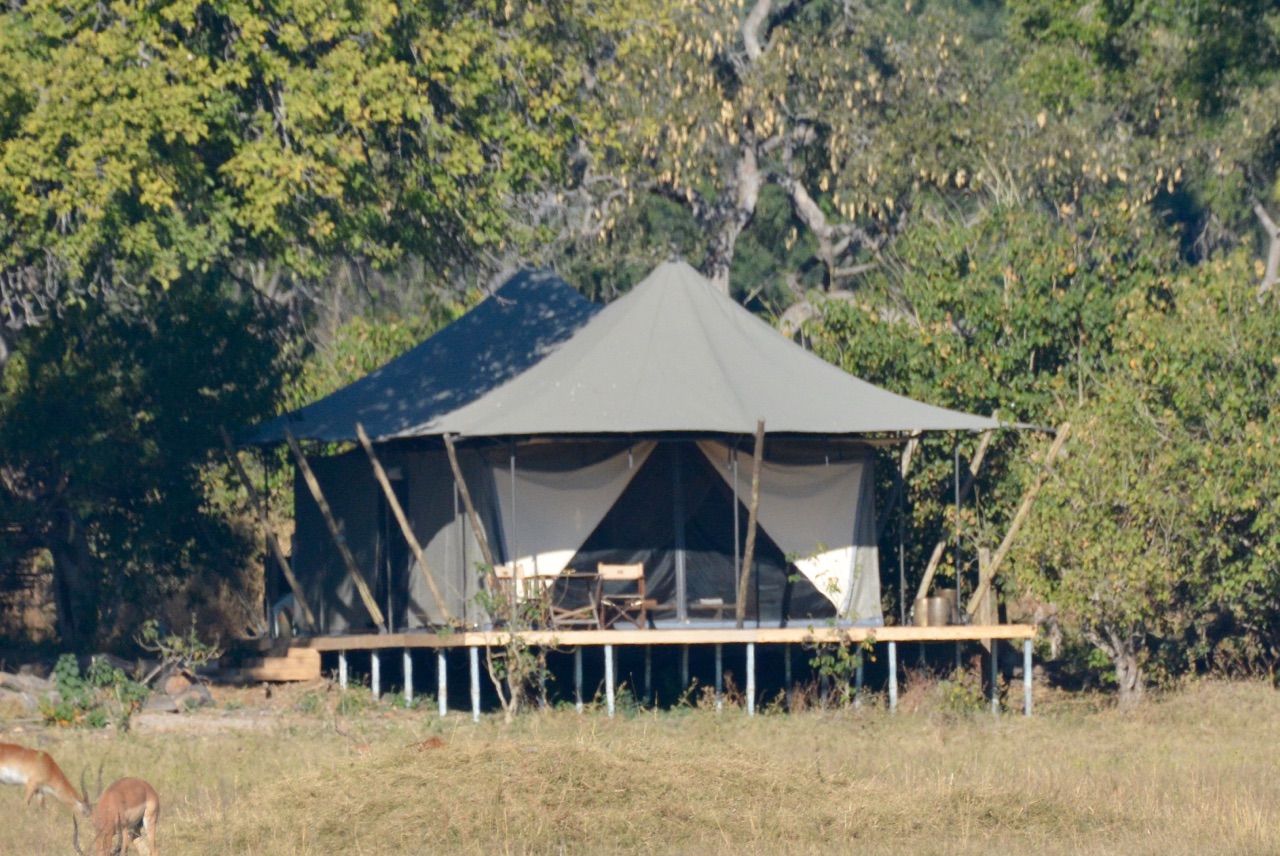
Vumbura Plains South Camp

Friday 21 July: Sylvia

It was quite sad to wake this morning knowing it was to be our last (at least this visit) at Mombo Trails. Doc was as excited and positive as ever this morning as we headed out. Despite having seen several small groups of female kudu we hadn’t seen any of the magnificently horned males so it was great to come across six of them not far from camp.

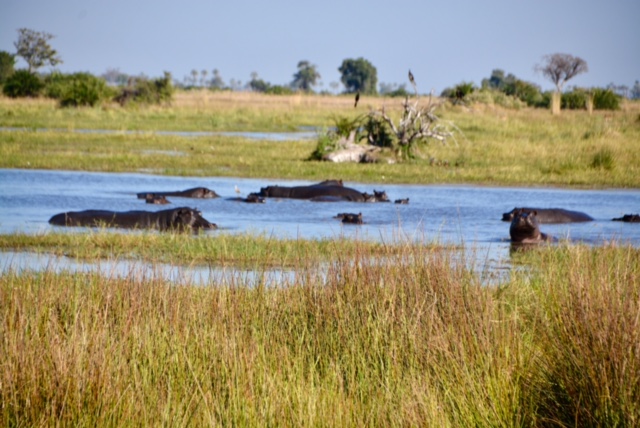
We headed North up towards the Moremi Hippo Pool, passing numerous groups of animals along the way. One tiny baby elephant was particularly cute, as was a massive bull elephant who posed beautifully. We drove through large swathes of turpentine grass, taller than the car and eventually reached the waterways leading to the pool. Large groups of red lechwe and numerous water birds created a peaceful scene. We enjoyed another morning tea with the hippos while a couple of large crocs baked in the sun at the far end of the pool and then headed back to the airstrip in time for our 11am pick up and transfer to Vumbura Plains.

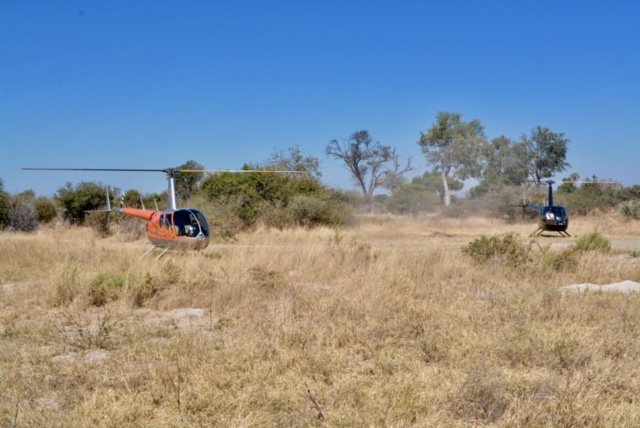
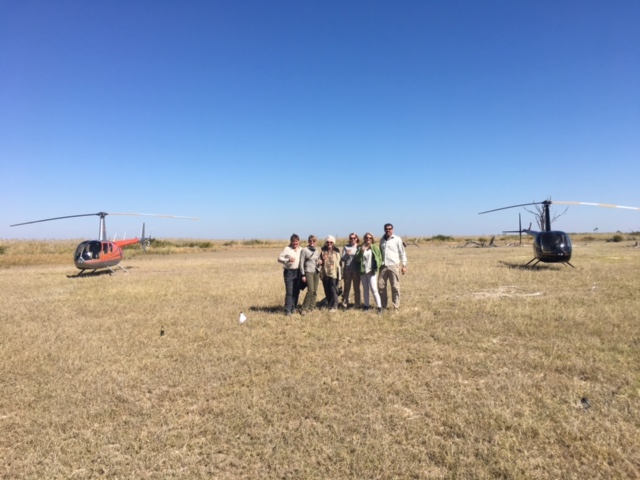
Two Robinson 44 helicopters arrived and we piled in, our bags would come later. It was fantastic to fly over the delta and get a real sense of the waterways. Of course we could also see some animals from the air. At one point we flew quite low – about 30m up and it seemed like we were skimming across the tops of the reeds. We headed to a small island and landed near a herd of red lechwe. The pilots surprised us all with glasses of champagne on an island that it is likely no human has ever stood on before. We then hopped back on board for the final five minute flight to Vumbura Plains South.

After lunch – there is so much food here – and the obligatory safety briefing we decided to wander to our rooms and then go for a walk along the boardwalk to the north camp where we had stayed a few years ago. Sometimes though nature has other plans as we experienced an elephant road block between Debbie and Dave’s room and ours. One elephant had broken a pipe on their plunge pool but we all sat out on their deck and enjoyed the experience while we waited for the path to clear enough for us to walk past. Eventually the main path cleared and Joanna and Leonie could go to their tent but the elephants were still around ours. A few minutes later they came back and said the elephants here seemed relaxed enough and we could come to our tent. We arrived and were surrounded – elephants grazing on the bushes all around our tent. One had knocked over our hot water heater but hopefully it will still work. We sat outside on the deck enjoying being so close to such magnificent beasts.

Luckily the elephants had moved away by 3:30pm when it was time to head back to the main area for high tea before heading out for our afternoon drive. The landscape is very different here with the Okavango floodwaters very evident and lots of small, wooded islands. It wasn’t long before we spotted a couple of water buck – very distinctive with the white circles on their butts looking like they have just sat on a freshly painted toilet seat.

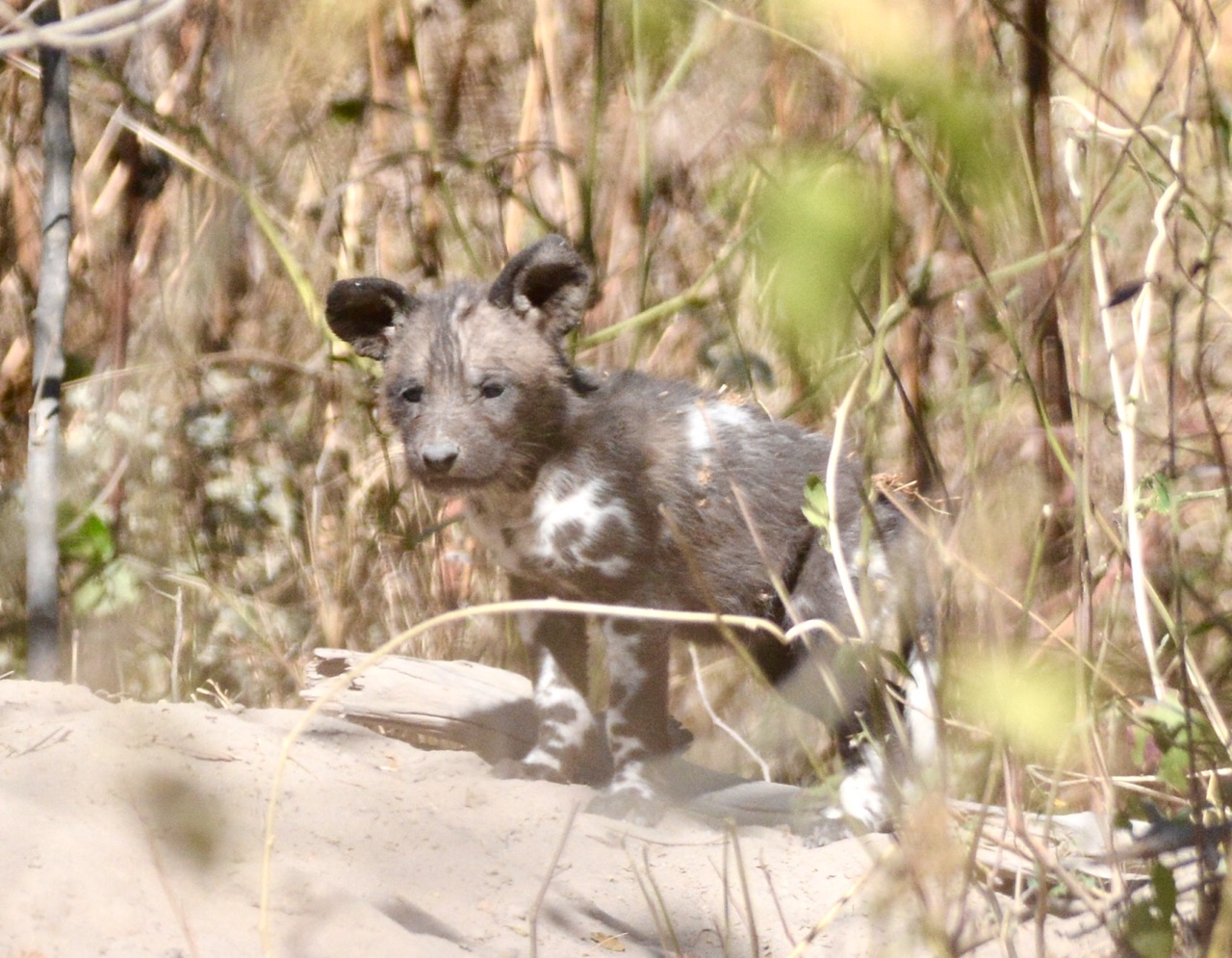
Not too much further on we came across five African wild dogs, sleeping in the shade, probably resting up before their evening hunt. Apparently they have pups nearby – we could see that the alpha female was nursing. We decided not to wait for the hunt – there was so much more to see.

We carried on, at times driving through moderately deep water and were completely bemused to see two lionesses up a tree. One was lying almost leopard like and looking quite comfortable. The other looked incredibly klutzy and uncomfortable sort of sitting on a forked branch with her hind legs dangling balancing herself on her front legs. We wondered how she would get down. We could see though that they had a great vantage point for surveying the surrounding area. Eventually the klutzy looking one manoeuvred herself, actually quite gracefully, down from the tree. After a few minutes she climbed back up again and found a much more comfortable looking spot. A troop of baboons came through the area and started their barking warning calls, looking quite agitated. Some even broke small branches off the tree they were sitting in in protest. A bit later the other one climbed down. I had heard about these lionesses the last time I was here but hadn’t seen them climbing. It was certainly an unusual and amusing sight.

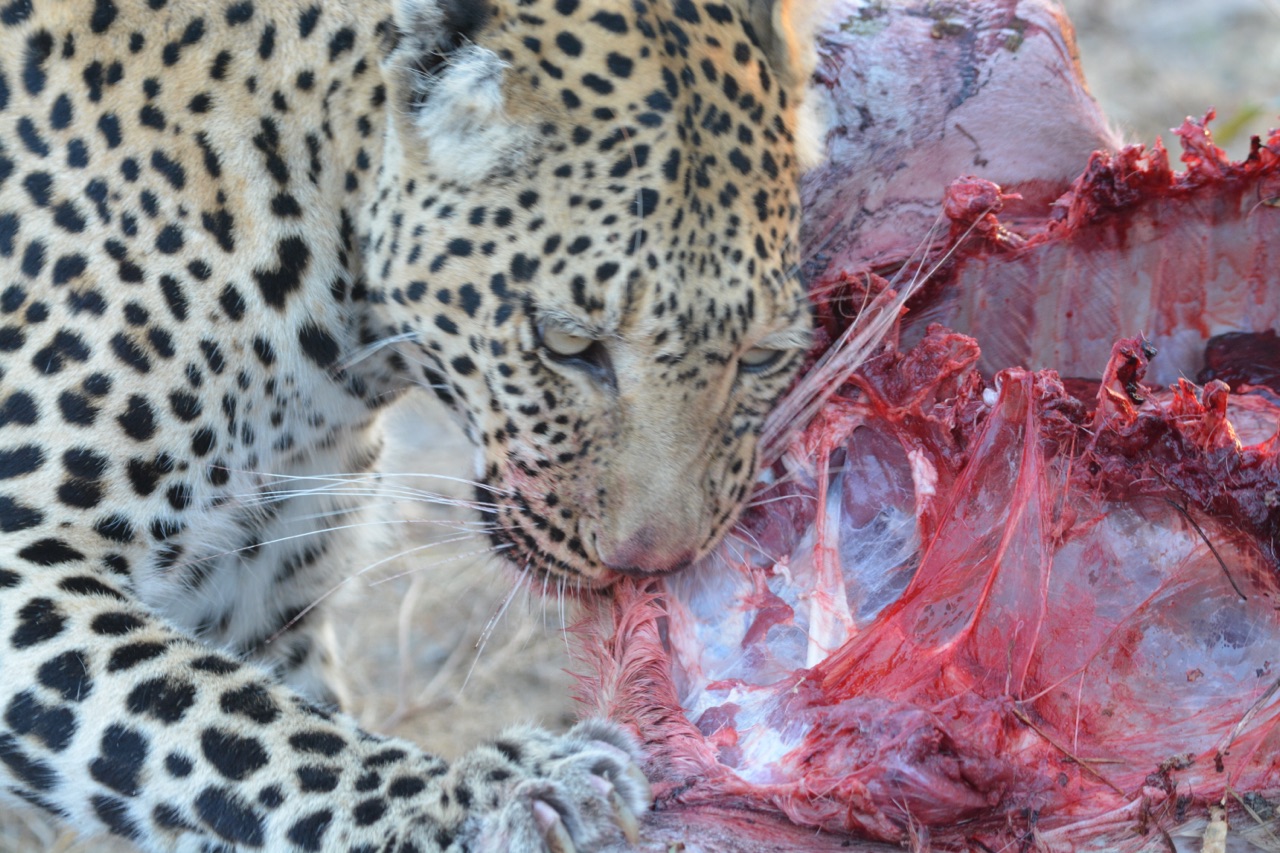
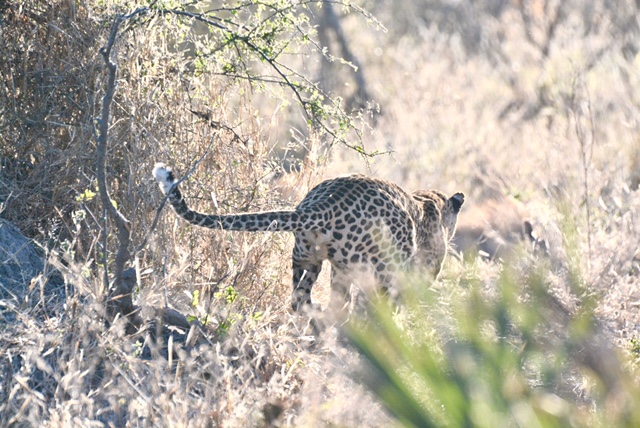
After driving through a few more large pools of water we came upon a small female leopard eating the remains of a baby red lechwe. It was starting to smell a little having been out in the sun since she killed it sometime early this morning or yesterday evening. After she had eaten enough she ripped up some of the nearby grass and covered the smelliest bits of the carcass with it to hide the scent from hyenas – it was amazing how much this reduced the smell.

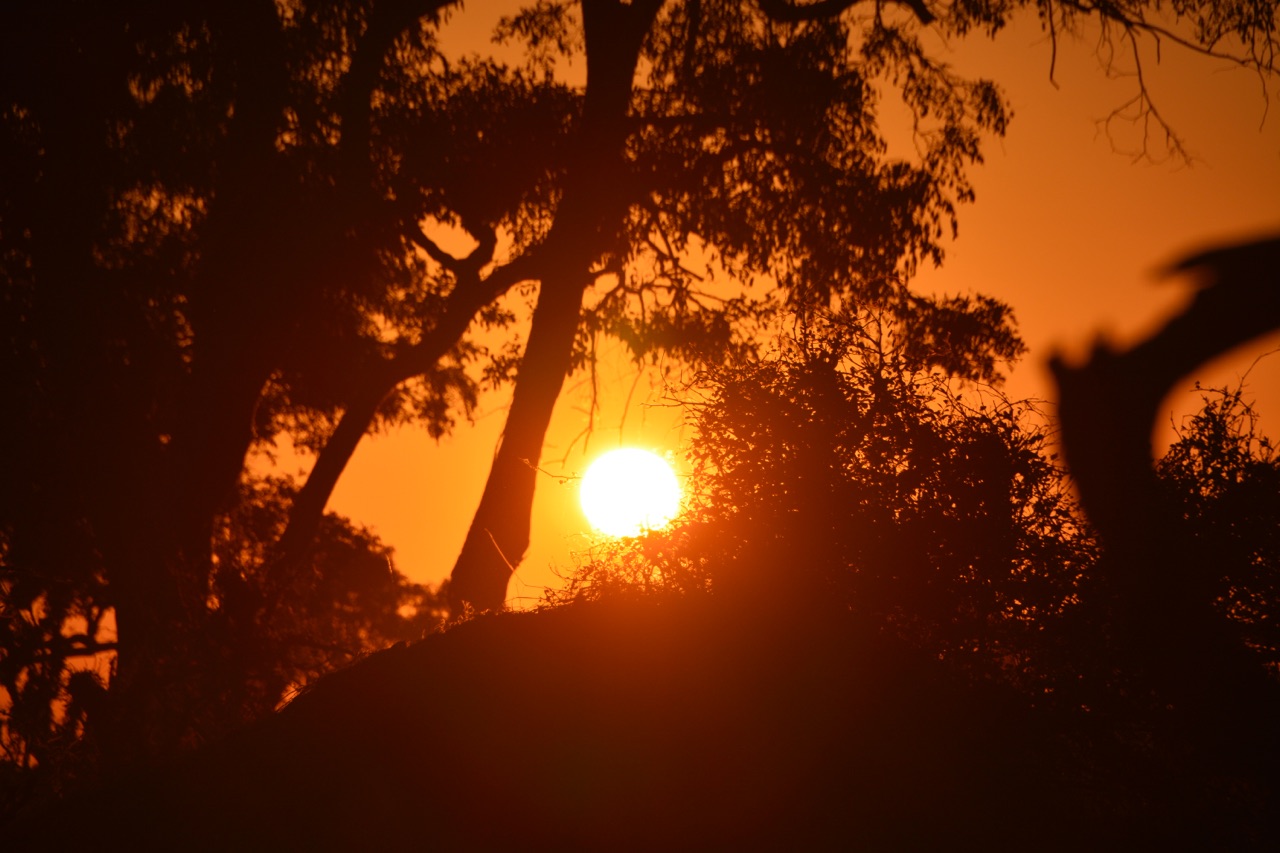
We headed back towards camp with another incredible African sunset setting the sky on fire. As it got darker Ron, our guide here, pulled out a spotlight and started using it to scan the area as we drove through. Other than numerous red lechwe, reedbuck, impala and the odd elephant, we saw a crocodile hunting frogs along the banks of one of the waterways and a porcupine scuttling between some trees.

Back in camp we enjoyed drinks around the fire under a clear, starlit sky while the painted reed frogs tinkled merrily in the reeds (one of the sounds I associate so clearly with this place) and the hippos grunted and grumbled while meandering along the edge of the water grazing.


Saturday 22 July 2017: Roger

We head out at seven am. Not far down the track we come across the wild dogs we had seen last night. Four of them are out hunting, it looks like the alpha female must have stayed with the cubs. We follow them back and forth through the scrub as they look for prey. Suddenly it’s all on, an impala the target. Ron, our guide, accelerates the landrover bouncing us at speed across the rough ground. A young bull elephant in musth we had spotted earler with, as Ron put it, “his fifth leg extended” gets a fright and charges alongside us. It’s all over pretty quick as the impala gets away.

We leave the dogs and head north into an area covered in mopane trees, which the elephants keep short by deliberately eating the tops, allowing a good supply of low level feed for their young.

First we spot a lion in waiting as his brother has the on-heat female in his company a few meters away. With a bit of luck the brother will doze off and the female will sneak away to give this guy a turn.

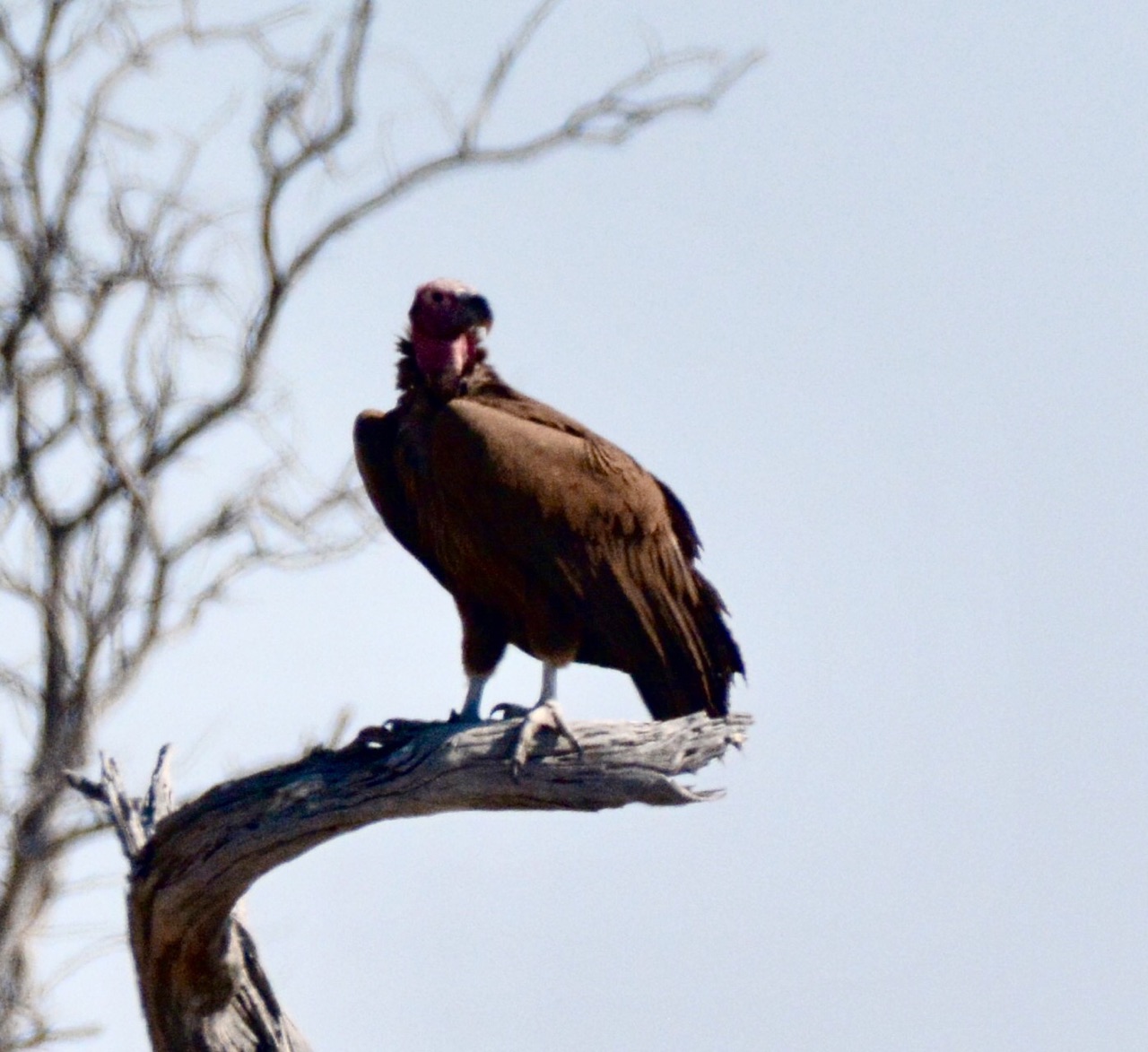
A large flock of vultures in the distance reveals the remains of a young giraffe, which must have died of natural causes as it had not been ripped apart by hyenas.

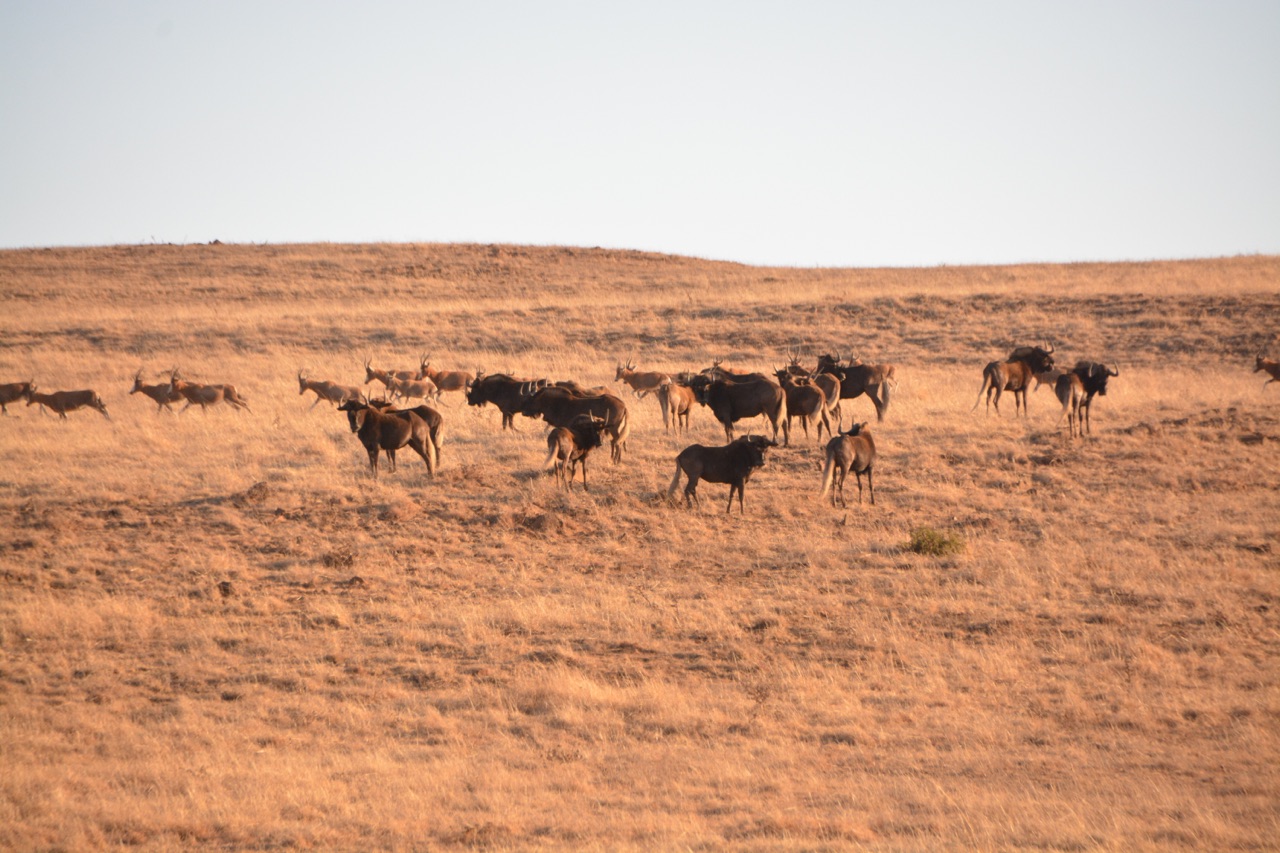
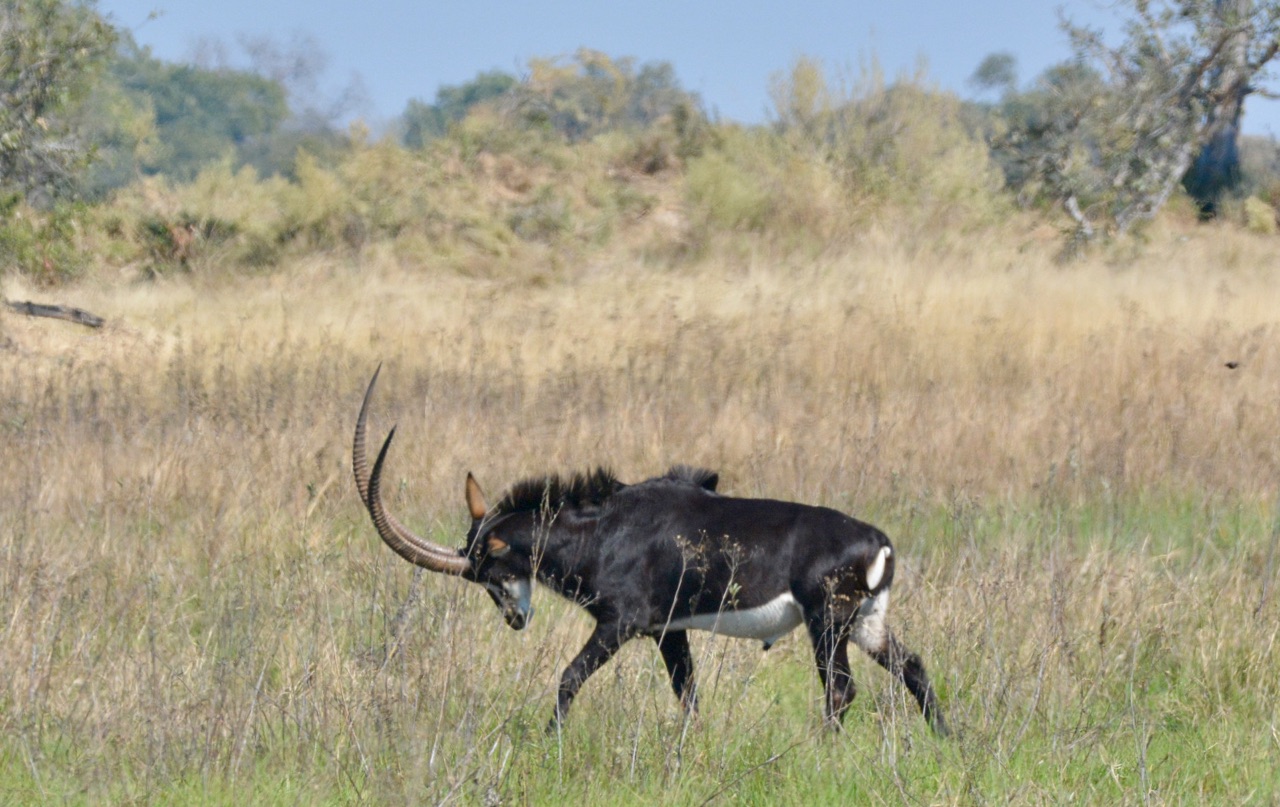
We drove on stopping by a pond for a brew as a few wildebeest graze near by. On the grassy plains nearby we spotted a heard of sable. Now nearly extinct, the hair from these was, for many years, used for making paint brushes. They were also hunted for their magnificent horns. These are another animal where both sexes grow horns.

A herd of elephants wandered past on their way to a watering hole. We drove over watching them refill. As they moved off a young female stomped her foot several times in the soft ground creating a mud bath. She proceeded to suck up and spray mud over herself until a larger one shoved her out of the way. This went on with even a young one having a go, spraying most of the mud around rather than on herself.

A couple of young warthogs looked on as we drove on.

We saw several more stunning birds

 Lilac breasted roller 

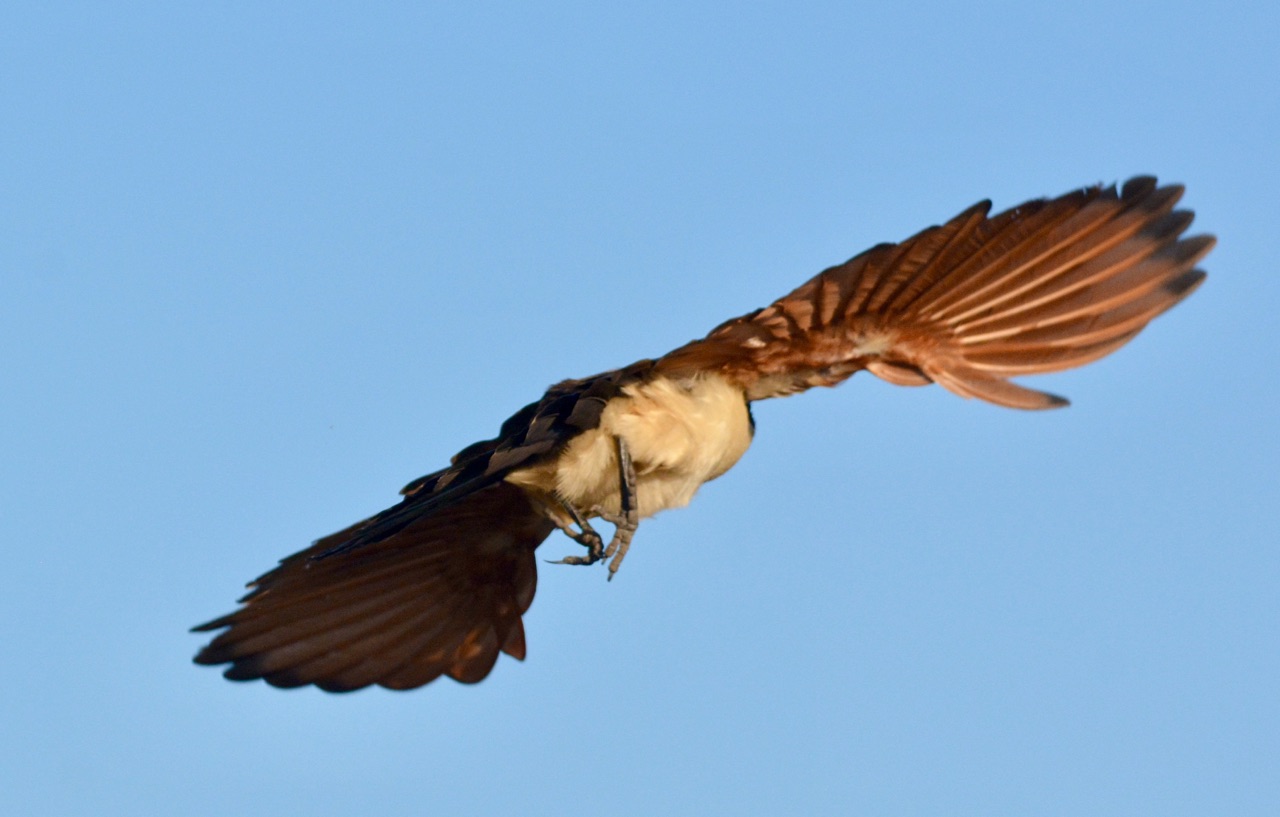
Coppery-tailed coucal

Sand Grouse

Wattled Crane

Blacksmith Lapwing

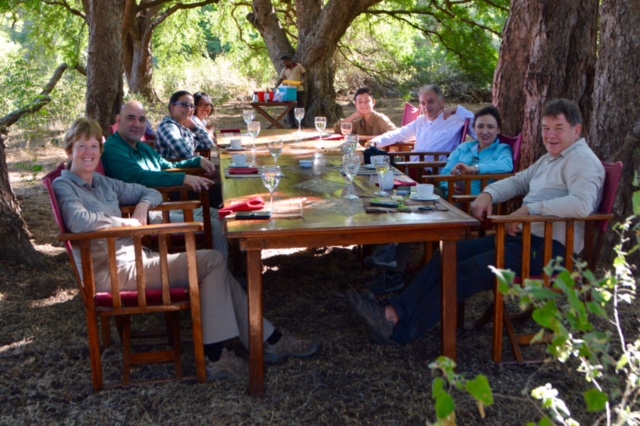
Heading back to camp we were ambushed by a Burbery bush lunch. We sat overlooking the wetlands while dining and drinking champagne.

Arriving back at the camp with its amazing views over the marshes, we were again barred from returning to our tents, this time by a bull elephant who made a false charge at Deb and Dave as they walked down the boardwalk to their tent. We withdrew to the dining area until he moved on.

At four we headed out again coming across a heard of some 600 buffalo grazing as they moved through the vegetation. Big bulls eyed us up as we looked on. Calves that become weak and linger at the back of the mob become lion tucker. Ox-peckers feed on the ticks and other insects that hitch a ride. Thousands of kilometres of buffalo fences have been built across Botswana to keep them away from farmed livestock as they carry both foot and mouth disease and anthrax.

We arrived at some wetlands and boarded mekoros to be poled through the still waters as the sun set.


Driving back to the camp in the dark Ron flashed his spotlight around looking for the red eyes of nocturnal predators.


Sunday 23 July: Sylvia

There was much excitement in camp this morning with all the guests sharing stories of the wonderful noises they had heard during the night. Apparently two bull hippos had a major altercation right near the camp and the male lions we had seen the other day were doing their usual nocturnal jaunt, roaring and marking their territory. I am not sure whether it was the hot sun, the long days catching up on me or the two G&T’s Roger plied me with (on top of champagne at lunch) but I slept soundly through it all.

We bundled up and headed out into the cool morning air and almost immediately came across a lone hippo walking down the road heading back to the water. They spend the nights grazing on land but are usually back in the water by the time we head out so it was great to see him ambling along.

It was definitely cooler this morning and we appreciated the wonderful hot water bottles we’ve had every morning to warm us on the drive even more than usual. The animals must have been feeling the cold too and been hiding in the bushes for warmth as there were very few about at first. The wild dogs were huddled in a heap acting as hot water bottles for each other. We did pass a few small, solitary steenbok hiding in the bushes.

Suddenly we spotted a familiar shape, reflected in a water hole – a maned, male lion, this one particularly blonde, raising his head to scan the surrounding area. Not too far away a male and a female were busy mating. He was waiting for the male to get tired so he could take over. Lion mating is quite a process. They mate over a period of several days at first every few minutes with the intervals between drawing out as they tire. Every now and then there may be a fight as another male from the pride comes in to take over. The actual mating itself lasts only a few seconds accompanied by a few grunts and a fair bit of the male biting the female on the shoulder. We were all well entertained by Roger’s running commentary! After one session the female rolled over with a roar and gave the male a good swat – “Jesus Christ! don’t get any ideas Sylvia”. There was at least a little tenderness between sessions as the male licked the female gently on the back a few times. At one point Dave declared “Roger James – relationship expert” based on the continuing amusing commentary.

This was more than could be said for the baboons we saw later in the morning. The troop were crossing a bridge and leaping through the shallow water to find a new spot to spend the day. One female had stopped at the end of the bridge and the male walked straight up to her, did his business with a fair bit of grunting and left. Again much hilarity and interesting commentary on board our vehicle.

We also found the small female leopard we had seen the other night with a kill, this time resting quite comfortably up a tall tree, and the large herd of buffalo we saw yesterday.

During our tea break Ron whipped out some maps, stuck them to the side of the vehicle and proceeded to explain the geography of the area to us. This delta is incredible with the water taking some six months to arrive here from Angola, eventually draining away into the Kalahari sand.

It was nice to get back into camp a bit earlier today, arriving about midday. Time for lunch, a quick walk down to North camp and back to stretch the legs and still time for a nice rest before the afternoon activities. Every other time I have been here this has been standard but is the first time all trip we’ve managed a really good midday siesta.

This afternoon things really went to the dogs – the wild ones that is. Very shortly after leaving camp we came across the pack of four on a hunt. The alpha female must have stayed behind with the pups. We bounced and twisted as we chased them through the bush, sometimes even sloshing through water. They travelled quite a long way but we eventually lost them in some thick bush.

We made our way slowly back to camp passing several elephants and a number of birds. As we got to the den area we saw the alpha female keeping watch and then had a real treat as the four very cute pups, now about 2 months old, came out to play. The mother kept chasing them back to the den, even nipping them a couple of times but every time she turned her back and headed out to keep watch they followed after her, running straight back to the den whenever she turned her head – just like naughty children everywhere.

Little Bee-eaters

Green Wood Hoopoe

Green Pigeon

Swallow-tail Bee-eater

Striped Kingfisher


We had arranged with Ron to have an earlier dinner and then head out for a night drive as this would be our last night here. We bounced along through the cold and dark and saw a few nocturnal animals like spring hares (a kangaroo-like rodent hopping along), an african wild cat, a civet, a scops owlet and a side-striped jackal. We also saw reedbuck, steenbok, elephants etc. as we got closer to camp we smelled the distinctive odour of buffalo and saw numerous green eyes glowing they way they do in the movies as we passed through the middle of the large herd we had seen earlier in the day.

Back in camp we were greeted with a cacophony of groans, moans and all manner of resonating sounds from a couple of mating hippos. Unlike the  and lions we had seen mating earlier in the day where it was all over in seconds, this went on for at least 30 minutes. It must have been mating day in the bush.


Monday 24 July: Sylvia

We packed our bags and headed out for our last game drive. It was fairly quiet at first as we made our way through the cold, revisiting the buffalo and sable we had seen previously. Then as we were heading towards the airstrip we came across a female leopard and her two cubs. The cubs, about 6 months old, had been spotted up a tree and on closer inspection the mother was found with a kill – most likely a reed buck – hidden deep within a nearby bush. We were entertained by their antics for some time before heading for the airstrip for our flight first to Maun and then on the Johannesburg. From there some continued on to NZ, Leonie headed to Tanzania, Roger headed off to meet up with a mate, Louie, who has a farm about three hours north and I headed back to Singapore for work.

Slender Mongoose

African Fish Eagle

Mombo Trails

Monday 17 July: Sylvia

It was great to catch up with my sister, Debbie, her husband, Dave, my niece, Joanna and my stepmum, Leonie, when we arrived in Johannesburg yesterday evening. After a few hassles – somehow I had booked and paid for 7 rooms instead of 3 – we enjoyed reconnecting over G&T’s and a snack.

This morning we met again for a leisurely (read very slow service) breakfast before walking the 50m or so across the road to check in for our Air Botswana flight to Maun. Once there we transferred to a Cessna Caravan for a quick flight across the Okavango Delta to our home for the next four days, Mombo camp. This has to be one of my favourite places in the world with impeccable service and outstanding wildlife. Wilderness Safaris have run the concession in this area for many years and most animals are completely used to the vehicles so we get to watch them up close acting completely naturally.

The old Mombo camp, where I have stayed several times before, is being completely rebuilt so this time we are at Mombo Trails, a temporary camp set up in the style of traditional old safari camps – no raised walkways, but fabulous tents and central areas all overlooking the flood plains with numerous plains game wandering around. We were met at the airstrip by our guide, Doc, and headed straight out for our game drive as no night drives are allowed in this area. Roger, Debbie, Dave and I have all experienced this before but for Joanna and Leonie it was all new. None of us were disappointed. We had already seen several elephants and giraffe from the air and almost around the first corner we came across a large dazzle of zebra. Then numerous giraffe as well as warthog, impala and several elephants.

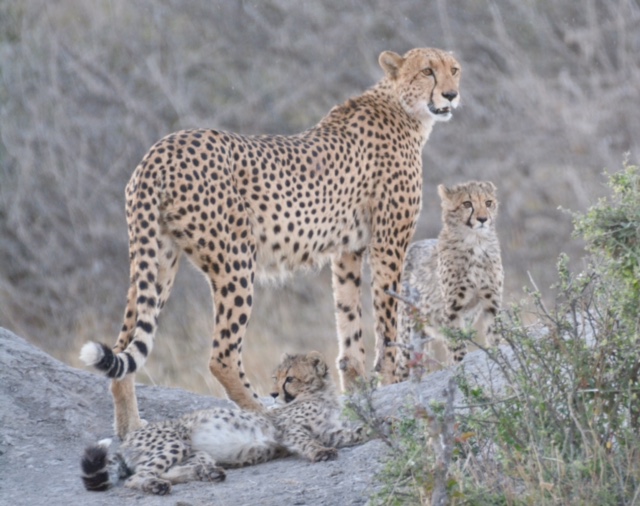
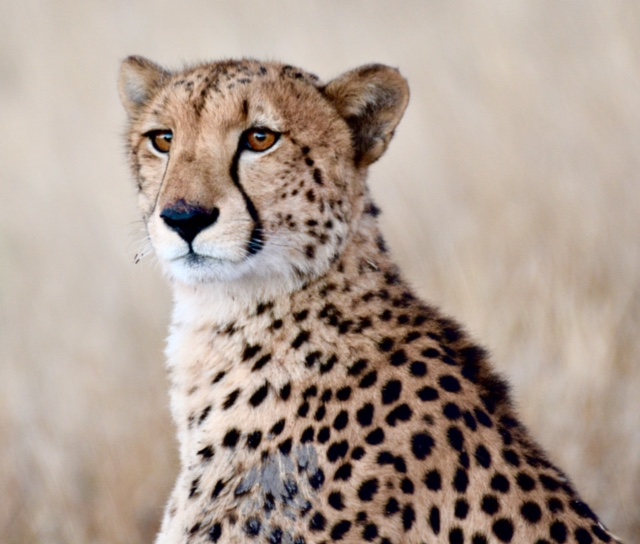
We had heard there was a mother cheetah with three cubs in the area that had made a kill in the morning so we headed out to look for them. As we got nearer the white-backed vultures started to swoop in – it looked like the cats were on the move. The reason soon became clear as we rounded a corner to see two large spotted hyena squabbling over what was left of the remains. They had obviously scared the cheetah away. But not far, we soon found them and spent some time following them in the glorious African sunset as they looked for a safe place to spend the night.

It was nearly dark as we headed back to camp, when we saw some more hyenas definitely on a mission. Then we heard the distinctive cries of hyenas in action and bounced off through the bush, ending up surrounded by hyenas as they crunched and cracked their way through a fresh impala carcass. We are not sure who did the killing, them or someone else, but they certainly made short work of the meal.

Arriving back in camp we were greeted with fresh G&T’s and then treated to some traditional song and dance before enjoying a fabulous dinner.


Tuesday 18 July 2017: Roger

At 6.30 we were were escorted to breakfast by our guide Doc. There are a number of ‘torch only armed’ security guards stationed along the track. In the tent there is a radio and an aerosol can with a horn on it to call for help should a friendly lion wander in to stay the night. Will, our table waiter, told us that recently an old deaf guy mistook this for mosquito spray. Guards and guides came running to the rescue. It’s not unusual to see lion foot prints in the sandy track leasing to the dining tent.

After breakfast we boarded the land-cruser heading east into the rising sun.

Only a few minutes from camp we run into a pretty calm bunch of elephants grazing on a rather thorny tree. A black backed jackal moved through the grass in the background. The elephant take only part of the bush and then move on to let the bush recover.

Just down the road we run into the Matata pride. The boss lion had been given a hiding the previous day by his brother, Stumpy, in order to steal a lioness from him. This pride lies around relaxing and sleeping only meters from us.

The car battery dies while we are in the middle of the pride, another vehicle gives us a push start and we head away from the pride. A vehicle with a new battery turns up and a change is made. Doc checks behind a bush so Debbie, escorted by Dave, could relieve herself. Just then a bunch of elephants come strolling through the bush; Sylvia points them out to Doc, who is busy helping with the battery. “Don’t worry, they’re my friends” he says.

We drive around and come across Stumpy (end of tail was removed by croc), who is giving his attention to his new conquest while two others try to sleep. Elephants wander past the lions not bothered by there presence.


We drive around looking at various animals that roam the delta. Impala,so well groomed with nice neat lines and colours, are in large and small mobs. The batchelor males hanging out together. I wonder what prompted Chev to come up with the name impala for such a large cumbersome car.


We see warthogs in a scuffle.

Tsessebee hang out in the shade.

Towers of giraffes wandered around often looking over tall bushes to watch what we were doing, their gait awkward as their right legs and then the left move together, giving the impression they are about to topple over.

We arrived back at the camp, passing a pond that was a few days ago a stream. Marabou storks and white pelican congregated to consume the trapped fish.

As we ate a lavish lunch hundreds of animals grazed on the grassy plains in front of the camp. After lunch we headed north along the east side of the plains by the camp, traveling alongside a river full of Nile crocodile, some sunbathing on the banks.

A large variety of game grazes on the plains, several in each group on alert for predators.

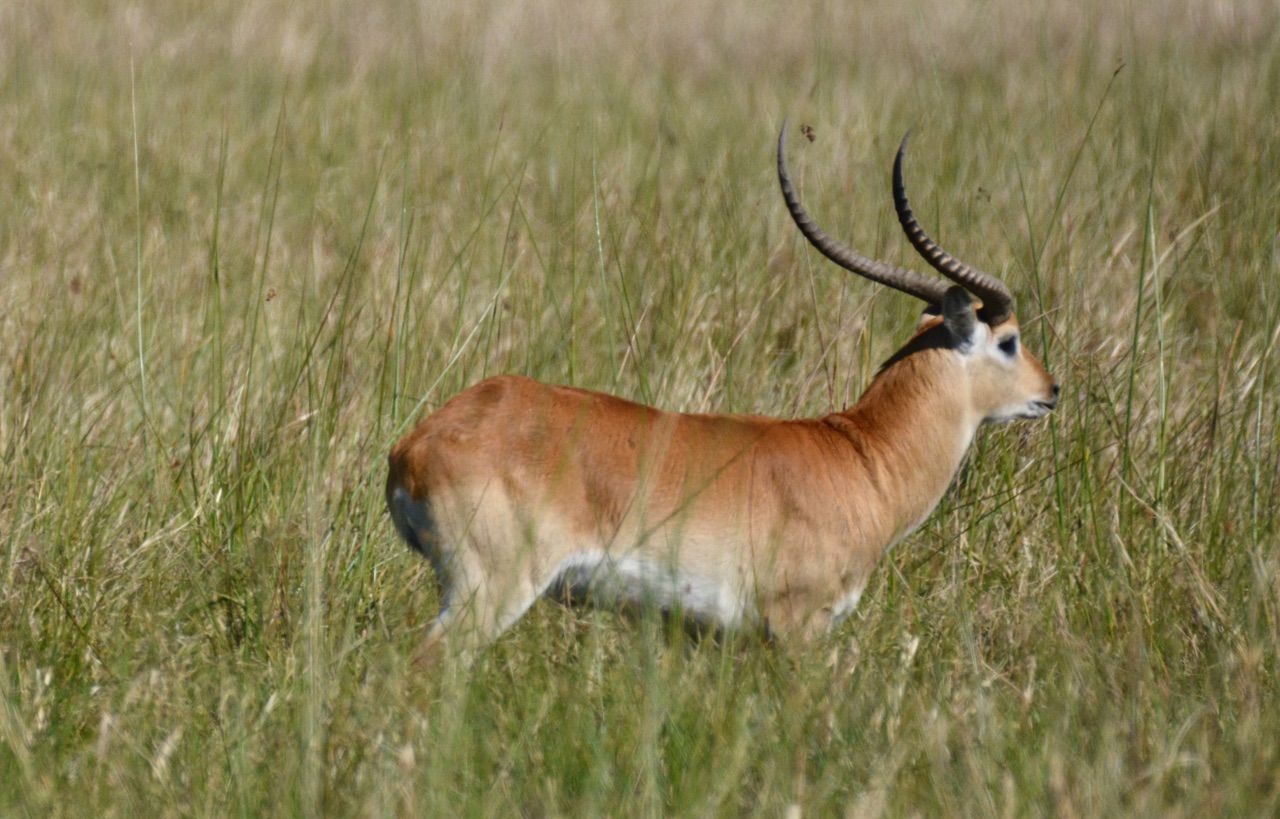
A red lechwe buck stands on an island debating the moment to cross in case a large crock is lying in wait.

Baboons hang out in the surrounding trees, young ones knocking off fruit for the older ones to pick up on the ground. Young ones ride on their mother’s backs like cowboys with high-backed saddles.

A pied kingfisher hovers above the water before adopting a strange shape to make a vertical dive on an unsuspecting fish.

Birds of prey soar overhead seeking their targets.

A magpie shrike darts from tree to tree feeding on insects

We can see our camp from the flats, the fancy tents standing out on the bush edge.

We get a call that Pula, a female leopard’s tracks have been spotted nearby. Not far south we spot the tracks on the sandy road. Driving through the scrub we find her chewing on a recently caught impala. She is totally oblivious to the vehicle, not even lifting her head to look as we pull up three meters away to watch her tear apart her prey. Soon she lifts her head and begins to drag the impala carcass towards a tree.

As the light fades, hyenas appear from the scrub and the leopard slinks off into the bush, leaving her catch to them. As the sun sets there is the sound of cracking and crunching as the hyenas consume the carcass bones and all. A marabou stalk watches over the proceedings as we drive back to the camp for dinner.


As we dine we hear lions making a kill a few hundred meters from the camp. This is soon replaced by the sound of hyenas laughing as they call the pack to take the prey from the lions. The guards are on full alert as we are escorted back to our tents. Apparently it works like this. If they spot the red eyes of a lion keep the light on its eyes so its night vision is blinded and it will retreat into the darkness. These guys seem to know what they are about as no one has been injured in these camps by wild game in the past twenty plus years.


Wednesday 19 July: Sylvia

It was not quite so cold this morning as we headed back out for another adventure. We headed north out of the camp and had only gone a few metres when we came across a small group of kudu and impala running and leaping over a termite mound. With the sun rising behind them they looked quite spectacular – as Debbie put it, “it almost looks like the cow jumping over the moon!”

We also spotted a tiny baby giraffe and, not far away, a lone hyena sniffing out the area as he headed home to sleep for the day, passing mere inches from the front of the land cruiser on his way.

Around the corner was a huge herd of zebra with the odd impala scattered in for good measure. As we continued we spotted large dust clouds, which on closer inspection turned out to be huge flocks of red-billed quelea flying in formation as they fed on seeds from the ground. They were a truly impressive sight, particularly with the sun catching them and made a fairly impressive sound as well.

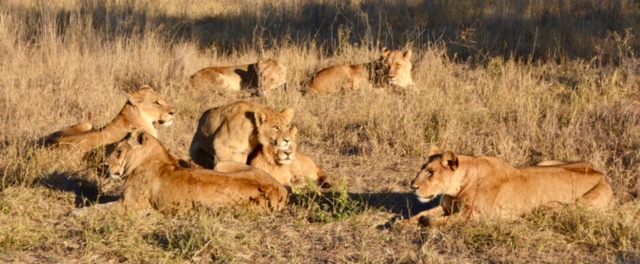
Next we stopped to watch a large troop of baboon playing and grooming each other, small ones riding piggy-back on their mothers. They started making their distinctive, barking alarm calls and we spotted the Moporota pride, a very healthy looking pride of six female and one stunning male lion and two cubs, wandering across the flood plain looking for somewhere to settle down for the day. The male, named Bankara which means big, is a particularly impressive specimen with a huge, thick mane and no scars on his face. They were sleeping in the sun and we were hoping to find rhino or cheetah so we didn’t linger too long.

We drove on passing a number of the usual suspects and then stopped to enjoy morning tea beside a hippo pool, to a chorus of wonderful grunts and groans. It is always great to stretch our legs and get off the vehicle for a bit. The hippo like to grunt and yawn and show us how big and menacing they are. There was also a lot of wonderful bird life by the pool, including my favourite, the malachite kingfisher, and some saddle-billed storks.

We decided to go and check out the cheetah and cubs we had seen a few days ago and as they were up and hunting spent some time following them. The cubs were very cute, pouncing on each other and playing, just like you would expect kittens to. As it got later Doc said that they had set up a surprise bush lunch for us but as the cheetah were still hunting he suggested we could ask them to bring the lunch to us instead. We all agreed and about 45 minutes later, just when the cheetah were laying down for a rest, Sepho, another guide, showed up with a delicious lunch which we ate in the shade of a large acacia tree.

We stayed with the cheetah all afternoon but unfortunately there was very little prey around. Mombo is an amazing place. There are usually impala around every corner but this day they were all in hiding. The poor cheetah had to go to bed hungry.

As it got dark we headed back towards camp, enjoying another magnificent sunset and spotting a side-striped jackal along the way. As we rounded a bend Doc stopped the vehicle and we were all thrilled to spot a black rhino – it was nearly dark but still great to see before it turned around and headed back to the bush.

Back at camp we enjoyed another fantastic meal, with the sounds of the bush resonating in the background – lions roaring, baboon barking and … just as our meal was finishing we heard, very close to camp, hyena squabbling, which could only mean one thing – fresh meat. Yompe, one of the other guides headed out in the land rover and came back to report that they were fighting over an impala – we are not sure if they killed it or stole it off the lions we had heard. Needless to say, there was no way Debbie was walking to the tent so we all piled on the back of a golf cart and were driven to our rooms in style.


Thursday 20 July 2017: Roger

We head out under the clear blue sky. It’s winter here which means it never rains; we haven’t even seen a cloud. Just outside the camp we come across a few lions from the maporota pride we had seen yesterday. We spot the male heading down the plains to collect his pride as they were too close to the border of another pride. The somewhat disobedient females took a while to obey before eventually heading north.

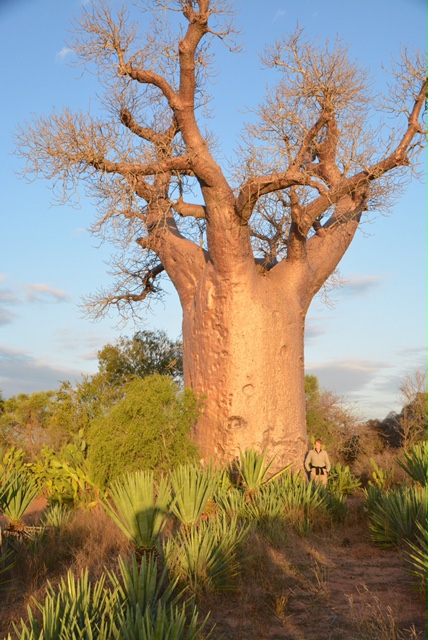
We headed south in search of the wild dogs. Along the way we stopped by a large baobab tree. Sylvia mentions the large baobab tree we had seen in the Kalahari Desert a couple of years ago. Doc said that was the area where he was brought up. Unfortunately the tree has now fallen down. He and his brother used to put wooden spikes in and climb and play in the top, much to the concern of his parents – not surprisingly as it was 40 odd meters high. One night when his father was away at the markets his uncle took them to the tree to let them hear the ghost that lived in the tree. They were laughing in disbelief until when approaching the tree a voice came out of the tree “I am the ghost of the tree! If you children ever come and climb me again something really bad will happen to you” In spite of being ridiculed at school they never climbed the tree again. It was not until they were in there twenties that their father finally owned up to being the ghost that night.

Moving on we spotted a few different birds. A “go-away” bird or grey lowry, alerts game of approaching danger.

Impala show off their jumping skills.

Sand grouse blend into the grass to avoid the birds of prey.

A swallow-tailed bee-eater takes flight as we pass.

Bateleur and African Hawk-eagles soar overhead looking for prey

As we head south to the dogs we run across what appears to be a giraffe kindergarten. About eight young giraffe have been left with a couple of adults while the others have gone off to feed.

A little further down the track we run across Stumpy, a large bull elephant. Yes, you guessed it, a crocodile got the end of his tail. I had visions of a croc flying through the air with the end of a tail streaming from its mouth.

Doc stops in Stumpy’s path; he walks almost right up to the vehicle before stepping back and walking around. “Don’t worry” says Doc, “he is my friend”. He then goes on to explain how hunted elephants have been known to beat people to death with a stick and then bury or throw logs on top of them. Stumpy, clearly quite relaxed around us and about 50 years old, has a trainee teenager about 14 with him teaching him the trade. He continues feeding as though we are not even there as do the rest of the animals around here. He reaches high into the tree, stripping the leaves from selected branches, somehow holding them and placing them into his mouth spilling few. His large molars are visible as he reaches up.

A little further down the track two teenage bulls shield and direct their little sister towards their mum as we approach. She takes a drink as mum looks at us, ears flapping. Doc stops the vehicle but leaves the engine running. Normally he switches it off so we can take better pictures. These ones are not so relaxed. Her trunk rises with a loud trumpet and we drive slowly off finding the rest of the family just around the corner on the other side of the track. A young bull trumpets as we drive on. I think our invisibility shield must have dropped on that occasion.

We arrive at the lair where the wild dogs are hiding the pups. The 17 or so dogs are lying around on sentry duty, protecting the area. They soon the get up and become alert as one of the pups appears briefly outside the hole. There is an alpha father and mother; the rest of the pack are just in support for the raising of the pups.

We head up a different track on the way home, barred at the river crossing as a bull elephant takes in his daily intake of around 200 litres of water. This is quite a long process as he blows bubbles at the end to clean his trunk and washes out his mouth before curling his trunk around his tusks as he moves away just to let us know who is in charge. A vehicle from another camp who has also been waiting crosses towards us.

Soon we stop at a pond occupied by a lone loser hippo, a male that has lost and been driven from the pod by a tougher male.

On the way back to camp we see more came and bird life.

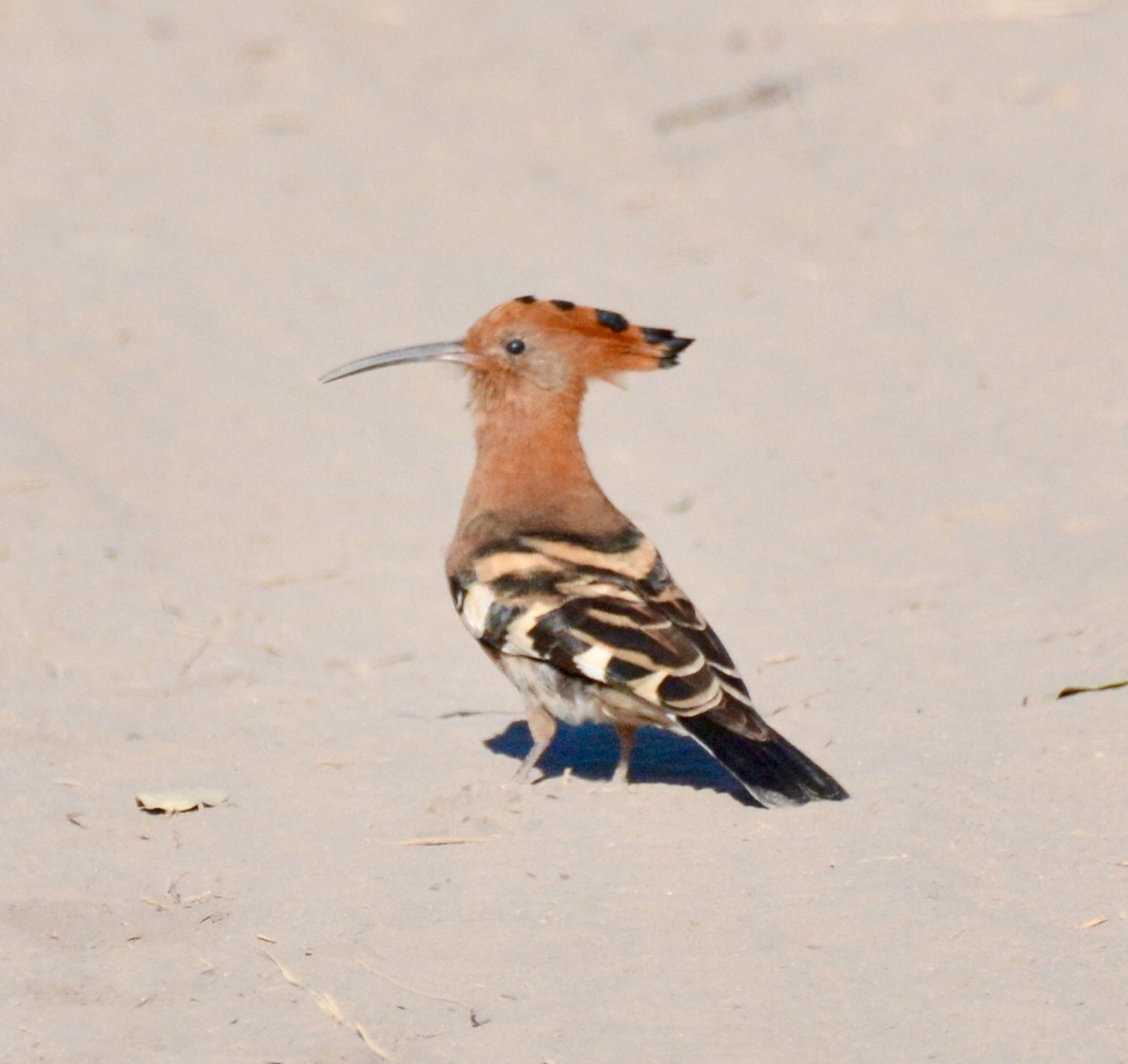
African Hoopoe

Wattled Plover

A large male ostrich grazes the plains while mum sits on the eggs. They swap over at night, when his black feathers will provide better camouflage.

A kori bustard, the national bird, is soon spotted. Now protected, these are the world’s heaviest flying bird, easily hunted as they need a runway to take off. 

We arrive back late again for lunch. Doc is far more interested in showing us stuff than watching the clock – he is a great guide.

After lunch we head south west spotting first banded mongoose, then some vervet monkeys.

We then get a call that Blue-eyes, a large male leopard is hunting nearby. As we approach he is in full hunting mode, crouched by a termite mound. Less than a hundred-metres away a group of impala stand under a tree separated only by some thick scrub. As Blue-eyes starts his stalk a go-away bird sparks up as do some helmeted guinea fowl perched in a tree above.

Their warning calls alert the impala who snort and retreat. Blue-eyes moves back and lays on the termite mound.

Suddenly he is alert as a family of warthogs return to their burrow on the other side of the mound. Blue-eyes leaps across trying to take a young one. There is a cloud of dust but no catch. A confused young warthog appears in front of us looking shocked.

After the failed attack Blue-eyes lay around the mound for a while before moving south’ marking his territory along the way. As he passed the odd snorting impala along the way he would raise his tail to let them know he was not hunting just now.

Madagascar 2: Dirt is just dirt

Tuesday 11 July 2017: Sylvia

I am somewhat conflicted staying in this place. Even more so than in many others I feel a burden of privilege. The locals live in small villages dotted around the area and earn approximately US$1 per day working in the fields or in the sisal factory. They live as subsistence farmers, the majority without electricity and none with running or clean water, growing crops along the riverside. The young boys look after the goats or zebu, herding them along the roads during the day. The young girls often carry water or other loads on their heads. Whilst they seem happy and the kids come running to smile, wave and say hello or bye-bye and get their photos taken as we drive through the villages I am acutely aware of the differences in our lives as I watch them fetching water from the river – the same place they bathe and do their laundry and wash their cows and …. I wonder what they must think of us as we sit on our kayaks and get pulled across the river by strong young men – these strange white people who can’t even walk across the river on their own.

We slept well last night in our comfortable  tent and after a light breakfast headed off with Alberto past the sisal factory (you can’t look inside anymore as they got too many complaints about the working conditions!!!) and through the sisal fields back to the river, where we crossed over to a different sacred forest – this time an ancient rather than current burial ground and a canopy or gallery forest rather than a spiny one.


The forest is really interesting, largely a mix of acacia and tamarind trees with several large banyan trees and vines. Our goal this morning was to find the two species of diurnal lemur endemic in this area, the famous ring-tailed lemur and veraux sifaka, otherwise known as the dancing lemur because they do not walk on the ground but kind of leap sideways.

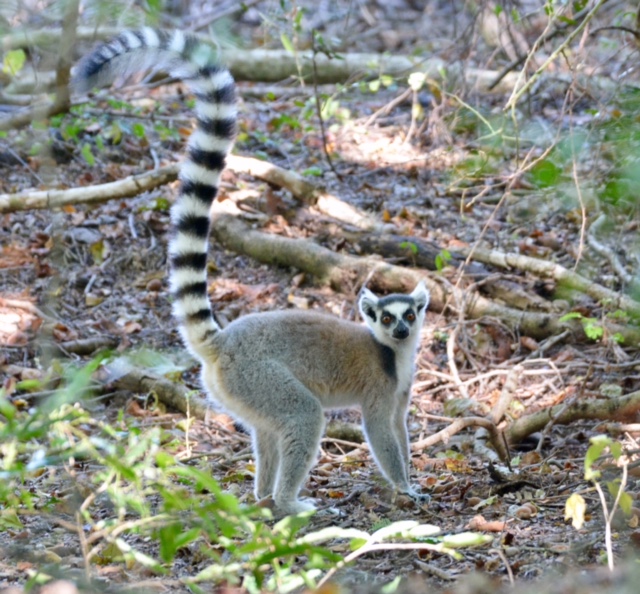
We were not long in the forest when we came across our first group of ring-tailed lemurs. These not-shy animals live in groups of twenty-thirty and spend 40% of their time foraging on the ground. They are really beautiful with their striped tails and large eyes. We saw several groups during the morning including some munching happily on cactus leaves, which they break off and hold in their hands to eat.

We also saw several much smaller groups of veraux sifaka, including a couple on the ground who treated us with a fantastic display of their dancing. This is apparently quite unusual at this time of the year as they tend to prefer to stay up in the trees more until the middle of winter. They are striking white animals with black faces and hands.

In what seemed like no time it was time to leave the sacred forest – probably just as well as Roger struggled to remember not to point and didn’t really want to have to sacrifice a zebu as atonement. It was a short thirty minute drive back to camp, passing through villages of waving, smiling children, and passing herds of goats, zebu and even turkeys.


We enjoyed another delicious lunch (the food here is incredibly good – as is the service, a very pleasant change after Andisibe) outside under three towering acacia trees. We were joined by a well-travelled Columbian family and enjoyed sharing stories of our different travels.

As we rested during the afternoon we could hear the children laughing and splashing in the river nearby. At one point a large group of kids came past fishing for the tiny fish in the river using old mosquito nets. There are heaps of kids everywhere here – they marry young, often around 15/16 and will start having children straight away. Apparently many of the marriages are arranged. The divorce rate is high and polygamy is still practised in some areas of the country.

Later in the afternoon we headed back out with Alberto to visit a community spiny forest. I remain quite intrigued by this unique and unusual forest with its eleven species of octopus trees and various different species of euphorbia. I fear for its future though – we see a few large octopus trees that are apparently about 80 years old. They are about the right size for the locals to cut down to make planks to build their houses – unfortunately the houses only last 6-7 years before the termites get them – there is definitely something wrong with this equation.

We watched a family of veraux sifaka bed themselves down in a prickly octopus tree for the evening and as it got dark searched for the three species of nocturnal lemur found here – not so successful this time; we only spied a couple of sportive lemurs way in the distance, eyes shining brightly in the torchlight. The two species of mouse lemurs proved to be elusive.


Wednesday 12 July 2017: Roger

At 8am we are back in the Landrover heading out the rough track to the spiny forest we visited last night. Incidentally the only vehicles that work in this country are Landrovers or Toyotas . Theo told us at dinner on the first night that they brought some Nissans but after just eighteen months they were wrecked.

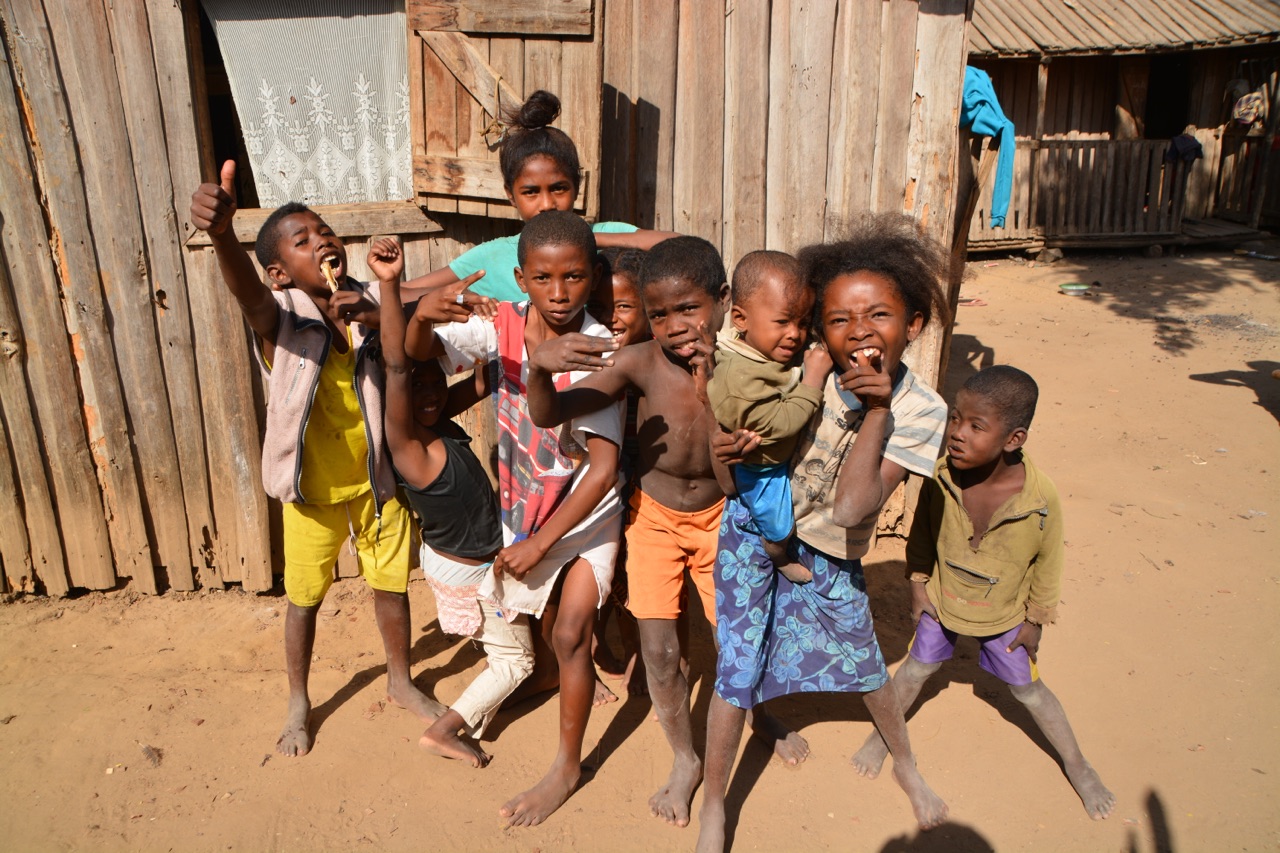
A bunch of kids were taking the family goats out for their daily feed. I jumped out to take a photo. The kids lined up to excitedly to get the picture taken. With excitement they looked at the back of the camera jabbering away and pointing at each other.

The track is lined with large cactus plants beyond which are paddocks, the cactus serving as an impregnable fence.

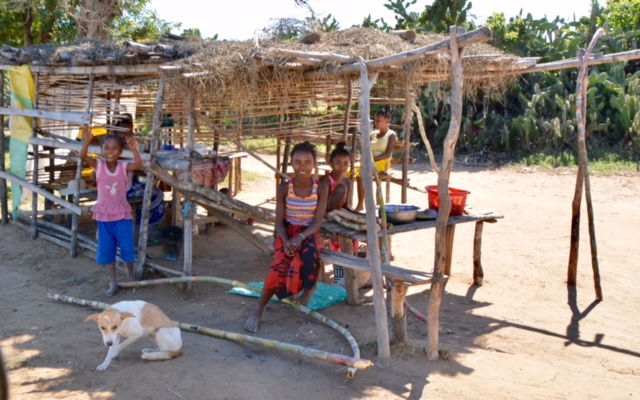
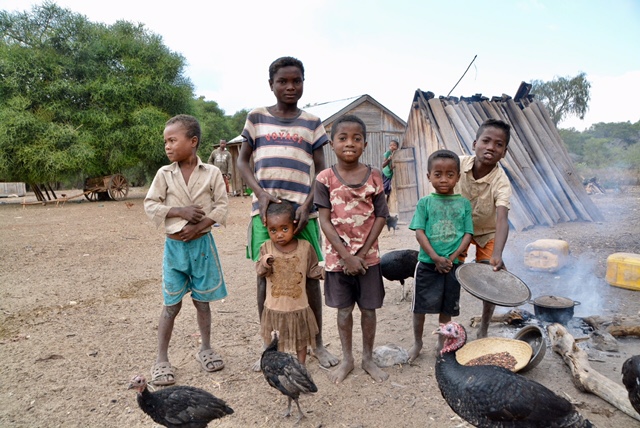
Arriving at the start point there is a shack housing a large family. Several kms from the river, from which water has to be carried, the grubby kids and a few turkeys gather around to have their pictures taken.

Heading into the spiny non sacred forest we spot a dancing (veraux sifaka) lemur with a baby in her lap high up in a spiky octopus tree.

Others are feeding in nearby trees leaping several meters from meal to meal, landing feet first, their tough feet oblivious to the sharp spines.

This forest is definitely not pretty but interesting with its eleven varieties of octopus and other spiky trees. Apart from a couple of rare, poisonous spiders there are no dangerous animals in Madagascar; even the snakes (mainly constrictors) won’t kill you.

A little further down the track two lemurs that we saw last night have been joined by a third still sleeping on the same branch.

Next stop was the main village on the river bank. We dismounted checking out the local solar power plant and the market area. People come here on Thursdays and Saturdays to sell their produce.

We stop in at a local family home walled off by a palisade fence. The main house is being attacked by termites. Interestingly these houses or huts are made from octopus trees which at felling time are eighty years old. They need to be replaced every seven years, probably part of the reason for the massive deforestation that has taken place in the country over the past two thousand years. This small compound contains in the big hut grandparents and parents, in the smaller huts the children and their children.

Each family has four or five children here as a form of both labour and superannuation as the children have to take care of elderly parents. A hint maybe to my daughters “Victoria and Kirstie”. The kids gather around eagerly to have their picture taken. One young boy about 10 is wearing a long baggy t-shirt which he is holding away from his body. Tt turns out the poor little bugger has just been circumcised; a tradition here for ten year olds.

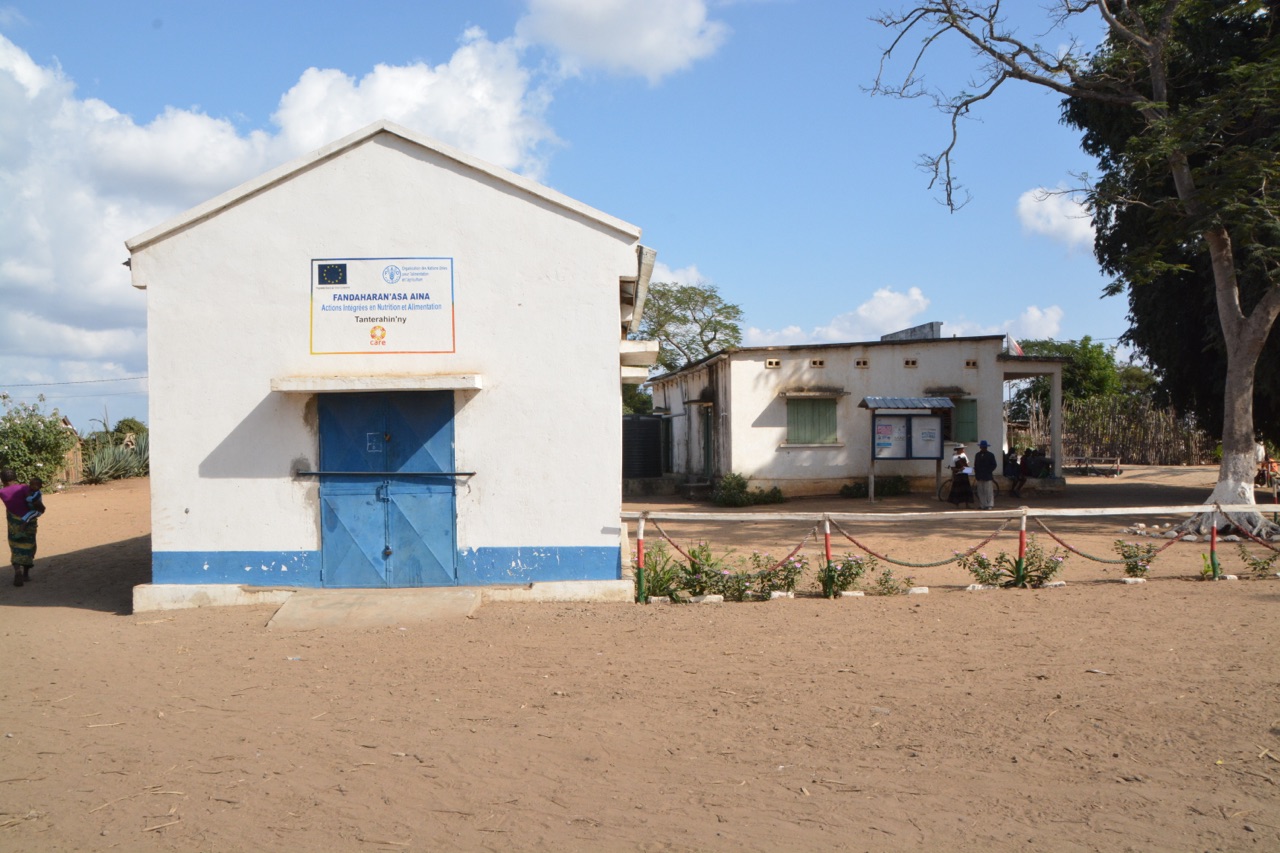
The village of about a thousand people has a primary and high school. There is a mayor’s office and aid station. Lots of people are gathered around the mayor’s office. A group of aid workers sit on the side of the road giving out money to mums with kids. They used to give out milk powder and baby food but the mums used to sell it to get money so now they just give money.

A visit to another not so fortunate family reveals tatami type mats on the floor, black with dirt. They sit proudly on the porch as I take their picture.

At the centre of town is the main shopping area with produce and second hand clothing for sale. A girl pumps water at the village well as dozens of people wander about buying their daily provisions. Lots of people gather to get their pictures taken smiling and pointing with excitement as they see themselves on the camera screen. The road through the village is concrete and there is street lighting; one building has a satellite dish and the odd house electric lights.

The woman here all have great postures, many one sees away from the village have a baby strapped to their back and a large load on their head moving as though they are unladen.

There are many little stalls at the front of houses where people prepare and sell food and other produce.

Later in the afternoon we took a drive out to a bunch of Baobab trees. The little mobile bar had been set up for us to enjoy a G&T while we watched the sun go down.


After the sun had set we hear the beat of a drum and three spear wielding warriors appear from the the dark, followed by a bunch of women. The entertained us with some custom dances.


Drinks over, we headed back to Mandrare River Camp for dinner with a great  family from Colombia. Theo and Zizi also joined us. Marcela, her husband-to-be-one-day Max, her son Thomas and brother Mauricio are passing through on their way to Kenya. We had a great time with them over both lunches and dinners.


Thursday 13 July 2017: Sylvia

We had a leisurely start this morning leaving camp at 9am to head back to the airstrip where Martin had the plane ready for our departure. We flew first 30 minutes south to Fort Dauphin to refuel, flying over large patches of planted land and small villages. As we neared For Dauphin and the coast many small fishing villages had set lines laid out and people dragging nets in the shallow water. Apparently there are plenty of fish in this area.

After refuelling we headed north for the two-and-a-half hour flight back to Tana. Another drive through this chaotic and colourful city and we arrived at our hotel for the night, Maison Gallieni. Perched high on the hill, it is a magnificent old brick building that once used to be the bank, and boasts incredible views over the city. It also houses the embassy of Monaco. It is a very small boutique hotel with beautiful rooms and friendly service. We were the only guests for the night and they served us dinner in a stunning dining room filled with many interesting artefacts and pieces of art. In stark contrast to the beautiful hotel, outside our window scores of young women did their laundry by hand, with water they carted themselves to the local “laundry bench”, while we spent most of the afternoon inside catching up on our emails.


Friday 14 July 2017: Roger

At 0615 we were picked up from the Maison Gallieni Hotel and driven across town to the office of the air charter company. Even at that time there were lots of people about. Apparently after 7am the city becomes gridlocked.

Around 8am we were driven the short distance to the airport where we boarded a Piper Aero 28, soon airborne and heading north 400 nautical miles to Antsiranana. The first part of the journey there are lots of rice fields terraced into the hills. An hour or so north we strike rolling country with no sign of tracks or roads.

In spite of there being no sign of life larger areas have been burnt off as though encouraging new grass growth for stock; some parts are still burning. We were unable to establish if they actually run stock out here. Another person said the burning happens because they have always done it. Most of the trees near inhabitated areas have been felled to make charcoal with which they cook.
In some areas up north an NGO has planted large areas of fast growing eucalyptus trees to supply fuel and try to save what few few indigenous trees that remain. With a mortality rate amongst children exceeding 12 percent (interestingly our last make-it-up-as-you-go guide told us it was under 1%) some electricity, water and sanitation would certainly not just save what trees are left but dramatically improve the health of the population.

Many large rivers run both east and west, most with small villages dotted along their banks servicing the rice fields.

There are no signs of roads or tracks – I presume they carry their crops to the east or west many miles to a track or road. There are only two actual roads in the north, one on each side of the island. Apparently the one on the east is not negotiable in places.

Three and a half hours later we come into land with the pilot muttering and cursing as he fights the rough air into a 30 plus knot head wind. We are picked up by our guide and a driver and head south down the main road. By the state of it I would be surprised if any money has been spent on it since the French left.

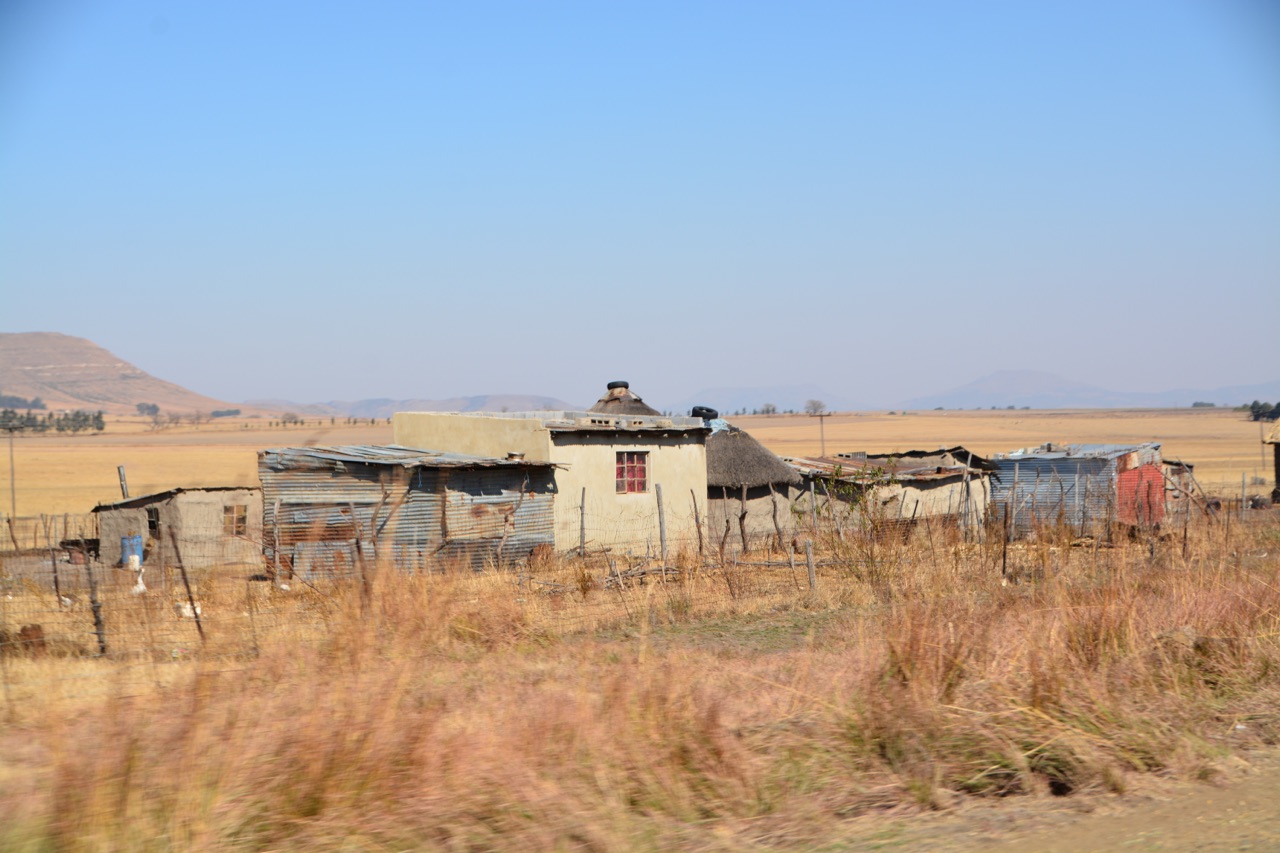
We often drive with one wheel off the road or on the other side to avoid the huge ruts and pot holes. The road is lined with small villages consisting of small shacks, many made of wood, others of rusting corrugated iron. They are surrounded by dirt and rubbish, the people look dirty and few look happy.

People sit by their roadside stalls selling whatever they can including plastic bottles are full of spices and herbs.

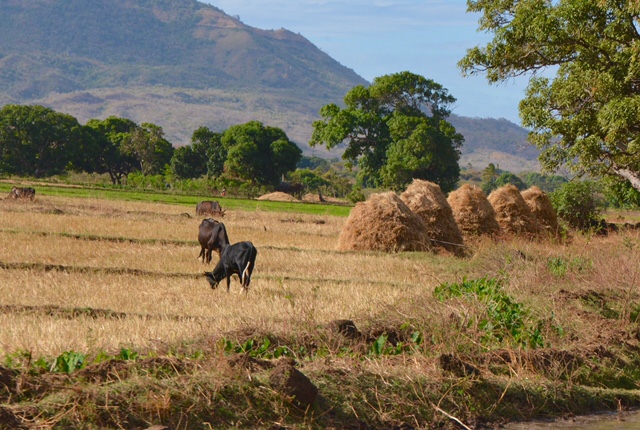
In places woman sit in the field threshing the rice by hand. It is harvested by hand and stacked in piles in the paddock to dry.

From planting to harvesting it takes two months. If there is a good water supply several crops can be harvested in a year. Zebu are used to cultivate the ground.

It’s hard to know what has happened here. It’s almost like time has stood still for the last two thousand years.  They live to exist; there is no want to to improve living standards. They don’t have power or running water, they still go and shit in the paddock, they are washing clothes in a muddy puddle.

Talking later to Herve who owns the lovely place we stayed, he explained that the people around here are really lazy and do just enough to survive. The men sit around most of the day chewing Katy, a kind of drug in a tree leaf it is supposed to make them strong and energised.

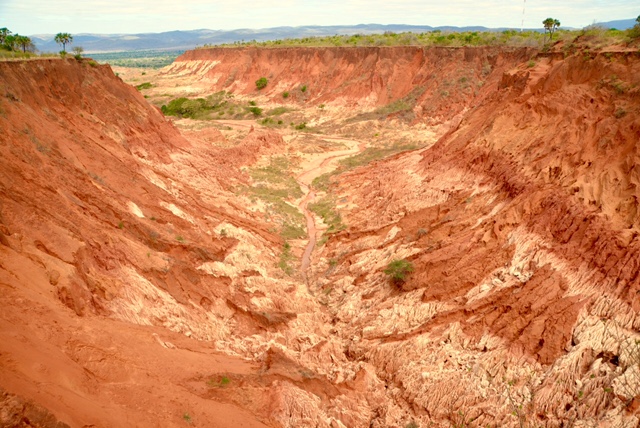
We traveled south for nearly an hour, eventually turning up a track made of red clay.  After 16kms of ruts and bumps we arrived at the Red Tsingy. This is a large washout that has exposed these Tsingy made up of a combination of laterite and other minerals.

We head back north passing again the villages. Bush taxis are the main form of public transport here. The cram everything they can in and on the vehicle.

We turn west and head up another rough, but sealed in places, road leading to the town of Joffreville, once an immaculate French military leave centre, now a run down shambles to blend in with the way the live around here. We arrive at The Litchi Tree hotel.

Run by Herve, who moved here from France 12 years ago and bought what was once the French commander’s house left to rack and ruin. He did a marvellous job of restoring it, even building his own furniture, and now with the help of Madiba, his eight year old adopted daughter runs by far the best accomodation we have experienced here.


Saturday 15 July: Sylvia

After a delicious breakfast served by our French host (the best pain au chocolat I’ve had outside of France) we were picked up for the short drive to Amber Mountain Forest Park. This is said to be primary forest but there are a large number of introduced species and in places the trees are planted in straight rows. It is stunning forest nonetheless.

We stopped along the way for our guide to point out some of the 1100 species of medicinal plants here. At one point she brought over a distinctive purple flower and tried in broken English to explain “mmmm it is kind of mmmm like a particular mmm organ of a woman”. From the glint in Roger’s eye I don’t think he needed the explanation. Apparently it is very good for all sorts of women’s problems and also for high blood pressure.

A short 400m walk took us down to a green lake, which is the main source of water for the people of Diego-Suarez.

We then started our very slow stroll through the forest, searching for chameleons and lemurs. We spotted a couple of groups of ruffed lemur eating wild lemons but the chameleons were remaining elusive.

We also passed two different waterfalls, the second a sacred one where the Malagasy come to ask favours of their ancestors, leaving rice, honey, alcohol and cash.

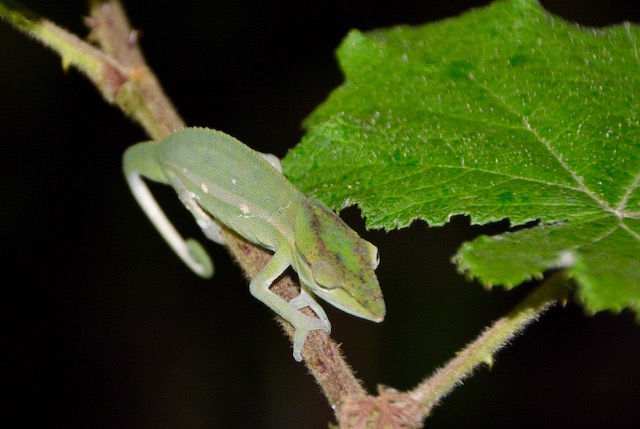
At the picnic area we finally found four different species of chameleon. One, the smallest chameleon in the world, lives covered in pine needles at the base of trees. Another was flattened against the bark and incredibly well camouflaged.

While we were eating lunch a curious mongoose came to check us out.

After lunch we headed back to Joffreville and spent some time wandering around the now dilapidated town. At one stage this used to be a favourite holiday spot for the French military as being on the hill it was cooler than Diego-Suarez, where they were based. After the French left in 1966 it has fallen into a state of disrepair. It is amazing that the Malagasy rather than move into the buildings and maintain them have let them go to ruin. Some are still in use by the Madagascar military but all in a very run-down state. Only the odd one or two has been maintained and is now in use as a hotel.

Young men sit around chewing the local drug of choice, katy, a green leaf grown locally, which is said to make them stronger.

In a small local market women sit selling rice, fruits, vegetables and various varieties of dried seafood. Chickens and ducks, many followed by their young wander around the town, often taking their lives in their hands as they run across the road in front of oncoming traffic. I think the “why did the chicken cross the road” jokes might have been invented here.


In one area is a large dilapidated multi-storey shell of a building that was apparently funded by the North Koreans and was once the teacher training institute but was damaged during a cyclone in the 90’s and was never repaired. One smaller building is still in use as a primary school but looks nearly as derelict.

It is hard to fathom that people here do not seem to want to improve their lives. Both here in the north and down south the guides commented on the locals lack of interest in education and in following suggestions from NGO’s to improve their fishing or farming methods. Somehow they seem content despite their lack of what we would consider to be basic necessities like power and running water. I am conscious of trying not to judge but struggle to understand.

We returned to the Litchi Tree and enjoyed a G&T (or in Roger’s case two) sitting out on the verandah with views over Diego-Suarez and the bay. With six guest rooms, this boutique hotel boasts an impressive bar and Herve cooks a mean meal. Eight years ago he adopted Madiba, a local baby, when she as an hour old. He now home-schools her and during the off season they travel to different parts of the world. She is a real delight and speaks excellent French and English. She seems to relish serving in the restaurant and showing us to our room, always with a beautiful smile. She and I played catch while Roger and Herve discussed the history of the country.

Later, after dinner, she showed us some of her very detailed drawings of the places they have visited. She is a charming and talented young girl and we couldn’t help reflecting on how different her life could have been.

On reflection I think our time in this area has been the opposite of our time in Andasibe. There the overall experience was outstanding but the hotel poor and here I would say the experience has been pretty average but the hotel outstanding. Mandrare River in the south seemed to get it pretty right on both counts.


Sunday 16 July 2017: Roger

Our guide and driver are waiting for us at seven in the trusty Toyota Landcruiser. Engine warning light still lit up as it has been for the past two days, we speed off down the road heading back to the airport. Chickens dive in all directions ,almost but not quite collected by the vehicles along the way. I am sure not even chickens know what their infatuation with the road is.

Alfa our pilot is waiting, soon airborne we head south, but much further west this time, revealing, in places, some quite rugged country.

There is the odd valley full of quite large villages surrounded by fields. This land must be like a sponge absorbing the water from the monsoon season and slowly releasing it over the dry season. Tracks, not roads, lead to these places.

In a country that is rated one of the poorest in the world, where 80% of the population have no power, water or proper sanitation but the prime minister has his own private jet and politicians become wealthy by being politicians, corruption is rife. Since independence in 1966 the population has grown from four to twenty three million. It makes one wonder what the future will hold. Will it be the same in a thousand years?

Madagascar Part I

Saturday 8 July 2017: Roger

Landing in Johannesburg around 8am we waited for nearly an hour to get through security and passport control in spite of just being in transit. Just after 10am we boarded the small AVRO RJ85 four-engined jet for a comfortable flight to Antananarivo.

Madagascar was apparently first inhabited around two thousand years ago by people from Indonesia then partially colonised by the British in 1810. In the 1880’s it was handed to the French, who had to fight the then king, eventually fully taking over in 1896. In 1960 independence was gained from France. The population at independence was 5 million; it’s now 26 million. As our guide Njaka put it, there is not much entertainment here!

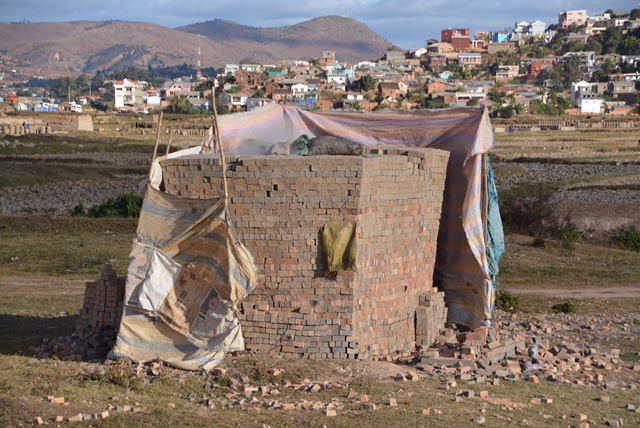
Our guide and a driver picked us up at the airport in a Toyota Landcruiser for the 150km, 4-hour drive to Andasibie. The first hour was through and around Antananarivo. On each side of the road are rice fields; in places these are also used to harvest bricks from. Thousand of grey mud-bricks lay in the fields drying in the sun. Like I had previously seen in parts of Africa they then lay a fire and build a kiln of bricks around it. The fire burns for around five days at the end of which they have baked orange bricks ready for sale.

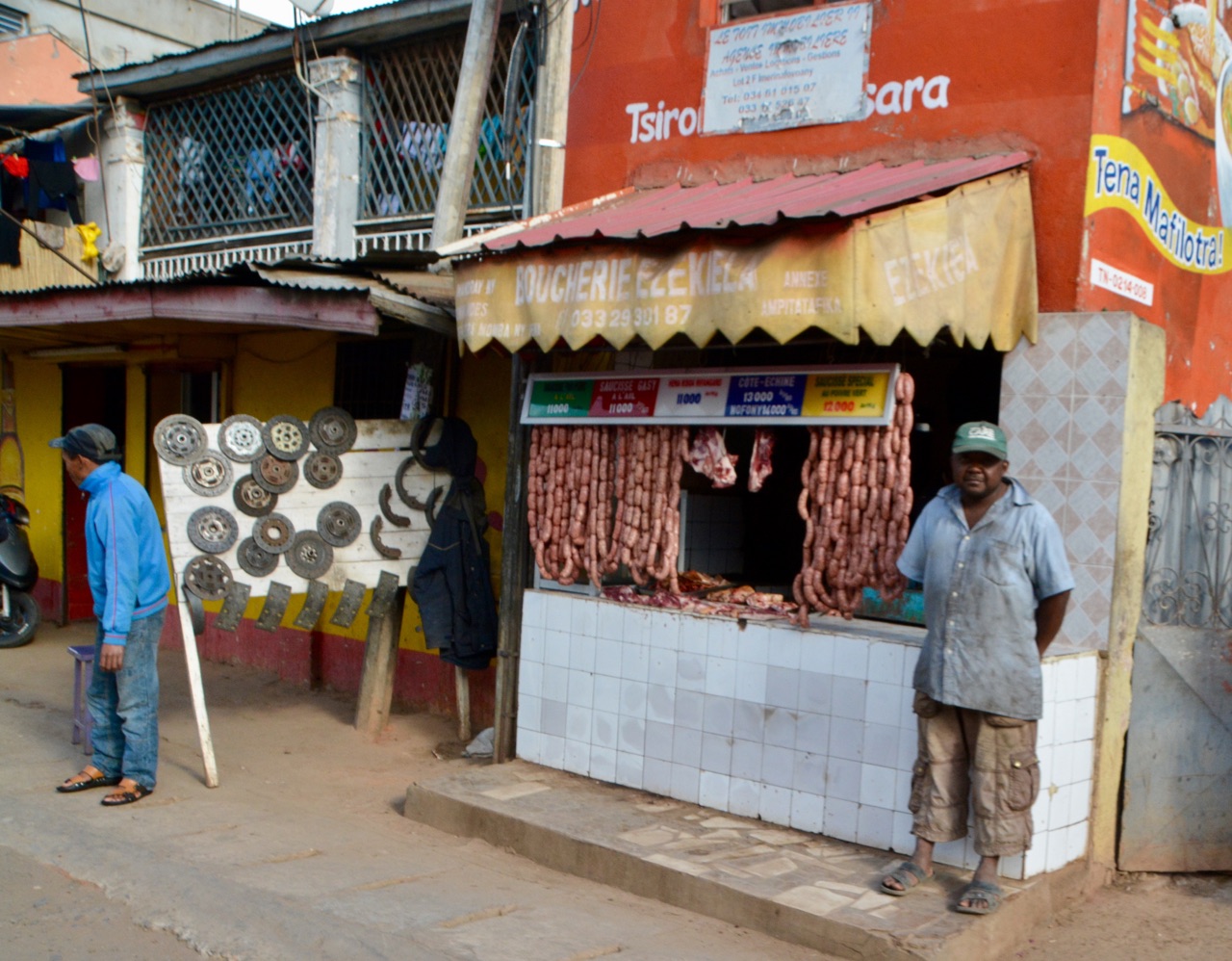
We passed through the shanty town where innovation is at its best; cars are being repaired on the roadside held up by rocks. There is just about everything one could buy in a large Walmart spread out along the side of the road. Fit looking men pull handcarts along the road, some at a steady trot. The heavier ones have a couple of extra blokes at the back pushing.

The roads are congested. In one area dozens of large trucks are parked up waiting for 8pm when they are allowed to enter the city centre to deliver their goods.

Most houses in the city have neither reticulated  water nor power supply. Today must be washing day as clothes are strewn everywhere, some hung but most having being washed in the brown water of the creeks are laid on the ground to dry. A lady sits, face painted in with a yellow tree bark (aparently this is to attract men) selling food.

We climb out of the city, eventually arriving at the top of a pass. The road winds its way seven kms down the a steep road. A large truck in front of us has flames coming from the brakes on the rear wheel; it takes several minutes of flashing lights and honking horn for him to get the hint and stop.

As we head further west houses tend to be made from timber rather than brick. Even as it gets dark lots of people are walking and pulling carts on the roads. Convoys of large trucks often make it hard to negotiate the relatively narrow road.

Turning off the main road we eventually come to a granite-paved track which leads to our hotel. We can’t get to our room for some time as they have misplaced the key.


Sunday 8 July 2017: Sylvia

The place we are staying is an interesting blend – the rooms are huge and quite nicely laid out but there is only a bath with a hand-held shower. The breakfast this morning was very basic with toast of a consistency somewhat akin to polystyrene!

After breakfast we met our guide and headed the short, bumpy drive to the Andasibe National Park for some traditional African waiting around while they organised tickets. We also met there our local guide, Desire, who is very friendly, knowledgeable and patient.

We spotted a short-horned (elephant-eared) chameleon on a tree nearby and a smaller version a few trees away.

We then headed off for a walk through the 40 hectares of this 861 hectare park that is open to tourists. The pathway was wide and paved with granite stones, which was quite helpful as the ground is very muddy. This is definitely rain forest – it rains 270+ days/year here and over 1.7m/year.

Not far down the path we spotted a small family of brown lemurs feeding in a tree. These lemurs are common across all of Madagascar. The two we have come specifically to this park to see are the Diadem Sifaka and the Indri-indri, the largest of all lemur.

We were not to be disappointed. Not too much further on we came across a family of diadem sifakas. These are the second largest of the lemurs here and a beautiful golden colour. I particularly enjoyed watching them jump through the trees. At certain times of the year they will come down to the ground and do a sideways sort of dance but we were satisfied watching them in the trees.

We had bought a new super-zoom lens for the camera and Roger seemed to enjoy trying it out – getting some great close-up shots.

We had heard a family of Indri-indri calling as we left the park headquarters. They make a fantastically haunting call. We soon came across the first of two families of them – again feeding in the branches high in a tree. Indri-indri have no tails, weigh up to about 12kg and can live to between 70 and 80 years. They seem to lead a fairly peaceful existence with their only predators being birds of prey and fossa (cat-fox like nocturnal animals). They eat mainly leaves and leap from tree to tree with remarkable speed and grace.

In the second family we came across, the mother was carrying a young baby – probably about 2 weeks old. All we could see was its little black face peeking out between the mothers stomach and leg.

This apparently is a fairly rare sighting, as was the pair of collared nightjars Desire spotted snuggled together in some leaves up a small bank. Even with him pointing them out to us it took several minutes before we were able to see them.

We headed back to “Fawlty Towers” for a break for lunch to discover once again that our room key was missing. Once that was found the safe couldn’t be opened but eventually we got it all sorted.

After lunch we headed to Lemur Island. This is an island that is part of a large hotel, complete with helicopter landing pad and rather overgrown golf course. The hotel is part of a larger estate, owned by a French man and incorporating a graphite mine; it is self contained with its own hydro-electric power and water supply. The island is home now to a number of lemurs that had been kept as pets. This is now illegal in Madagascar and the hotel has set up the island as a sanctuary for them – babies are rehabilitated to the wild. The lemurs on the island (brown, bamboo and ruffed) are all very tame and jumped on our shoulders and even heads. At one point Roger and I had three lemurs on each of us and were trying to take photos of each other as the lemurs jumped between us.

On a separate island was a diadem sifaka – we were not able to land but sat in our canoe as it was coaxed ever closer to us with pieces of banana. None of this was exactly a wildlife experience but it was fun and a great way to see the lemurs up close.

We decided to take a break in the sun after the lemurs and ordered a couple of gin and tonics but unfortunately no gin here! So Roger ordered a glass of wine that came filled to the brim but looked, smelled and apparently tasted more like diesel! It must have been bad as I’ve never known him to leave a glass untouched before. Bazil and Manuel are definitely in charge here.

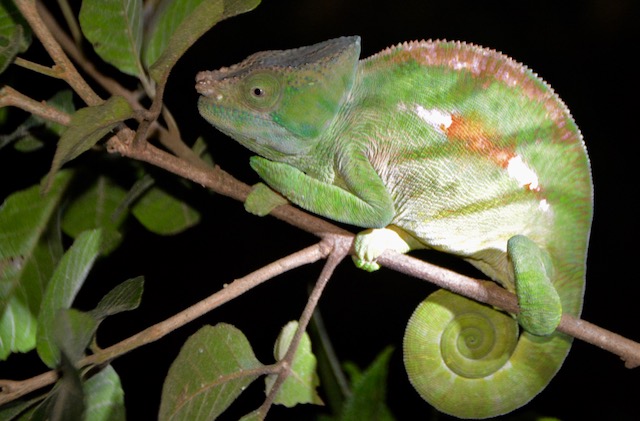
In the evening we met Desire again for a night walk, spot-lighting for nocturnal animals. We saw the largest (parson’s) and smallest (nose-horned) chameleons from the rain forest and also the largest nocturnal (woolly) and smallest (mouse) lemurs as well as a couple of other chameleons and a yellow-toed tree frog.

With a 5am departure tomorrow morning it was then time to call it a day. The hotel may not have been up to standard but the experience away from the hotel and the guiding of Desire were outstanding.


Monday 10 July 2017: Roger

As we headed down the stone drive way at 5am the valley was covered in fog. As daylight broke we were heading back up the valley towards the winding road. In places a narrow guage rail line runs alongside the road, built in the 1920s with compensation paid to France by the Germans for WWI. It is still in use but only for freight. Partially wiped out in places by a recient cyclone it is now running again.

As we pass through towns lots of people are out and about. Entering the capital the place is chaotic with mainly Mercedes mini buses ferrying people around, competing with bullock-carts, hand-carts, old Citroen taxis and cars for space on the road. Mercedes has done a great sales job here as they also seem to dominate the truck market. The streets are lined with stalls; the brick makers and rice growers are at work in the fields. Hundreds of men stand on the side of the road.

Arriving at the back gate to the airport we are lead to a Cessna 210. With its new 300 horsepower turbo engine and new coat of paint it is to fly us to Mandrare River, down the south end of Madagascar. Martin, the South African pilot soon appears and after waiting for the fog to clear we are airborne.

As we get airborne we can see that Antananarivo (Tana) is a city built around rice paddies. Every bit of flat land is a rice field ,at present some flooded, some dry. Martin tells me that in the wet season it’s like one big lake. As we fly south there are thousands of valleys all terraced into rice fields. It seems that every gully with a spring has been terraced to allow water to flow evenly over the ground. Many are really remote with no sign of roads. Villages have large sheds.

Cruising at 140 knots with a tail wind giving us 180 knots, we covered the 380 nautical miles in two and a half hours. As we approached the dirt airstrip we could see mile upon mile of, what looked like pineapple plants. These turned out to be sisal plants. There are around thirty thousand hectares of then in the area. Used for making large ropes for tying up cargo and other large ships and also for rugs. The outside fronds are cut by hand from each plant, bundled and then carted by tractor to the local factory. The ground is prepared by tractor and the plants planted by hand. This employs around a thousand locals at a rate of 2400 riaria per day, about USD1.

We did few circuits of the strip before touching down to be met by Theo the camp manager. A short drive in a Landrover had us at the camp. Theo’s wife Zizi was there to meet us and after a tour of the facilities we stowed our kit in our tent and headed of for our first activity.

A 15 min drive up a rough sandy/dirt road, passing through the local village got us to the start point. A couple of kayak are used to take us across the shallow river. On the other side are sandy river flats where the locals are planting their sweet potato crops. Thousands of these cuttings are placed in the sand and in four months produce a 30 to 50 mm tuda.


After crossing the flats we enter the sacred spiny Forrest. Alberto our guide gives a run down on the rules: “no pointing, no toileting and no removing anything.” Nearly every plant in here has a spike on it. We stick to the path as Alfred gives us a run down on the burial customs of the locals. The wealthy have a tomb surrounded by a concrete or stone wall; for the not so wealthy a shallow hole is dug and rocks piled on top. Between 3 and 20 zebu (the local cow) are sacrificed as part of the ceremony depending on one’s status. At USD300 each, dying can be expensive. The leftover meat is salted and given to those attending to take home.

We spot a couple of nocturnal sportive lemur hiding in a tree.

A couple of happy looking woman stroll through the forest on their way home from the river, heavy loads on there heads and babies on their backs.

The sun is setting as we are dragged back across the river where drinks and nibbles are laid out for us so we can sit and watch while the locals wrap up there day at the river.


From a thunderstorm to a castle

Thursday 6 July 2017

Having spent Wednesday and part of Thursday catching up on some work and a bit of writing while Sylvia has been hard at work, we felt relaxed as we headed to Marseilles at 3pm to catch our flight via Frankfurt to Johannesburg and then on to Antananarivo in Madagascar. Prior to boarding there was a delay due to thunderstorms in Frankfurt. We had experienced this a couple of weeks ago and had plenty of time to catch our connecting flight. Boarding half an hour late, we were then told we would have to wait up to an hour to take off as the storms had come back. Eventually airborne and not far from Frankfurt we were put in a holding pattern as the storm was still going on. Eventually we got diverted to Düsseldorf.

The crew were great, apologising and telling us how when we got off the plane there would be people there to sort out accommodation for the night and our new flights. The load of 150 happy passengers disembarked to be told pick up your bags and head to check-in where they will sort you out. Did the crew know? Were they just avoiding the problem!?

At the check-in no-one was there. Sylvia intercepted a Lufthansa staff member who was walking past. “Sorry, we are all off. You will need to get a train to Frankfurt and sort it out there, it’s not my problem – we are all off!” I went in search of our bag, which appeared on a conveyor an hour later. I think someone has stolen the wheels of efficiency here.

Back at the check out Sylvia is on hold with Lufthansa. She suggested I find us a hotel. After ringing a couple of local ones and getting no reply I got on the net and found Schlosshotel Hugenpoet, a castle hotel only 14kms away. Apparently under EU rules if your flight is diverted due to bad weather the airline is supposed to provide you accommodation and refund 50% of the fare. We will have to wait and see.

At around midnight the taxi dropped us at the hotel. The receptionist directed us to a tiny lift, which we squeezed into. Ending up somehow in the basement, surrounded by steam pipes in the bowels of the building and in fits of laughter, we eventually worked it out and got to the second floor in the very old, well-preserved castle.

This place as been around in one form or another for over a thousand years. It has been in its present form with a few alterations since 1696. It has been in the hands of its present owners since 1831 and was turned into a hotel in 1955. With only 36 rooms, a moat and a number of out buildings, and set in a forest, it’s a magnificent place.

A huge marble staircase led us down to breakfast on the balcony. Wedding preparations were underway with a large pink function tent set up in the grounds.

As Sylvia caught up on some work I explored the grounds.


Around midday the wedding got under way and we observed and listened to a woman with an operatic voice squawk out some songs.

After a bit of a look around inside it was time for us to head back to the airport to try our luck again.

As we publish this we are pushing back from the terminal about to head to Johannesburg.

All is not what it seems…

Tuesday 4 July 2017 – Not a cafe in sight

I took another stroll up the Pic where I had a chat with a young guy who was up there on fire watch with maps and a good pair of binos. He had also brought up a supply of canned drinks to sell to thirsty trampers.

On returning to the car at Saint-Mathieu-de-Triviers I decided to drive around some of the local villages in search of a cafe. In NZ just about every small town has a cafe – not the case here! Not being able to read the signs, I just drove down the main, and a few other, streets of each town I came to. Stunning village after stunning village and nothing. Eventually I came across a town, called Corconne, situated on the side of a steep hill with a church above the town, narrow steep streets and old buildings, it was home to Lalisson bar and restaurant.

Entering the bar it reminded me of a country pub back home. Everyone seemed to know each other. I was welcomed with a friendly smile and they made every effort to make me welcome in spite of my point and pay method of communication. The local beer was great, as was the Iberian ham and cheese salad. I also found out google translate is no good at translating a french menu – it just goes from french to french!!

After picking Sylvia up from work we headed east to Saintes Maries de la Mer, a real holiday town made up of restaurants, shops and accommodation and a couple of small beaches.


Monday 3 July 2017 – Clear water by the sea…

Our friend Jo had written to us after reading a recent post and told how she had enjoyed visiting Sete and about how clear the water was. I arrived around midday to clear blue skies and a stunning holiday town with canals packed with both commercial and pleasure craft. The water is extremely clear in these canals and waterways – it’s a pity the bottoms are lined with rubbish.

A relatively young town, not established until the mid 1600’s and going by the name of Cette until 1928, it was the site of many battles, changing hands a a number of times over a couple of hundred years. Between 1821 and 1869 the impressive sea wall was built.

It has a couple of mandatory forts, a light house and a control tower on the hill.

I ordered a fish salad at a canal-side restaurant. It turned out to be octopus. When one doesn’t speak the lingo, one just has to laugh and take what you get. It was very nice.

A stroll through the streets revealed the true beauty of the not-so-old town, until that is I came across what some distorted architect must have decided would be an asset to its future.

I drove back up the coast checking out a number of more modern resort towns.

In the evening we relaxed in the roof top bar at the Pullman Hotel where we have been staying the past couple of weeks.

The staff up here in the evenings are really friendly but have no sense of awareness or perception of service. Sylvia ordered a bottle of San Pellegrino and after 10 minutes or so it arrived, along with my glass of wine, unopened and with no glass. Another 10 minutes and a glass turned up but no opener. Not willing to damage her unfilled, well-kept teeth or let me open it on the table ledge, she waited and eventually a person with an opener turned up, whipping the top off and speeding off without noticing that my wine glass could have done with a refill. We were joined by Cecile, a colleague of Sylvia’s, who shared our amusement at the service or lack thereof.

A whizz around Rome

Friday 30 June 2017

After spending the day catching up on a few admin things I picked Sylvia up at 3pm and we headed to Marseilles airport. We were booked on a Ryan Air flight to Rome. Terminal 2 where they depart from is quite basic but the boarding process was efficient and on time. On the 737-800 the seats were basic but comfortable with enough leg room. The staff made every effort to sell not only food and drinks but duty free as well as they wheeled carts up and down the aisle. A couple of years ago I read something about Ryan air wanting to carry passengers standing on short flights.

An hour later we touched down in Rome. After checking into Hotel Argentina we took a stroll and sat riverside on the Fiume Tevere opposite Tiberina Island. The riverside was lit up by stalls and restaurants.


Saturday 1 July 2017

We took a stroll down the river spanned by its old bridges and lined with character buildings, passing the Temple of Hercules Victor dating back to around 200BC.

We then strolled up the Circus Maximus, a large oval race track where chariot racing took place back in the day.

Arriving at the Palatino we brought a ticket to it and the Colosseum. This once city is pretty amazing with its multi-storey apartments overlooking the race track. There are the remains of an aqueduct that once supplied the city with water. For some reason (maybe Ben Hur) I had always envisaged Rome to be built of stone. I was suprised to see most of the buildings here were brick. Further investigation revealed that in fact the walls were made of an early version of concrete – made from volcanic ash and sand, laid rather than poured and mixed with rubble or stone to give it strength -then clad with brick or sometimes stone.


Some artists had grabbed a chunk of space here exhibiting some art not quite in keeping with the general theme of the place.

We eventually dropped down into the Forum, once the main commercial area.

Eventually finding our way out we headed down the Via dei Fori Imperiali to the colosseum. Soldiers and their vehicles blocked off the roads, I presume to keep bad people in trucks away from the thousands gathered in and around the venue. Touts, some with English and Irish accents, tried to talk us into hiring them as a guide.

Inside this concrete, in places 50m high, structure is really impressive. Under the area where the wooden floor of the arena once lay covered in sand, one can see the maze of rooms where players from lions to Gladiators were caged. Completed in 80AD it could seat up to eighty thousand.

Strolling back up the Via dei Fori Imperiali we passed the Colonna Traianei situated across the road from Mussolini’s palace, now a museum.

Hidden not far off Corso Via del is the Trevi fountain. Surrounded by hundreds of people, water has been gushing out here since 19AD, then supplied by an Aquaduct. The fountain itself was completed in 1762. The 2.8 million cubic feet of water that gushes out every day is now recycled. Around €3000 in coins are tossed in every day.

Our next stop was the Spanish Steps with a fountain at the base and church at the top.

From here we took the subway to the Vatican. Thousands of people queued to go into St Paul’s Cathedral and the Vatican museum. The square in front of the cathedral Is pretty impressive with a large statue in the middle.

Just down the road by the river is fort Saint Angelo built in 123AD as a mausoleum, later turned into a fort for the pope, and now a museum.

At the Piazza Navona we stopped for an afternoon wine and watched the many people go by. With its central statue and colourful buildings this is a very relaxing place.

Just a few blocks away is the Pantheon. Completed around 126AD this non reinforced building with its dome is quite an outstanding piece of engineering. In building the dome they used heavy aggregate in the base, thinning it as it got higher using pumice in the thinner top part of the dome.


We arrived back at the hotel in time for the 5pm free drinks and nibbles. In the evening we took a stroll across the river to the Trastevere area, where we enjoyed a great meal of pasta and meatballs.

Lyon, Grenoble and more…

Monday 25 June 2017

Last night we received an email from our friend, Karen, suggesting a couple more places to visit in the area. Karen, her husband Steve and their three kids had spent eighteen months living in Aix en Provence. After dropping Sylvia off I took  a bit of morning exercise, up to the top of Pic Saint-loup and back, avoiding the chateau after a thoughtful Stuart translated the sign I put in last week’s blog -basically it said “keep out!”

I headed out to the west of the Pic into some very arid and scrubby land, spotted with vineyards. This area is renown for having some of the best wine in the area. Passing through many small and old villages I eventually arrived at St-Jean-de Fos.On a hill above the end of a steep rocky gorge with a large swimming lake, it is another really old town. Being a Monday, apart from a bar that didn’t seem to sell wine, everything was closed.

From there I headed down the valley to Aniane another old town. In both these towns the streets were being re sealed making the narrow streets even harder to negotiate than usual. These are very much lived in towns. As one walks the narrow streets many voices can be heard coming from the shuttered  windows of these very old buildings. I have the urge to knock on a door and ask to look around but refrain as my one French word is probably not going to help negotiate the way in.

I made my way back, via lots of back roads, wondering how people sustain a living around here.


Tuesday 21 June 2017

I headed north up the 300 odd kms to Lyon. It’s an easy drive, most of it at 130kph – or a bit faster as they don’t seem to police the speed on these fantastic roads. If you are in the fast lane people generally pull over and let you through. Arriving around noon my primary reason for being here is to meet with Qedric, the second son of my late brother Gareth. Qedric met Lison, a girl from Lyon, fell madly in love and followed her home.

Qedric and I met outside the opera theatre opposite the Hotel de Ville, which around here is what they call the town hall.

We strolled down the road to cafe 203 where we enjoyed a great lunch and a good catch up. Qedric also gave me a bit of a rundown on the town and the places to see. After lunch he headed back to work and I took a stroll up some steps then dropped down past a park to the river which almost encircles this part of town.

Across the river I found some steps leading up a hill with both a castle and a miniature Eiffel Tower on it. Eventually I found my way around to an old Roman ampitheater which is still in use – not bad for a few rock seats over 2000 years old.

A bit further around  was the castle, which turned out to be Basilica of Notre-Dame de Fourviere. Yes it turned out to be a church and a bloody big one at that.

The views across the city from the hilltop were fantastic.

An easy winding track and some steps lead back down to the river. Close to the river was another huge church. Cathédrale Saint-Jean-Baptiste de Lyon was completed in the 1400’s.


Back across the river I headed up a wide pedestrian boulevard. The people here are generally slim and dressed with style. The city has an elegance about it with many old buildings, with the new ones blending in.


Wednesday 22 June 2017

At the top of Pic Saint-loup I was surprised to see a group of thirty plus arrive shortly after me at the top. Back at the car I headed southeast to explore a town I had spotted a few days ago.

Castries, with its large castle on the top of the hill in the middle of the town, dates back to the 11th century. There is an old aqueduct 1.8 km long that was built in the sixteen hundreds to bring water a total of 7kms to the castle’s gardens. I parked the car and took a stroll around.

In places people had built their houses into the arches of the aqueduct, the new stone standing out from the old.

As I walked past the castle gate it opened. A nice lady with good English explained that I could not go in as they were just there preparing for a fair being held in the weekend. It doesn’t appear to be open to the public very often and we are off to Rome for the weekend. Shame as I would love to take a look around the inside.

After picking Sylvia up from work we headed to Saint-Guilhem-Le-Desert, another place young Karen had recommended we visit. On the way a stack of angry looking clouds formed in front of us. Soon we were being pelted by rain and hail with strong winds buffeting the car around. Lots of cars pulled off the road as visibility dropped to almost zero. The weather eased and we made it up the valley to the village. Established originally as a monastery in 806, this town of around 300 people, a hotel and  a couple of restaurants is well worth a visit.


Thursday 29 June 2017

Qedric had told me the Resistance Museum near Grenoble was well worth a visit. About 280kms to the northeast it was an easy drive, mainly on the A7 motorway. From Grenoble I headed into the foothills in the Royans area discovering a couple of outstanding towns along the way. Saint-Nazareth-en-Royans is stunning, with its ancient aqueduct straddling the ravine as though hiding the town.

A little further up the valley I found Pont-en-Royans tucked under the towering cliffs that surrounded green and tranquil river valley.


After a very quiet chat with a lady at the information office here, “shsh – they are having a meeting in the back”, she tossed me some brochures in French and ushered me out the door. With my best “bonjour” and some sign language I managed to get a good coffee at the cafe across the road and study the map.

Heading back down the valley, then south on route D76, aI passed through a few more villages then the road began to climb up through forest country. Then quite by surprise, I was suddenly on a spectacular road which had been chiseled into the cliffs between 1861 and 1898 in order to get timber from the forests on plateau.

I found a little siding, stopped and walked back along the road. In places the little stone wall was the only protection from a vertical drop of several hundred meters. With no diggers or rock breakers back in those days this is certainly an amazing feat of both engineering and determination.

A short tunnel took me from the cliffs to the plateau with its huge forests on its rolling land. Eventually I arrived at the Resistance Museum, which is dug into the side of a hill above the plains of Vercors.

The museum is a memorial to those of the resistance who fought hard to disrupt the German forces throughout WW2. There are few exhibits but some excellent movie footage in two theatre spaces in the complex. The English audio cue is synchronised with the movies. It showed footage of the Resistance blowing up parts of the cliff road I had just driven.

I headed down onto the plains then back through a tunnel under the mountains and linked eventually with the A9 for the journey home.

A weekend on the Rhine

Friday 23 June 2017

I picked Sylvia up from the Royal Canin head office at 4pm and we drove to Marseilles where we caught a flight to Frankfurt. With the state of emergency still in place in France it is now necessary to battle lengthy cues at emigration even when traveling within the EU.

Arriving in Frankfurt we were met by my sister Rachel and her husband, Edward. Heading through Wiesbaden and down alongside the Rhine river, we arrived at their place in the picturesque village of Woolerschied in the hills not far from Lorch. Their adult children, Tristan and Killian, were there to meet us. We had a pleasant evening chatting and catching up until well after midnight. It had been three years since my last visit. Rachel had visited NZ after the death of out brother Gareth in April last year.

The next morning we rose a little late to a traditional German breakfast of breads, meats, cheeses and coffee. Mid morning we set off to Kaub, a town on the Rhine famous for its mid-river castle, built in 1327, originally as just a tower to collect tolls on the river. Years later the outer structure was added after the pope, through the local bishop, told the owner to stop collecting the tax or he would be both excommunicated and attacked. He told the pope where to go and built the outer structure in the shape of a ship to break up the river ice and reinforced the structure with soldiers and cannons. Tolls were collected here up until the mid 1800s.


This place is also where in 1814 Field Marshal Blucher built a bridge out of boats and took his twenty thousand Prussian and Russian troops across the river to give Nepoleon a spanking.

This part of the river has a number of castles mostly on top of the surround[ding hills. The river is also one of the busiest cargo rivers in Europe.

From there we drove alongside the river as Rachel gave us a running commentary on the stories around the many castles on this part of the river. Tristan was keen to demonstrate the speed and handling of his new company car, an M3 BMW; the performance was somewhat governed by his mother from the back seat.

We then headed up the hill to a place called Loreley, apparently it got its name from a young lady who fell off there a few centeries ago, romance or lack of was involved. Here in the 1930 Hitler had a 17,000 seat auditorium built. It is still in use today. There is an open air bar on the edge of the cliff with stunning views over the river. The management had yet to hear about the great German efficiency as the service was worse than bad. Eventually we got a drink and enjoyed the stunning views while chatting away.


Later in the afternoon we returned to their place where Edward cooked up a variety of meats on the grill. We ate, drank and chatted again late into the evening.
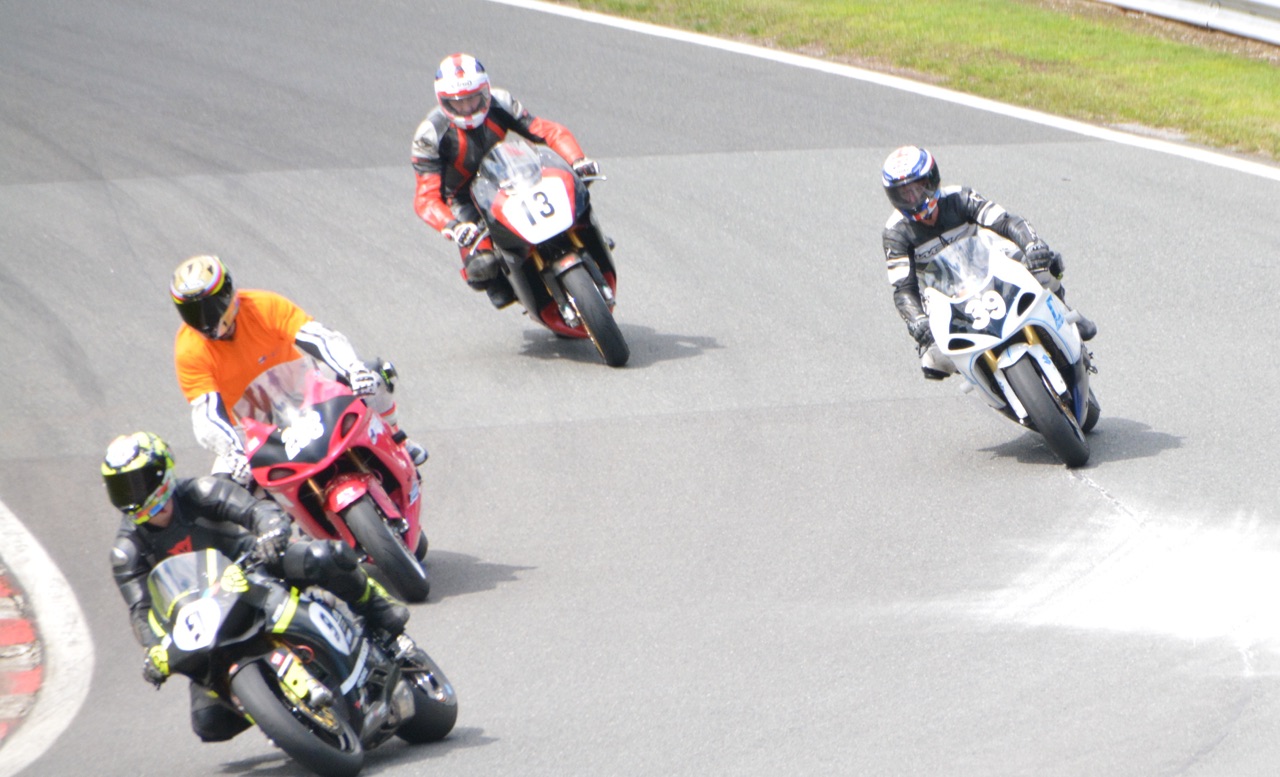
Sunday morning after another late start and great breakfast it was time to head back to the airport.

Tristan and Killian dropped us off for our afternoon flight back to Marseilles.


Back to the South of France

Sunday 18 June 2017

I spent Saturday in Singapore with Renee and Cale, who are at present non-stop traveling around Asia. This included a stroll down Orchard Road and a visit back to the Battle Box at Fort Canning Park. The second tour I enjoyed as much as the first.

Midnight Sylvia and I boarded a plan for our flight to Marseilles via Frankfurt. We picked up a rental car – the worst car I have driven for many years. It probably rates close to the Ford teams van I had in the seventies; even on a straight piece of smooth road it wanders, requiring constant correction. Every corner it feels like it wants to tip over.  Now aptly named the Citron Tipper.

We headed out to Avignon.

Dating back to 100 AD it has a history full of attacks and plagues etc. like most cities in this part of the world. In the mid 1300’s a 4300m wall 8m high was built around this city. During the 13 hundreds a number of popes hung out here. It was their funds that were used to build the wall and the many large buildings behind it. Today 12,000 of the city’s 90,000 population live behind the wall.

Arriving in Montpellier just after noon, we wandered the streets finding a lovely outdoor cafe  and enjoying some local food. This town, with its old buildings and fantastic way of blending the old and the new, has a relaxing vibe about it. The history here is impressive but I wrote about that last year.


Monday 19 June 2017

After dropping Sylvia off at the Royal Canin head office, I drove the tipper carefully through the country lanes and up the hill to Gallargues-le-Montueux.

Overlooking the surrounding countryside, with its narrow crooked streets and a population of 3,500, it’s a really neat quiet town.

A short drive through some scrubby and scruffy countryside  landed me at Sommieres. This place has been around a fair while. In the first century AD Tiberius, a Roman emperor, had the bridge built; not quite as wide as it should have been as I had to drive the Tipper up onto the footpath to let an on coming truck pass.

In the eleventh century a chateau was built on the hill. Later fortified and strengthened, it became part of the French kingdom in 1248. Later it became known for a siege in 1573 when held by protestants. They held off the other side for a couple of months by pouring boiling oil and molten iron on the attackers. There were a couple more sieges the following centuries as the two religions fought it out.

I parked across the river and strolled across the bridge to the main town. At the end of the bridge one of the original city gates leads into the cobbled streets.  It was while wandering the streets I realised what it is that draws me to these places. Every street and every building is a little different. Nothing seems to follow a straight line – it’s almost like they always laid the footings of the buildings in the afternoon after a long wine lunch. Walls often bulge out, arches are often present. One wonders if they are there to hold the buildings apart. In the back streets lies an abandoned church.


The road winds its way up to the Chateau which looks to be in good order with its tall tower but is closed just now. I followed a track in the bush running up the ridge alongside the now crumbling fortress walls. The view from up here was stunning.
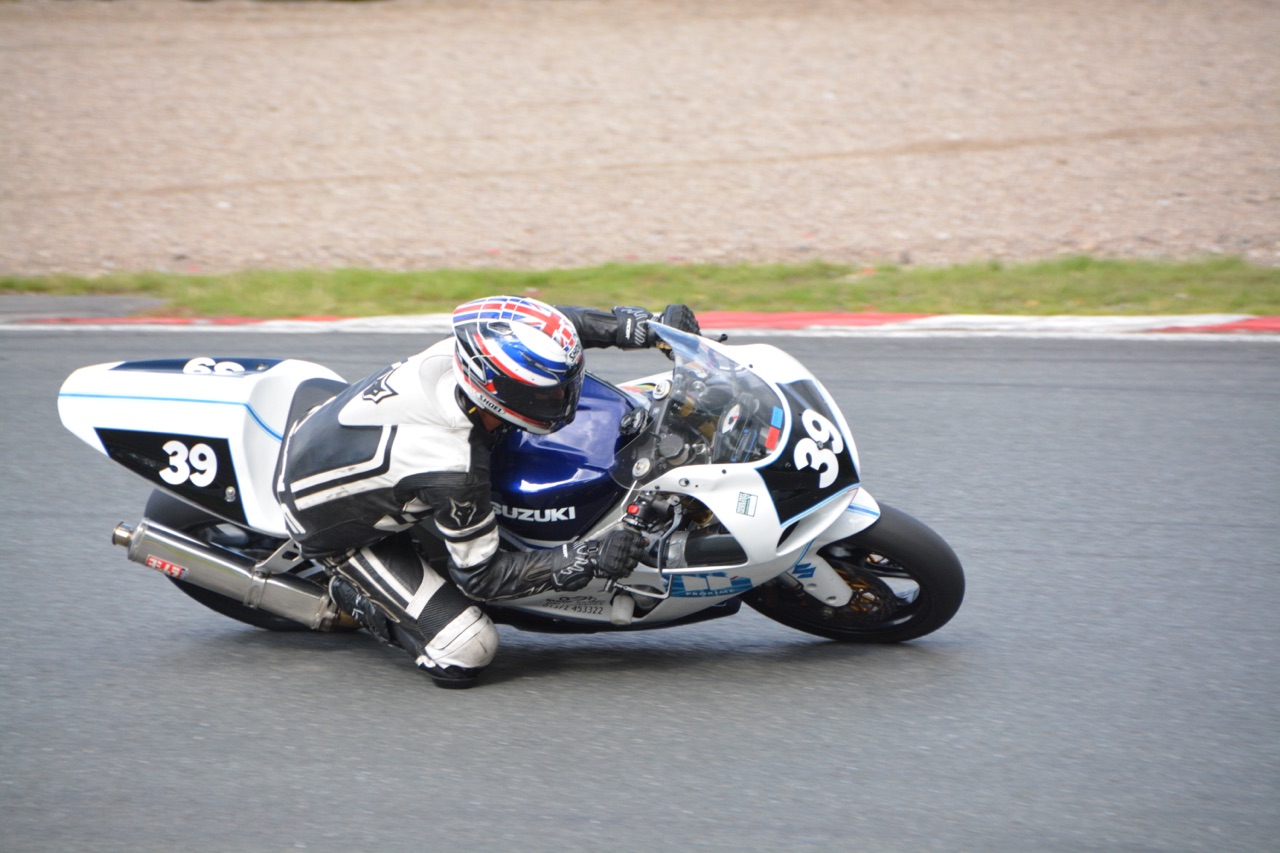
 

The track eventually leads me back down the hill where I come across a stone tunnel. I can see vehicle lights well in the tunnel. There were no rail lines and the lights seemed to be moving away from me so I ventured in. A few hundred meters later I reached the other end of this handmade, old railway tunnel, now being turned into a cycle way.

After the tunnel a deep cutting continued for a while and eventually the ground flattened out and I was able to sneak through a hedge onto the road that lead back to town.

After a relaxed lunch I drove around the district coming across many small villages. Most had a chateau, church or fort, and sometimes all three, on the high ground.


Wednesday 21 March 2017

From the chateau at Sommieres I had spotted a nicely shaped hill in the distance. I showed the picture to the guy on the desk at the our hotel. Pic Saint-Loup he said. I asked if one could take a stroll to the top. “It’s very hard and takes four hours, you have to go very early in the morning.”

After dropping Sylvia at work I drove to the general area of the hill. Eventually I found a car park and a track. Forty minutes later I was at the top. At only 662m, with the car park at 300m it wasn’t exactly a big climb.  The hill itself is impressive. On the north side it has vertical bluffs and is the highest hill in the area with great views of the surrounding countryside. There is also a stone church and a cross at the top.

A thirty-minute stroll down the hill on the rough track, often shaded by the surrounding scrub, and I was back at the car.

Around 6pm I picked Sylvia up from work and we headed to Aigues-Mortes.

Rumour has it Gaius Marius founded this city in 102 BC. With its nearby salt flats this became quite a sought after area. In 1272 the order was given to build a wall to encircle the small town. It took thirty years to complete. These are the most impressive city walls I have seen in this part of the world. At the east end of the town is a tall tower originally used as a watch tower to warn of approaching bad people.

Behind the walls is a thriving little town with lots of restaurants, shops and housing.
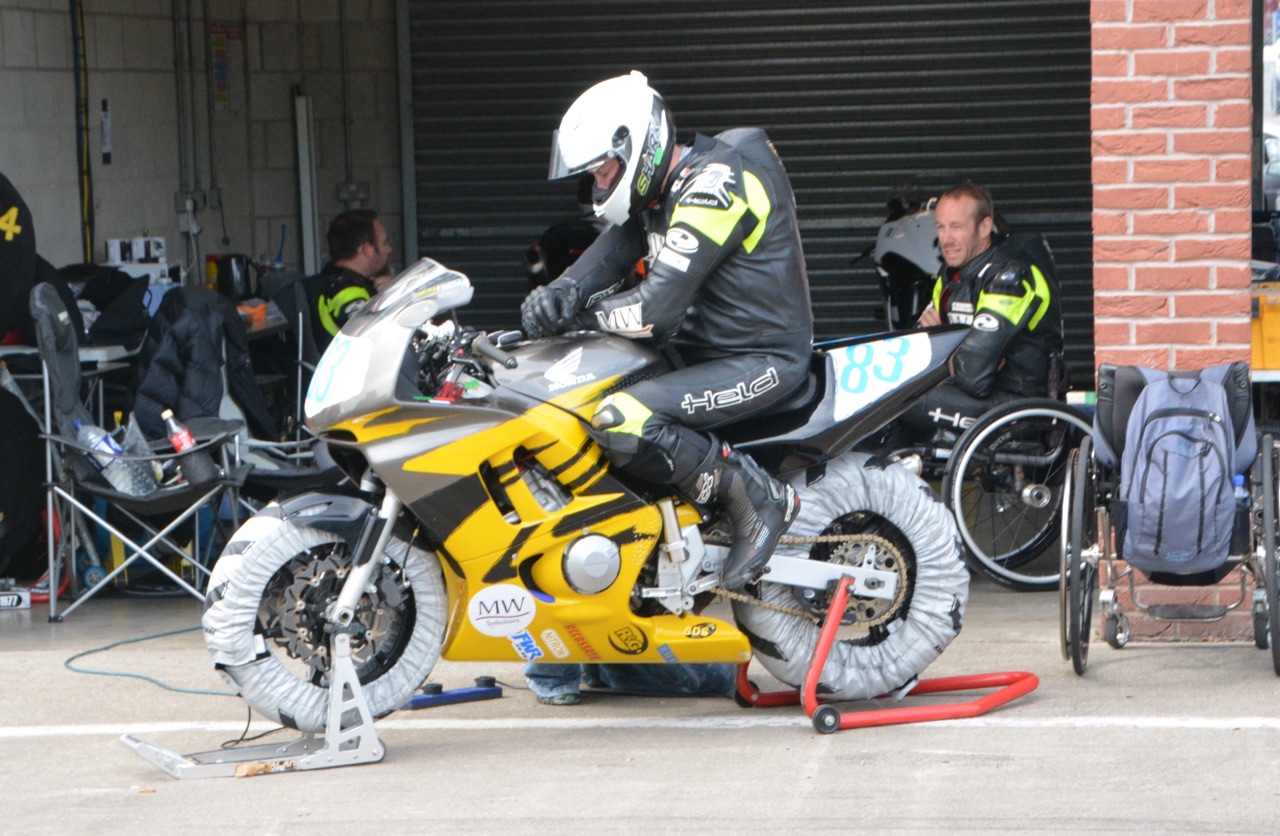

Thursday 22 June 2017

I headed to Saint-Mathieu-de-Triviers, a town to the west of Pic Saint-Loop. I was amused driving through the town’s narrow streets to see signs indicating the street width. Down one of these streets I came across two opposing houses with big scrape marks down their sides. Someone didn’t read the sign.

Soon I found the track heading up the hill starting at 130m and 7 kms from the top. As I scrambled up some loose rock I looked up to see the remains of a Chateau well above me.

As it turned out, the track lead right up to the centre of it. With vertical cliffs on the north side and four tiers of 4-meter high walls to the south it must have been quite a fort in its day. It first appears in history in the mid 1200’s. It survived a major siege and a few other battles. When in 1659 Jacques Valant the then owner died it began to decay. In the 1700’s Louis XIV authorised a local bishop to destroy the buildings. The stones were offered as compensation for those carrying out the demolition. By then people must have got sick of carrying stones as the task was never completed. Today it’s pretty derelict but must have once been a great feat of engineering. One can still see partial remains of tunnels, caverns and the outline of the main buildings.
Climbing down the east end I found the main track with a sign on it. I assume it said something along the lines of “Chateau ruins, come and take a look around.” I am sure my French speaking friends will enlighten me if I got it wrong!

The track continued along the side of the hill with the odd branch of to the ridge. Eventually the track joined with the track I had come up yesterday for the push to the summit. At the summit the weather was still hazy and not good for photography so I rested a few minutes and then returned the way I had come.

In the evening we took a trip to Nimes. The old city here has a Colosseum built by the Romans in the first century. As we arrived people were preparing to enter for a musical event. All the roads around the area were blocked off with trucks and armed police, we presumed to stop vehicles getting near the crowd.  The old city here is less attractive than the others we have seen so far.