Hong Kong is not all Apartments

Wednesday 27 November 2017

We had arrived late last night and are staying at the East Hotel on the northeast side of the island, close to the Royal Canin office. Upgraded to a corner room we had a great view over the thousands of appartments in front of the hotel and across the harbour to Kowloon.

Last time I was here a long time friend of mine, who works at the local sports institute, had told me there are some good walks on the island. Heading up Mt Parker Rd I was surprised by the number of picnic spots and rest areas, most with good views back over the city.

About 20 minutes up the hill I came to a sign pointing up some steps tp Mt Butler. Some 500 reasonably steep steps later I was standing on top and taken aback by both the view and the amount of bush that extended out from here.

Interestingly Hong kong has the highst population density in the world at over 16,000 people per square kilometre. Apparently if the whole world’s population lived in this density the total population could all fit into Egypt; that would be interesting. With only a third of the country urbanised it leaves room for some big parks. From Mt Butler it looks like the population is tucked mostly into the bays around the island apart from one rather large block of apartments stacked up in a saddle.

As I was admiring the view a very energetic Swiss lady came bounding onto the summit from the other direction; it turned out she lived here and knew her way around. She suggested I might like to head over to the apartments in the saddle (Hong Kong Park View) along Wilson’s trail, over Violet hill and down to Repulse Bay, then get a bus back from there or walk down past the reservoirs and back up over the hill. I set off on what were mostly pretty good tracks, most of the steps in the early part – and there were lots of them – made of concrete. Heading down towards Repulse Bay they are all stone with a concrete water channel on one side. Reaching the bottom there is a large concrete drain running towards the reservoirs. Still having a bit of energy left I headed north along the east side of the reservoir. The track was more like a stream bed for a start but worked out okay after a while with good views up into the bush.

The reservoirs are well set up with the two upper ones feeding the lower one. They get massive rains here so I am sure they fill up pretty quick. From the reservoirs I got back onto the other end of Mt Parker Road which took me back over the hill and then to the hotel, passing  one strange looking double decker tram – something I had not seen before.

Pat came and caught up with us later that evening for a couple of drinks before we headed out to Mr and Mr Fox, a rather nice local restaurant for a rather tasty steak. Tomorrow we head back to Singapore for a few days.

Taiwan

Saturday 25 November 2017

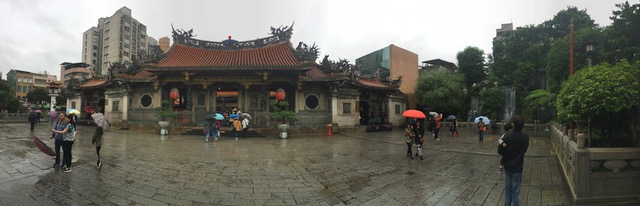
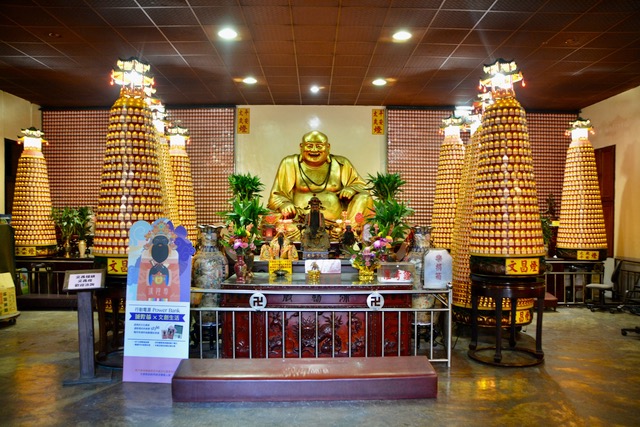
Having arrived late last night from Shanghai we had a late start to the day. Around noon we jumped on the easy to use MRT and headed to Longshan Temple on the west side of Taipei City. 

Founded in 1738 by Han immigrants from Fujian, it is quite an interesting place to visit. The majority of the visitors were there to participate, holding incense sticks up and bowing to the particular Buddhist statue they were in front of. This was followed by chucking a couple of bits of moon shaped wood in the air and depending on which way they land determines how your prayer went. Looked like gambling to me. 

There is a shop there where people buy offerings for the gods which they place on tables around the place. I presume if the gods aren’t hungry they take them back to the shop and sell them again the next day!!

It is a really nice place and very interesting to see. There is a lot going on and I am sure it would take a lifetime to really understand what it all means and how it works.

After visiting the temple we wandered the local streets, which were also interesting. Obviously not popular with European tourists as we were the only ones. the area is quite old and in places a bit run down. First stop was a foot massage; interestingly they put a plastic bag in the tub prior to filling it for the foot soak while they gave our shoulders a bit of a rub. Then it was feet dried and into the foot and lower leg part. We were amused as three Chinese guys opposite us screamed and grimaced and squawked through the whole process. 

 A bit further down the street we came across a covered ally with a number of little, mainly food, shops. One restaurant had snake on the menu; these were displayed live in glass cases alongside. In another glass case were a bunch of fat white rats; I couldn’t quite work out whether the rats were to feed the snakes or whether one could order those too. We didn’t actually stick around to find out!

Back on the street we came across a covered restaurant with pink tables and chairs in the middle of the street. A local on a motorbike didn’t seem to mind as he drove through the middle of it. 

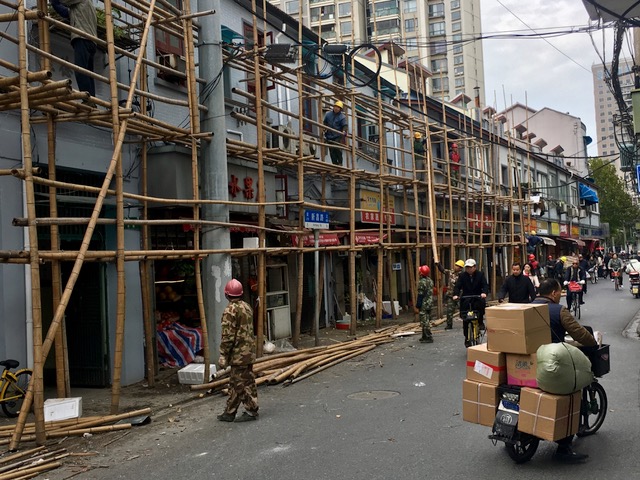
It’s funny because the streets of Taipei look just how I imagined them. Maybe it’s the signage one sees in pictures or on movies I have seen in the past. I discovered over the next few days that these oblong signs are consistent in all the places we visited. Many of the buildings are not well maintained and lots have little cage like boxes stuck on the windows.There are a lot of interesting small shops with formica tables are around here.

On the way back we stopped in another part of town which was a little more upmarket and packed with people, loud music blurting out from many of the shops. We found a war museum there but unfortunately it was closed for maintenance. 


Sunday 26 November 2017 

We took an Uber north to Juifen. This is an old and interesting part of the island with good views in spite of the bad weather over the protruding headlands. 

We sort of followed the crowd and ended up in a mostly covered ally, know and Juifen Old Street. This ran for the best part of a kilometre, snaking its way through the buildings. At a maximum of three maters wide and packed with people compressed between the shops and eateries each side, it was hard to believe the amount and variety of food on sale here. Large pots of fish balls bubbled away as families crammed in to throw back large amounts of scoff. There were a couple of times along this slow moving trail one had to hold one’s breath as the stench of what ever they were preparing was quite unbearable. 


Eventually we popped out the other end and decided to find a different way back rather than battling the crowds. A path took us down the hill and back around to the main road. Sylvia had somehow worked out the bus system so we mounted a bus that struggled to make the tight corners on the winding road over a hill and down to the coast. 

The Golden waterfall with its yellow colour was well worth a look.

We strolled the rest of the way down to the coast looking back to see what are the remains of a huge copper processing plant. As I looked up at it I had visions of it been a modern day Machu Picchu; don’t think it will be around in a thousand years though. Mining has been part of Taiwan for hundreds of years. In 1981 the  Taiwan Metals Mining Company took out a large loan to build this copper processing plant. By 1987 copper prices declined and it went broke. 

We caught a bus from the bay about 20kms around the coast to the large port city of Keelung. Most of the shipping to the north part of the country goes through this port. 

Here we caught the train back to our hotel at Nangang. MRT and local rail travel here is cheap and efficient. Although some of the signage rather amusing.

After missing out on the cigar bar in Shanghai, given their change of rules, we were pleased to find, after surfing the net, that Taipei has lots of them. A short taxi ride and we arrived at the Cigar Emporium. This bar is really well done with its Art Deco look, leather chairs, great ventilation and good service. It’s a shame they only serve wine by the bottle – I just had to drink a whole one.

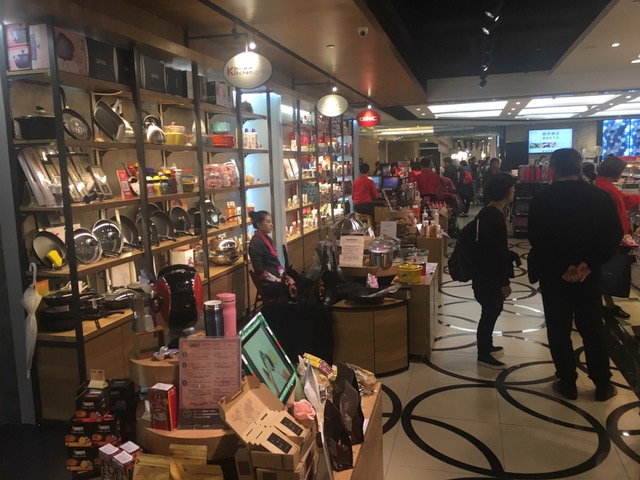
After a relaxing couple of hours we took a stroll to Taipei 101. With the tip at 509.2m 2004 it was the world’s tallest building, not outgrown until 2010. It also had the world’s fastest elevator until 2015, reaching speeds of 1010m/minute (60 kph). Unfortunately I forgot to take a photo of the speedo on the way up and only captured one on the way down at 600m/minute. As we stepped through the retail floors we were both really taken with the layout and presentation. Although hard to capture on an iPhone it was up with the best we have seen. 


Eventually arriving at the viewing deck the views were stunning. We really enjoy going up these tall buildings.

In the centre of the floor there is a  a big ball – 600 tons of it suspended in the middle on ropes and and rams. This wind  damper is designed to counter the movement of such events as typhoons and earthquakes. During typhoons they close the viewing floors but as earthquakes are unpredictable, people are there when they take place. There is video of it moving along with the crowd staggering around during a recent earthquake. The ball can move up to a meter and a half which some smart engineer must have worked out will stop the building moving to much and being damaged in such an event.


Monday 27 November 2017

I had found a pass on line for the Taiwan High Speed Trains; interestingly the three day pass was cheaper than the two day pass. At 75 USD it was also cheaper than a return trip to the bottom of the island. Mid-morning I jumped the train heading south down the west coast. I also really enjoy the speed and efficiency of the fast trains, even though when you are sitting in them it doesn’t feel like one is moving that fast. The transport infrastructure here is impressive with many roads, motorways and train tracks on pylons. They seem to be really good at sticking stuff up in the air.

As the train sped south through city after city it was almost like the west coast is just one big city with a bit of bush and a few rice paddies dispersed throughout. 

The Japanese built train reached 300kph as it sped south, stopping at only a few of the twelve stations along the way and covering the 350km in just over 90 minutes. The planning for this train started in the 80’s when they found they were running out of space on the west coast to build enough roads to move the population around. 90% of the 23m population live in this area. Opening in 2007 the rail system last year carried 50 million passengers, still short of the 80 million predicted. As we pull into Zuoying Station teams of six cleaners stand stand at attention in two ranks ready to board the train. 

A very helpful local English teacher assisted me in taking the local MRT into Kaohsiung City for a look around. With a population of 3 million this city has wide main streets and quite a large port area. It is quite a tidy city. There is lots of construction going on around the inner port area which looks like the are trying to turn it into a tourist come entertainment area. Trams rolled back and fourth along the waterfront. 

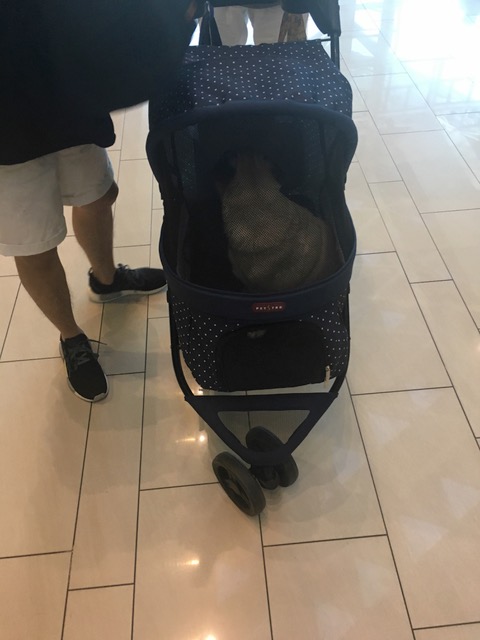
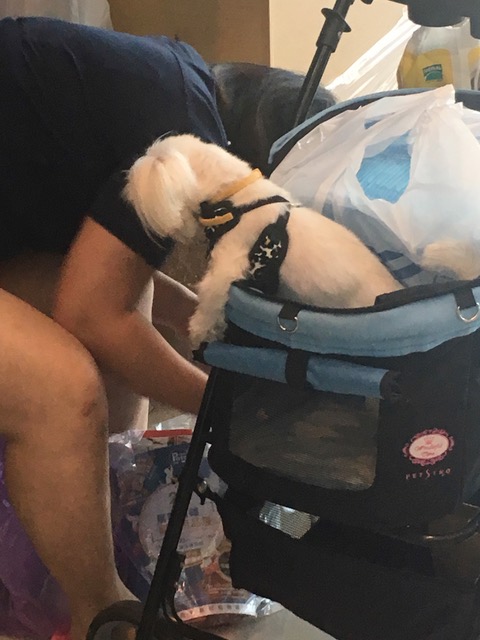
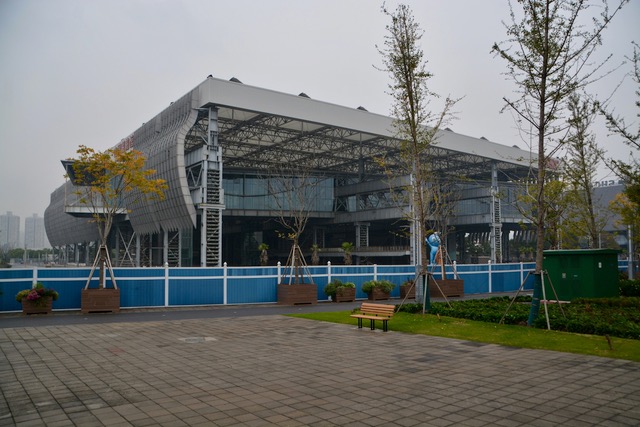
There is a large exhibition hall which in one half was running a pet fair. I didn’t venture but there was a fair bit of dog action going on in the corridors outside. I always believed that one owned a dog to take it for walks and in turn both parties got a bit of exercise. Not the case here – the dogs are very much in charge being pushed around in strollers. 

Kaohsiung also boasts a tall building. At 347m and 85 stories, 85 Sky Tower is a hotel with a restaurant with a public viewing deck under that giving unobstructed views. Well unobstructed apart from the smog that hangs over the city, and some not too clean windows. 

The return journey was an easy one, the metro back to the main station running every four minutes. Just over 90 minutes on the fast train had me back at Nangang station and our hotel.

In the evening Stan and some of his Royal Canin Taiwan team took us back to Tower 101 where we enjoyed a multi-course Taiwanese meal on the 82nd floor. 


Tuesday 28th November 2017

Back on the THSR I headed south again getting off at the Hsinchu stop. Like all these stations they are outside the city with local rail transportation to the city. The local train up on pylons took us over rice fields and into the Center of this, just under 500 thousand people, town. 

One thing that I have noticed over the past couple of days is every low rise building has a number of shiny stainless steel tanks on top of them that glisten in the sun at certain times of the day. I presume they are for there water supply.

Another thing that is prominent in Taiwan cities are the buildings built out over the footpaths providing shelter, extra retail space, and also a place for people to ride their motorcycles into and park up. 

I had spotted on the map not far from the station the Hsinchu City God’s Temple. Arriving at the location I couldn’t see the temple. I crossed the road and looked back seeing the decorated gables of the Temple. The whole, quite large, building is hidden behind stalls with narrow alleyways as a way of access. Built in the 1700’s and refurbished in the 1920’s this temple is about the ghosts. I was told these are the ones who don’t qualify to make it to the after life for reincarnation and just hang around as ghosts. Looks like the kind of catorgry I would fit into. 

Inside the place was busy with people praying and just hanging around; apart from me not a tourist in site. With many shrine rooms, statues and even a furnace blasting away (not quite sure what that was for), the temple has a large kitchen and lots of other rooms. No one seemed to mind me wandering around. 

From here I made my way through the town, with lots of small retail shops here selling just about everything. Just like everywhere in Taiwan motorbikes charge along footpaths and through pedestrian malls.

I was back at the hotel by two ready to be picked up and join the others for the flight to Hong Kong. The temperature here over the last few days has been great at between 18 and 23 degrees centigrade.

The Streets of Shanghai

Monday 20 November 2017

One of Sylvia’s team was leaving today so I volunteered to go out and get a nice letter opening knife as a gift. I started the search at the local plaza, which, with seven floors of expensive shopping, drew a blank.

I wandered the local streets near the Jing’an Temple and still nothing. With the aid of Google-translate and a picture I asked a couple of security guards who told me to order one on line. Eventually, probably to get rid of me, they pointed down a street so off I went. I put souvenir shops into Google maps and one popped up only a few kms away. I always enjoy strolling the streets of big cities as a good way to get a feel for the place. Most of the streets have plane trees growing down each side, which leads to the employment of many people to sweep up the leaves with there efficient home made brooms.

There are lots of small shops and workshops across the city crammed with stock. People race around on three wheel motorbikes delivering goods of carrying their tools of trade.

As it turned out, the souvenir shop didn’t exist. Next I headed across town, where I remembered seeing a large area of shops on a previous visit here. Just now it is hairy crab season. I watched a guy pull them out of a bucket and tie them ready for sale.

Eventually some helpful people in a gift shop gave me directions to a shop they reckoned should have a letter knife, I had by now found a youtube video to assist with enquiries. With a piece of paper with the shop name and directions in Chinese for me to show people off I headed. Soon I was pounced on by one, then another, tout who wanted, in broken English, to take me to their shop. Having got rid of them I found the shop but no luck.

Then a young woman with really good English asked if she could help. She led me around several shops but still no luck. She then suggested a cup of coffee and lead me into a restaurant. I was buying lunch and what’s more they didn’t even have coffee!! Then the questions started. How long are you in town? Which hotel are you staying at? Can I add you on We Chat? Can I have your phone number? Can we hang out while you’re here? Lunch over, and having not answered any questions, I hit the footpath alone, heading back across town to what I thought was an ornamental sword shop I had found online. I found my way up to the sixth floor where this place was located to find it was a media place, which had written an article about a sword shop which was 17 kms away and closed in five minutes. A guy from the US that worked there directed me to an antique shop close by. It no longer existed. After 20kms of walking the day was almost over and no letter knife. In the end I did find a nice good luck bowl, which made a good present. I had also seen lots of interesting sites along the way.


Tuesday 21 November 2017

On the way to People’s Square and the Shanghai Museum I passed through a nice little park where a security guard was giving a couple of woman a serious dressing down for daring to walk their bikes through the park. At the exit to the park hundreds of rental bikes jammed up the footpath. There must be hundreds of thousands of these in Shanghai as everywhere I went there were bunches of them often blocking the footpath. Only very occasionally I did see one being ridden.

Pottery, art, furniture and coins were the main things on display over five floors of the museum, some items dating back 5,000 years. Some early coins were made in the shape of knives.

After the museum I strolled to the Bund, a nicely done area on the bank of the Huangpu River. Hundreds of little pot plants make up a hanging garden wall popular with tourists.

Dozens of barges make their way up the river loaded with various cargo. I followed the Bund up river to the end to discover it is being extended. There are also many new buildings going up in this area.

Passing the end of the works I was intrigued by a two-plus meter wall that runs alongside the river with large gates in it at varying intervals. These gates have rubber seals and stays to pull them in tight to prevent flooding when the river rises.

Continuing up river more bikes blocked the footpath at regular intervals.

One of the big dangers I have discovered here are electric motor bikes which silently speed out from buildings with no warning. They seem to have their own set of rules, which include running red lights and not diverting to avoid pedestrians on the footpaths or pedestrian crossings.e

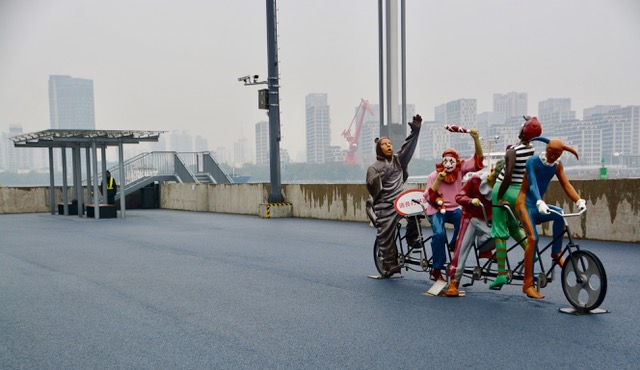
A few kms up river I came across a walking-come-running track. This is a really well done place with various gardens along the way. Seating areas are set along the way on piers built out onto the river. A bored looking security guard stood every 200m; many workers tended the gardens and kept the place pristine. I walked the length of the track, which must have been close to 10kms.

Near the end of the track are lots of stairs and tent type stands, aparently built for the world expo in 2008 but not used since. There are some impressive bridges crossing the river. A large ship with some interesting antennas sticking up sits in dry dock.

The track ended at a gate that was locked so I had to backtrack then make my way across town back to the hotel.


Wednesday 22 November 2017

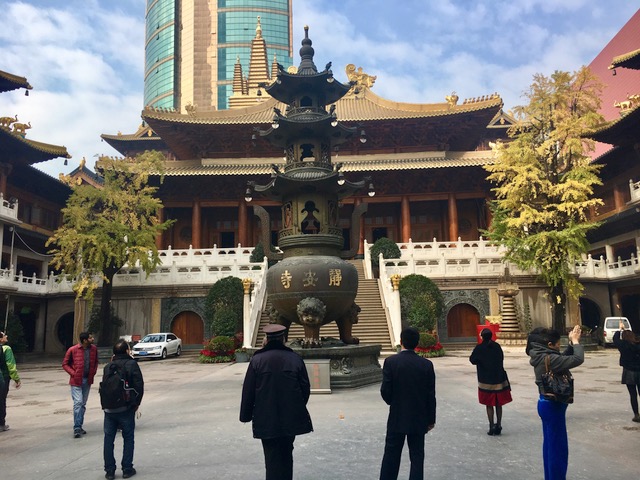
I started the day with a visit to the Jing’An Temple. Originating in 247AD, apart from being turned into a plastic factory during the cultural revolution, and back to a temple in 1983, it’s been a temple the rest of the time.

The main hall has a large sitting buddha and large round wooden columns holding up the roof. There are a number of worship halls in other parts of the building and a large statue stands in the courtyard, which people throw money up and into.

I took the number 2 train from the temple to the other side of the river where there are a bunch of the tallest buildings in town. I had seen the Oriental Pearl TV Tower quite a few times and was curious to see if it allowed the public up for a look. I was in luck, they did and what’s more it wasn’t too busy. Taking various lifts, eventually we reached the 359m capsule. The weather wasn’t very good and the windows were dirty but the experience was an enjoyable one. At about 250m there is a glass deck which is fun to walk around on.


Thursday 23 November 2017

I took the line seven train north about 18km to Gucun Park. Luckily it was quiet as by the look of the size of the entrance it caters for a lot of visitors. Even the ticket office has 20 windows.

I headed down the west end to a bird area. As I headed through the gate a lady in a hut yells out and rushes over to stop me. I show her my ticket; she shakes her head then leads me to another ticket office but there is no-one there. After an attempt with Google translate was going no where I took my wallet out and held it open. She took 20 locals and in I went. The area is well-manicured and maintained. A lot of the birds were in cages. I found a flamingo pond and was looking at what I thought were statues when one of them moved.

Opposite there was a parrot area the parrots were chained to the logs they sat on. The keeper was, I think, tied to her i-phone as she’d didn’t even look up.

I wandered through the rest of the park, which had a variety of landscapes.

Exiting the park on the east side I enjoyed a stroll back into town to meet up with Sylvia’s team for an activity. We were briefed up, divided into two groups and jumped in a taxi, our group heading to Tianzifang shopping centre, where we had to find a number of objects and photograph them with at least two of the team in the photo. We also had to complete some tasks, one of which was eating stinky tofu, which I hope I never have to eat again!

After that we headed to a restaurant. The traffic was so bad that we walked the last kilometre. On arrival the guy who had organised the challenge said we had all done very well. He departed and we tucked into a very nice traditional meal at a large round table.

Arriving back at the hotel a few of us retired to the bar for an entertaining evening – flaming B52s, burned lips and a few bottles of bubbles concluded and enjoyable evening.


A second long shot in Texas

Monday 30 October 2017

In May last year I had the privilege of spending a week with Todd doing some long-range shooting on a ranch near Canadian in Texas. See: A long shot in Texas. Since then Todd and his wife Shannon, along with her father, visited Queenstown in New Zealand and I had the opportunity to take Todd up to a friend’s station near Mount Cook. There we went up on the hill at about 1500m and saw a few thar but nothing worth shooting. We had a good look at the scenery, which Todd enjoyed so much he took Shannon and her father back up there the next day for a helicopter flight around Mount Cook. During that trip Todd invited me back to Texas.

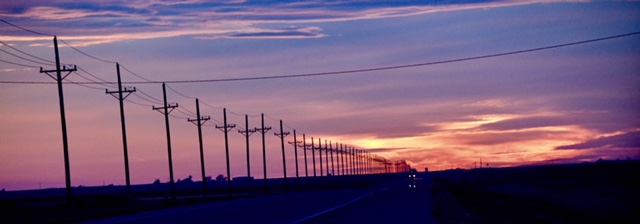
Arriving in Amarillo late Sunday night, I spent the night in a motel near the airport. Heading north just after 5am I was bemused by these red lights spread far and wide that flashed on for a few seconds and then went off. As the dawn light appeared it turned out that these were on the top of hundreds and hundreds of windmills that become very prominent across the panhandle plains.

Arriving at Sleepy Hollow, the training house where I will be staying for the next ten days, I was met by Joe and Aaron who are US Marshals. They are here as sponsors for the international police snipers who are attending the training this week.
Soon the rest of the group turns up and Todd gets the training underway.

I really enjoy this training as there is so much to learn in long range shooting, a lot of which I covered in last year’s story.
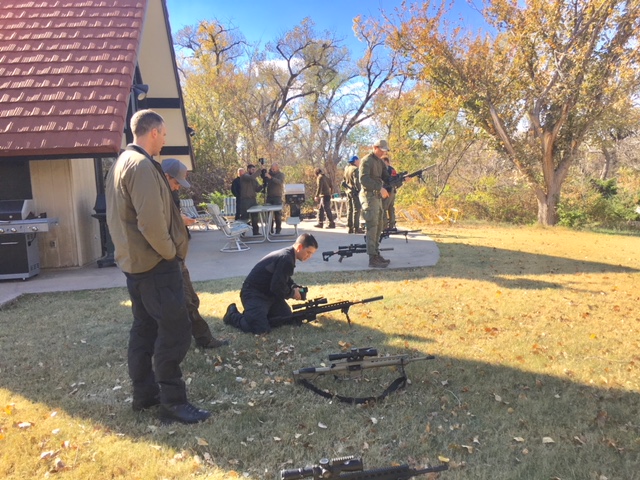
Each morning is spent on theory and the afternoon out shooting. Monday afternoon we zero our .308/7.62 rifles at 100m then true the zero at around 700m making adjustments in our Kestrel ballistic calculators/programme to adjust the algorithm to match the flight path of the bullet. We then get to shoot the wind course where we walk around the top of a hill engaging 12 inch discs out to 600m and 16” targets out to over 800m at various wind angles. The wind is gusting over 20mph in places making the targets hard to hit.


As the week goes on we engage targets effectively out to just over 1000m. At 1200m the standard military ammunition we are using reaches the end of its capability. We also had a couple of Marathon robotic targets running round on a flat area 600m away which were effectively engaged.

On Wednesday night we head down to Pampa, 40 or so miles down the road, for a BBQ rib meal at a restaurant. All 23 of us were tucking into some rather tasty food when a big local Texan strolls up to our long table and says “are you guys military?” Then, before anyone could answer, “I am going to buy your supper!” He then strolled of to the reception and paid the bill for all of us.

As the week went buy we shot at various places, one being the golf course, where we drove along a road stopping to shoot the 18 targets at various places and various ranges and wind angles.

Canadian is a dry town in a dry county but there are two restaurants in town where one can have a drink with a meal by, I think, joining a club by producing ID. The Stumbling Goat we had eaten at a couple of times during the week. Just down the road the other is the Cattle Exchange which I visited with Des and his team on Friday night before they left town.

Saturday morning I was alone at Sleepy Hollow and headed out to shoot the wind course again. While doing so I looked up the valley to see in the distance both ends of a long train which must have been well over a mile long. Over a hundred of these roll through this valley every day.

While looking at the map over lunch I realised that Dodge City in Kansas wasn’t too far away. Made famous by Wyatt Earp and a few others back in the late 1800’s, I thought it deserved a look. The 150-mile drive was interesting as this is big bold country where one can see for miles. Even a driveway to someone’s ranch can look like it goes into infinity. The drive took me through a strip of Oklahoma into Kansas.


Arriving in Dodge late afternoon I was surprised to see what looked like a deserted town. There wasn’t even a bar in the Main Street. However there stood a statue of Wyatt and a mention of a few other characters from those days.


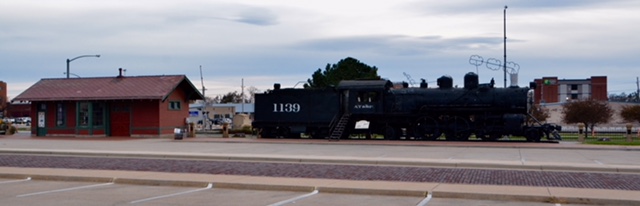
Just down the road from the city centre is a sort of mock up town and a train in an area called Boot Hill. It was all closed up but I presume that is where they will re enact some of Wyatt’s antics to drag in the much needed tourist dollar.

In 1871 rancher Henry J. Sitler built a sod house west of Fort Dodge to oversee his cattle operations in the region. Conveniently located near the Santa Fe Trail and Arkansas river, Sitler’s house quickly became a stopping point for travelers. Others saw the commercial potential of the region with the Santa Fe Railroad rapidly approaching from the east. In 1872, Dodge City was staked out on the 100th meridian and became the legal western boundary of Fort Dodge. The early settlers in Dodge City traded in buffalo bones and hides and provided a civilian community for Fort Dodge. However, with the arrival of the railroad, Dodge City soon became involved in the cattle trade. The town flourished attracting bars, brothels and a fair bit of mischief which required a good lawman to keep it in some sort of order.

The longhorn cattle being driven up from Texas carried a tick that spread splenic fever. As more agricultural settlers moved into western Kansas, pressure increased on the Kansas State legislature to do something about splenic fever. Consequently, in 1885 the quarantine line was extended across the state and the Western Trail was all but shut down. By 1886, the cowboys, saloon keepers, gamblers, and brothel owners moved west to greener pastures, and Dodge City became a sleepy little town much like other communities in western Kansas. Thanks Wikipedia

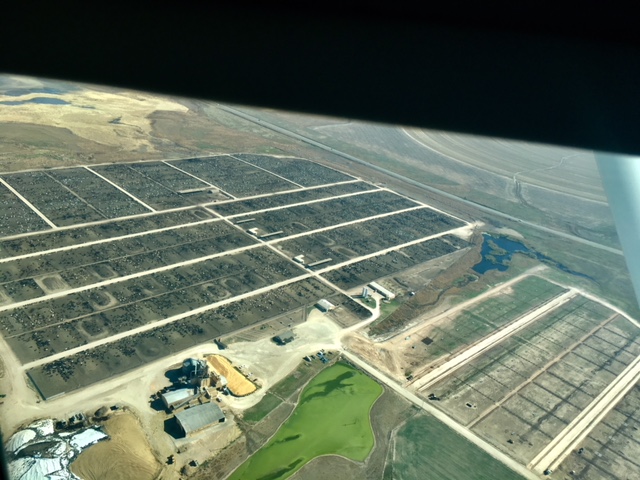
I drove east through what is still a sleepy town, passing grain silos and a large meat works with thousands of cattle awaiting their fate across the road.

The main industries here now are the meat works, farm machinery and cropping. In the late 1800’s after the cattle boom, a variety of German wheat was planted in large areas around here followed by a drought that turned the area into a dust bowl as high winds blew away the top soil. 5 miles down the road I came to Fort Dodge, now run down with the housing area a home for wounded veterans.


As I headed back to Canadian the sun was setting lighting up the sky’s in stunning colours. Apparently great sunsets are just the norm here.


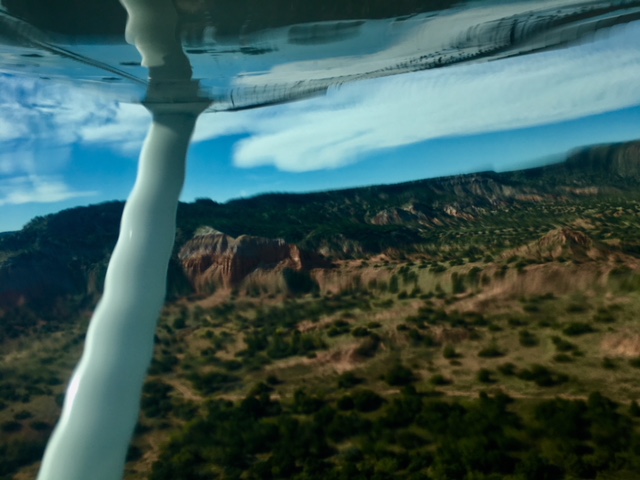
Sunday morning Todd and Shannon picked me up and we drove to Pampa for brunch with their son Will, where we shared some great Mexican food. After lunch Todd and I headed to the Canadian airport, where Todd and his friend Eddy have a few aeroplanes. We dragged a Cessna 180 out of the hanger, fuelled up and, with Todd at the controls, were soon airborne. We headed south east to the Palo Duro Canyon, this 60 mile long canyon with 800ft cliffs is second only to the Grand Canyon.

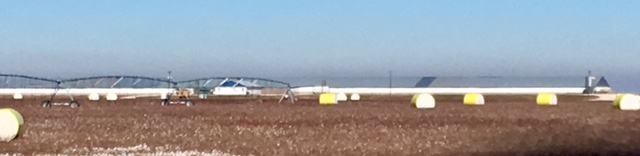
We flew the length of the canyon, at times well below the cliff tops on each side. The flight there and back was also interesting giving a great view of the different types of farming taking place in the panhandle of Texas. Cotton and other crops are being harvested on the large plains. The white crop of cotton, now mostly in round yellow bales makes for quite a contrast.

The number of windmills in this part of the world is staggering. Normally in lots of a hundred, they are in patches right across the landscape. I reckon there are so many that if they have a serious wind here they will speed up the rotation of the earth. Trucks and trains carry in blades for these beasts.

That evening at Sleepy Hollow two new US Marshals arrived. Mike and Mike, like the two previous Marshals, were great guys. As coincidence would have it, one of the Mikes had worked with some friends of mine in another part of this bloody small world.

On Monday another group of snipers turned up from Europe to undergo Todd’s training. All of a sudden it was Tuesday evening and my last night. Todd, Eddy (the ranch owner), the two Mikes and I, headed into the Stumbling Goat for a meal, after which we headed back to Sleepy Hollow for a drink and a yarn. Texas is big and time goes fast as all of a sudden it was the early hours of Wednesday. When we rose a few hours later at 7 it had snowed making the autumn colours stand out even more.

After the morning lesson and lunch with Todd it was time for me to hit the road. I had once again had a great time in Texas with a great bunch of people. I can’t wait for Todd and Shannon to come back to NZ so as to return their generous hospitality.

While waiting to board the flight at Amarillo a tall guy strolled over and said I looked like a Kiwi. We had a bit of a yarn and caught up again in the boarding lounge in Houston. It turned out Jonathan, from Wanaka, and I knew a few of the same people from down south. We ended up chatting in the business class galley, joined by Lisa from Auckland, for several hours of the flight home until both the business and premium galleys ran out of beer. Meeting great people is one of the many things I enjoy about travel.


A pleasant few days in and around London

Monday 2 October 2017

Arriving at Heathrow after an overnight flight from Singapore we caught the Heathrow Express to Paddington. For £52  return, moving at up to 160kph, we were at Paddington station quite quickly.

We checked into the quite new Novotel – their bottom priced rooms are called Superior Suites and compared with many other hotels they should be branded inferior. The detail in the workmanship, painting, tiling etc is pretty shoddy. English was the second or third language for most of the staff.

Sylvia did some work then headed of to a few meetings.

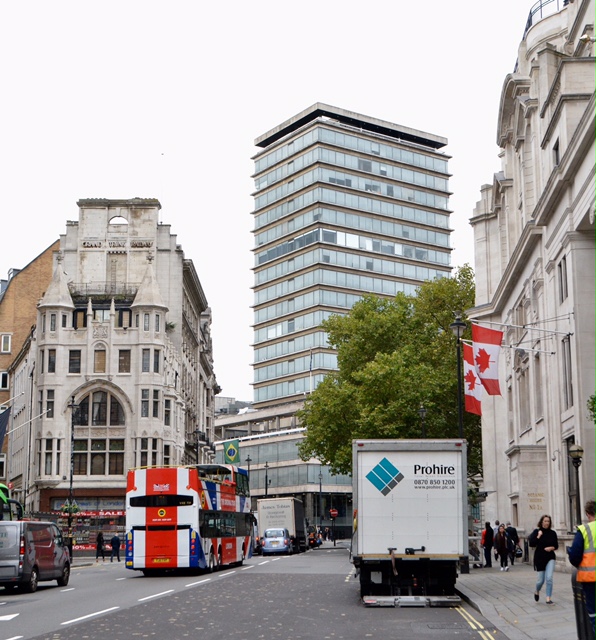
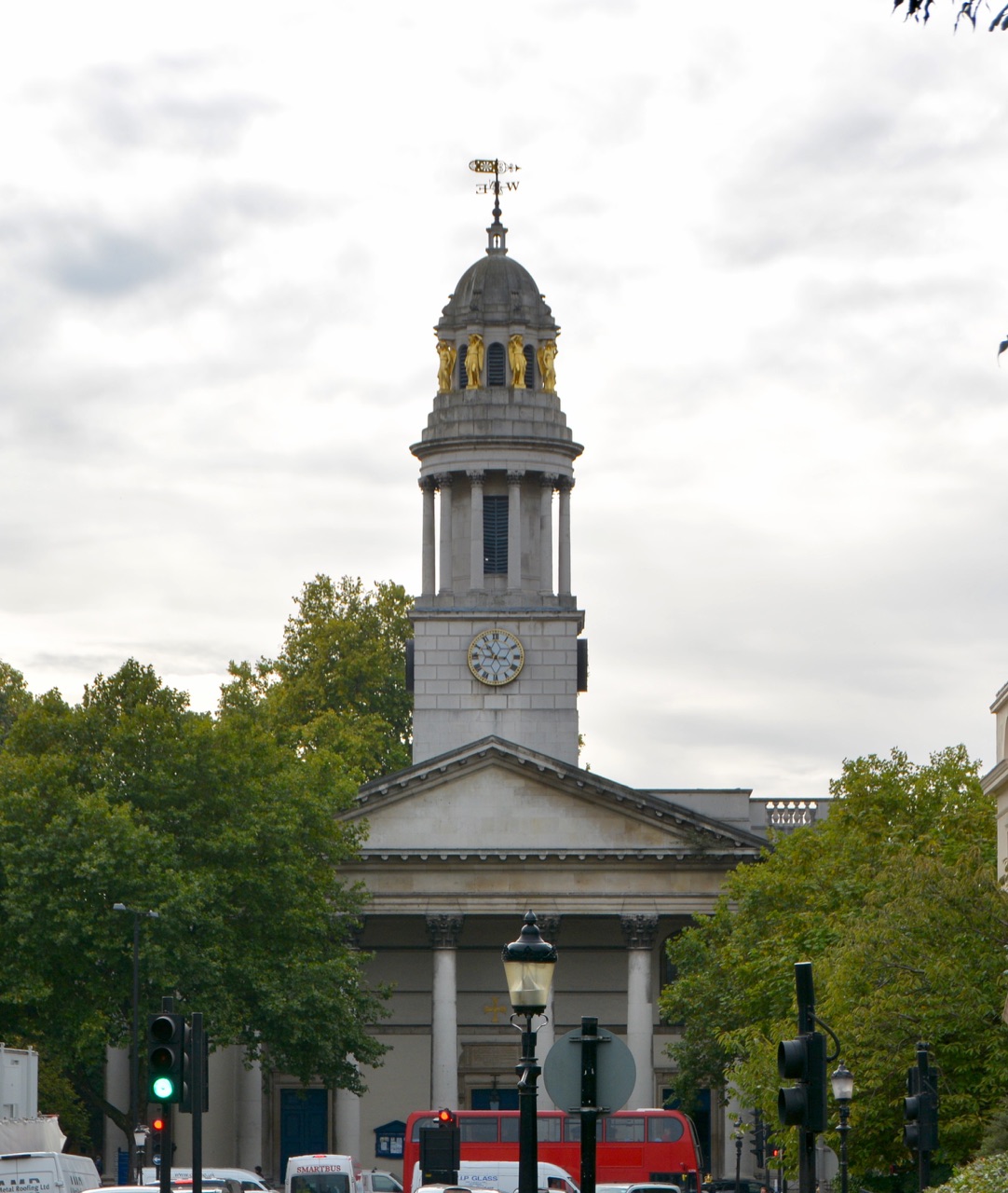
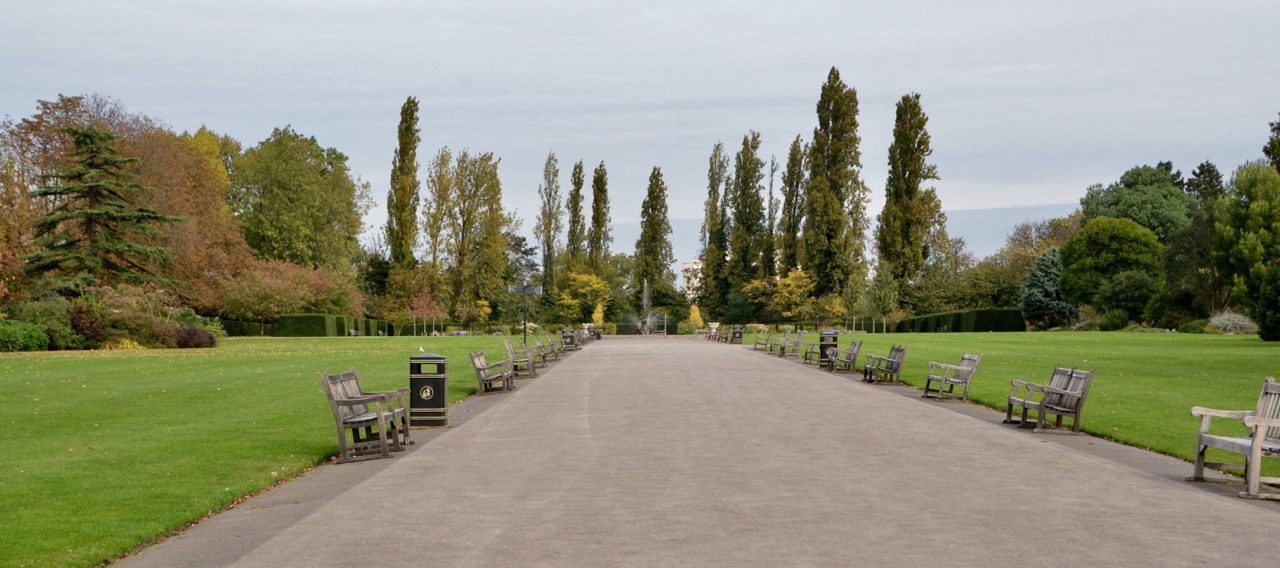
After finishing writing last week’s blog I took a stroll through Paddington to Hyde Park. The thing I really enjoy about London is the feeling of space as, compared with most cities in the world, the buildings are relatively  short, meaning one can see the sky whilst walking down the streets. There are few buildings around the park that protrude above the trees. What’s more the sky was blue with little sign of pollution.

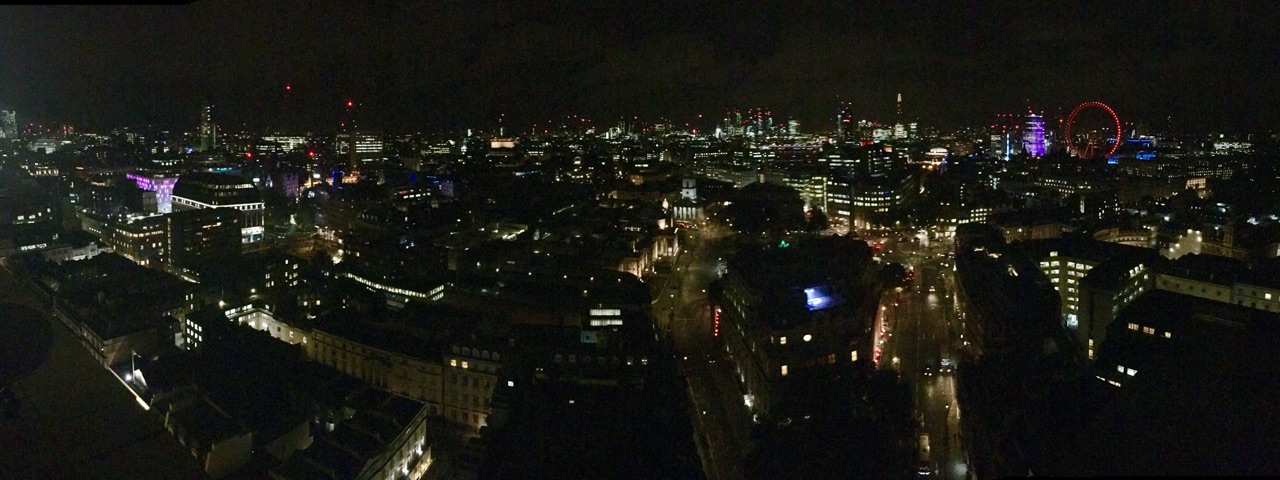
A stroll through a few streets, across Green Park and down Pall Mall and I arrived at New Zealand House. My friend Evan, who works there as the NZ Defense Attaché, had invited me to the top floor to sample some wine and cheese. It was a great gathering with lots of interesting people.


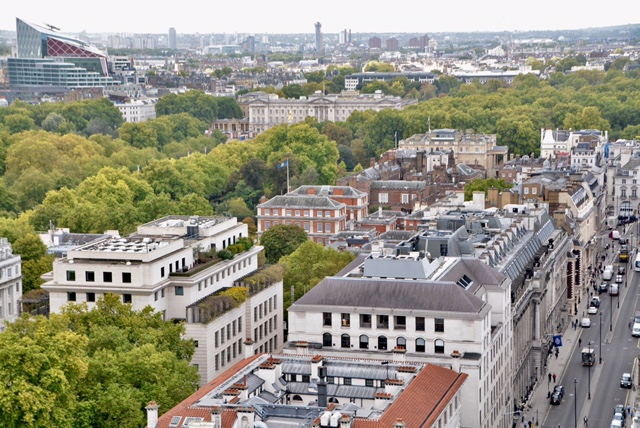
This is one of, if not the the, tallest buildings in central London with amazing views.


Tuesday 3 October 2017

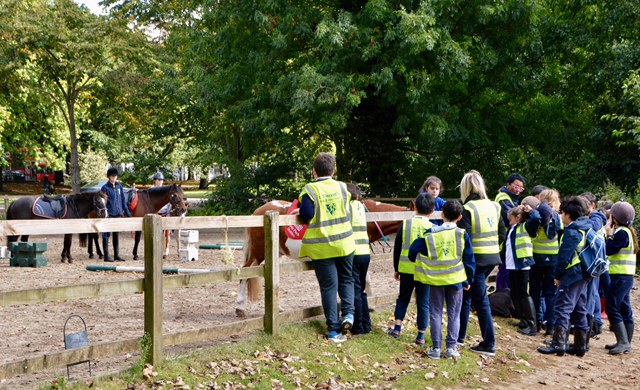
Another stroll through Hyde park:  I came across ponies, penned up, waiting for an enthusiastic bunch of kids to take a ride. Later I spotted these same ponies being ridden through the streets.

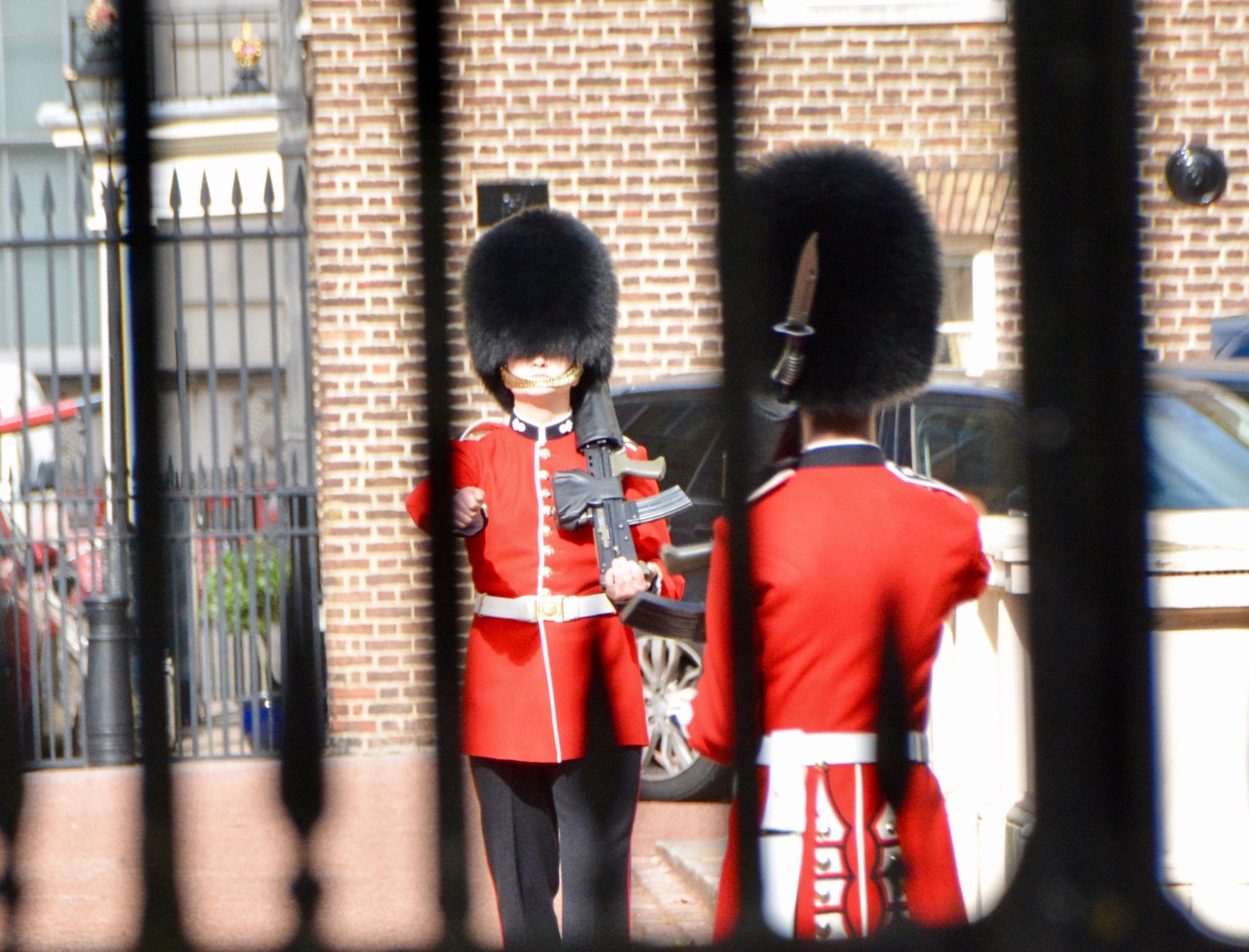
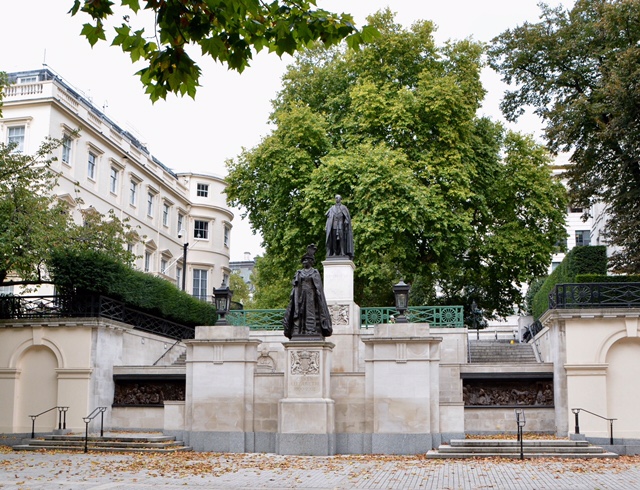
At Clarence House, which adjoins St James Palace where Prince Charles hangs out, two policeman slouched around their guard post MP5’s not exactly at the ready. Inside the gate two guardsmen in their red tunics and bear skin hats stood to attention, marching from time to time back and forth behind the high steel gate. 


A little further down the mall there are statues to various Kings, Queens, Dukes and heroes.

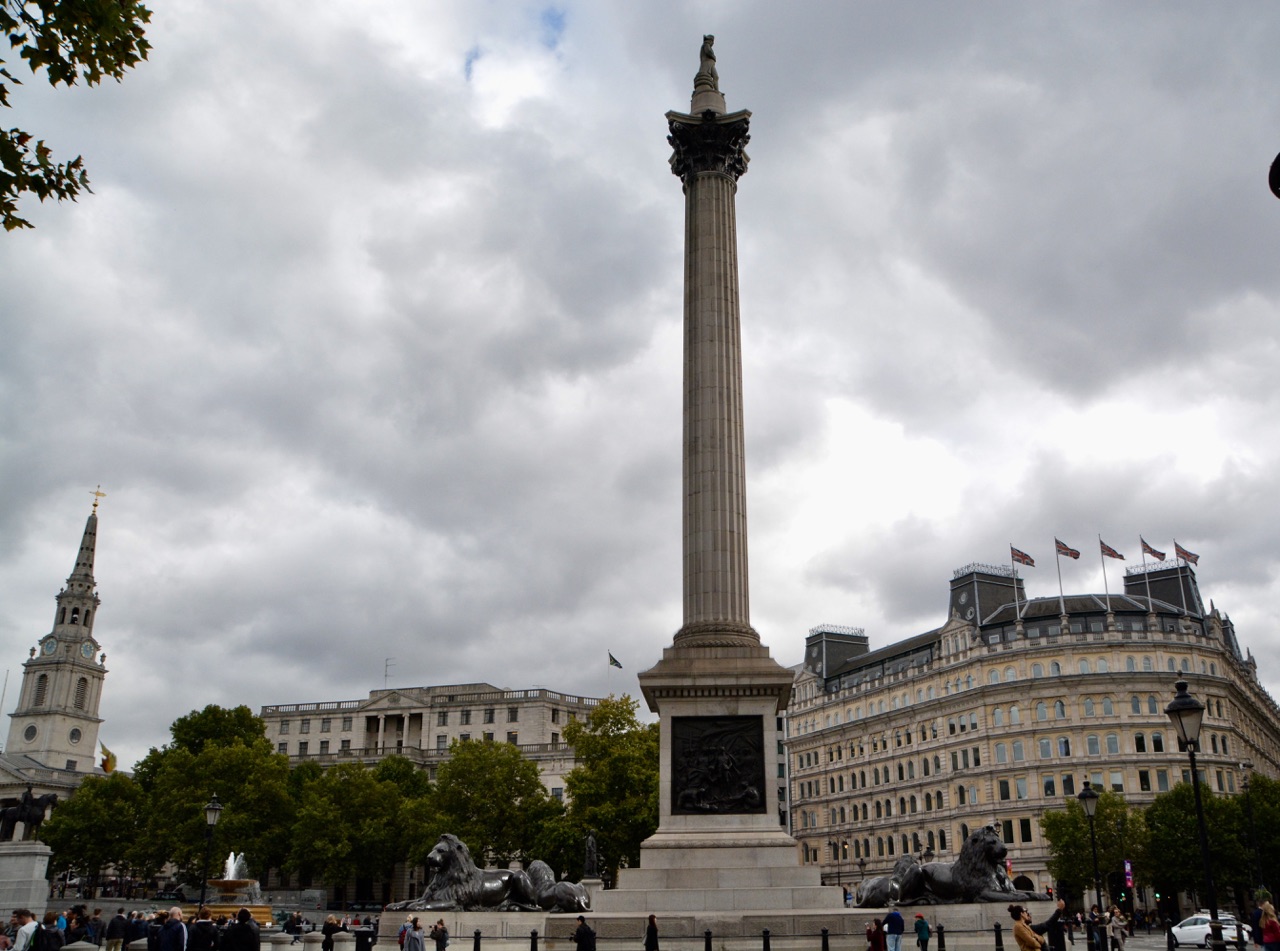
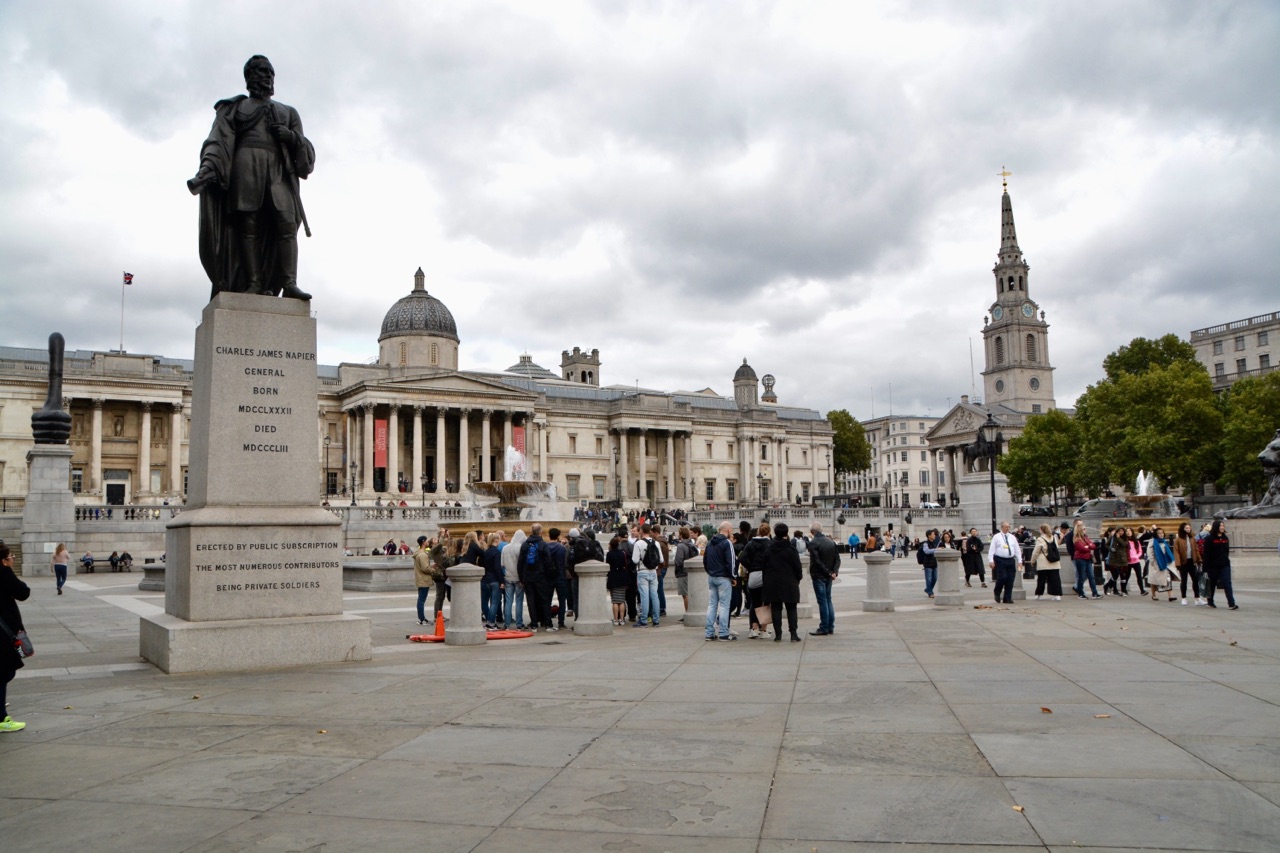
The Mall leads down to Trafalgar Square where lots of people sat on the steps enjoying the sunshine.

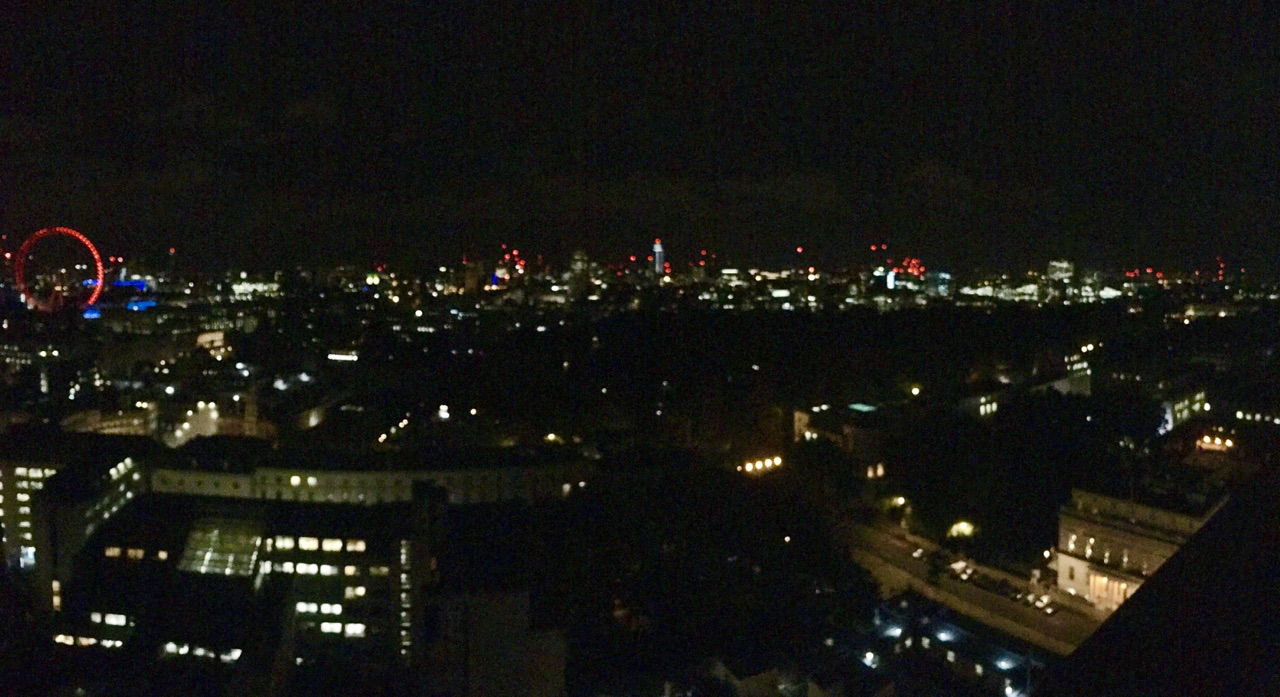
Back at NZ House, Evan took me to the top floor again to have a look by day. It’s not the best looking building in London but certainly has the best views.

In the distance stands the charred shell of the Grenfell Tower, where around 80 people perished in the June fire. Like every big city I have visited lately numerous tower cranes are dotted around the city. After viewing the city from up high we headed to the Thai Square Restaurant and enjoyed a lunch with Evan and Willie who was passing through London.

I took a stroll home via the side of Buckingham Palace; the security fence and cameras on the walls around the garden look pretty serious. Apparently it got beefed up after a guy got inside and sat on the Queen’s bed.

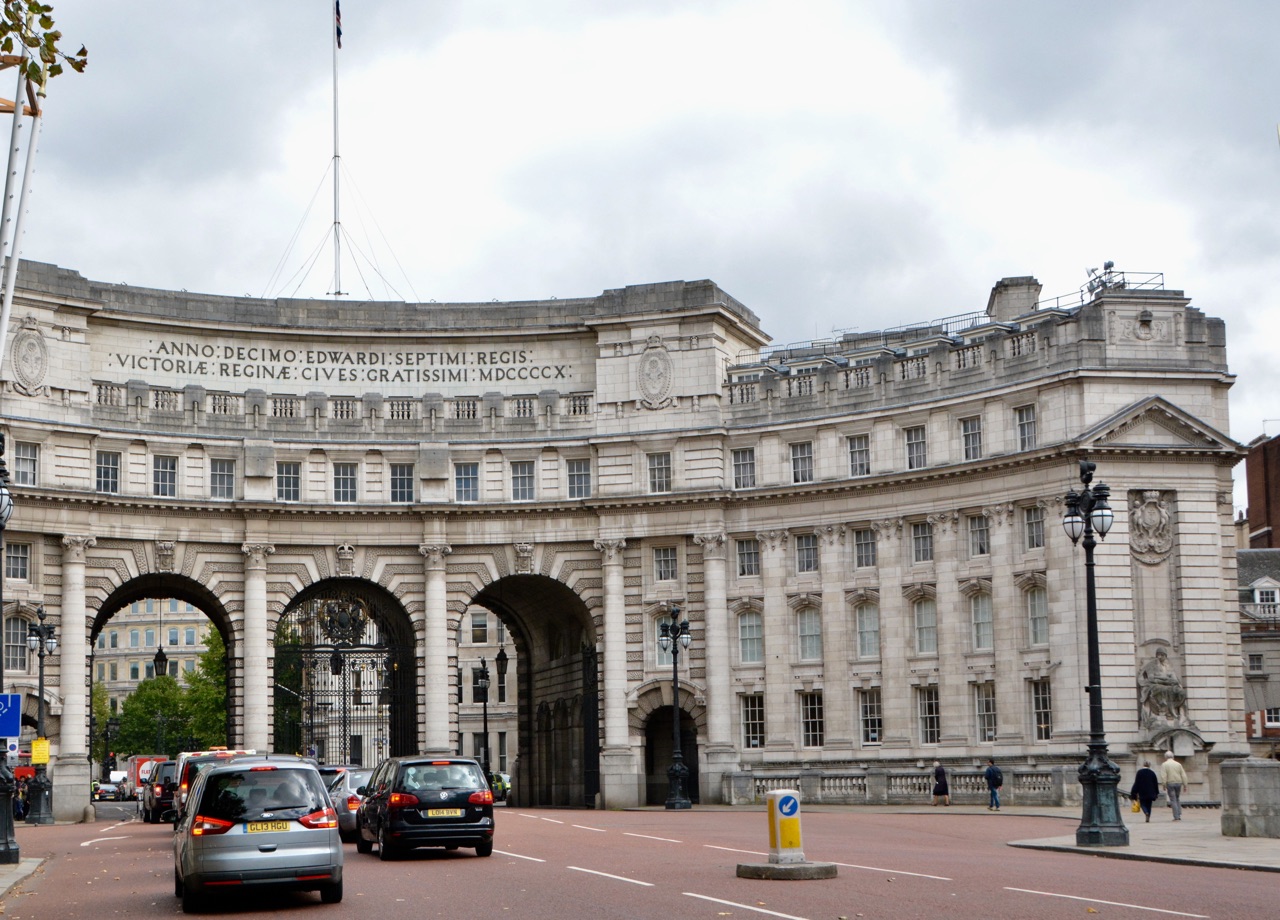
A bit further down the road near a Hyde park entrance is the Duke of Wellington Arch along with a few other statues.


Wednesday 4 October 2017

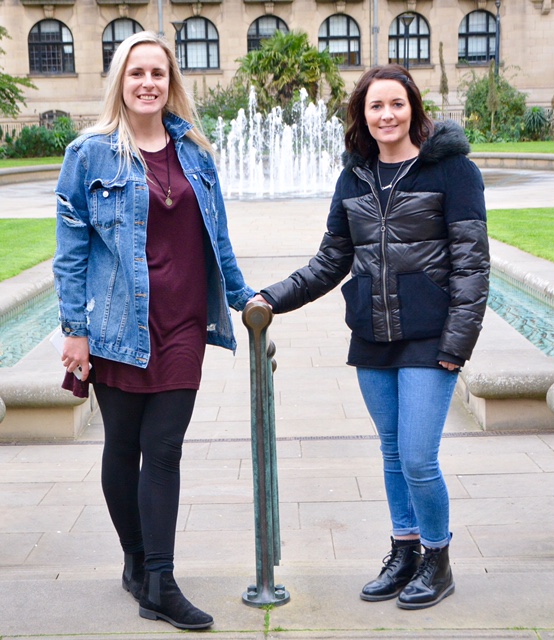
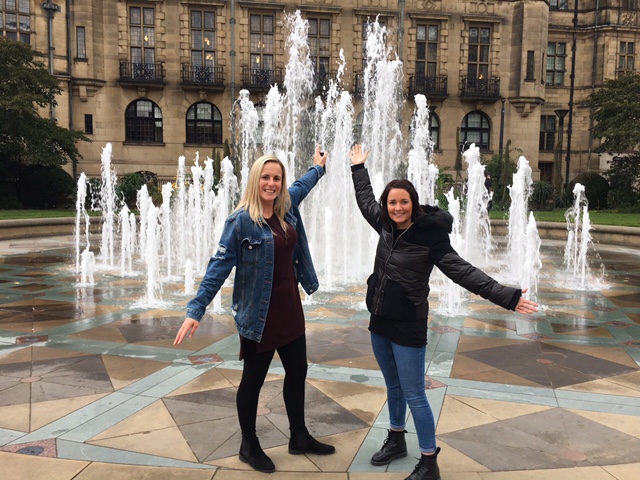
A couple of years ago, when taking a boat down the Amazon with AJ And Cam, we had met three lovely English girls from Sheffield. Today I headed to off to pay them a visit.

Gabbie, Georgia, Gemma, AJ and I on the Amazon, January 2015

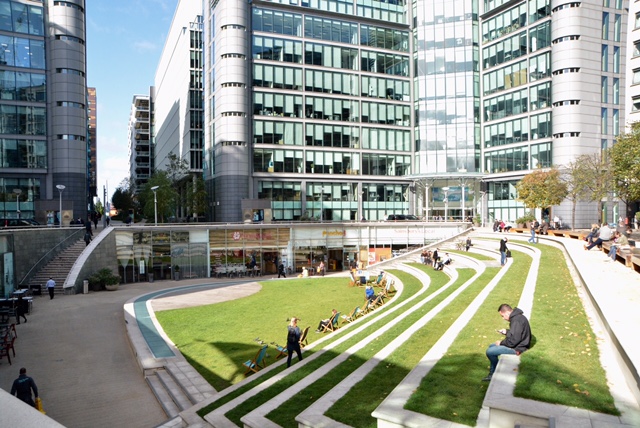
I headed down outside the new development near the hotel which runs to a canal. Crossing the canal I headed alongside the A40.


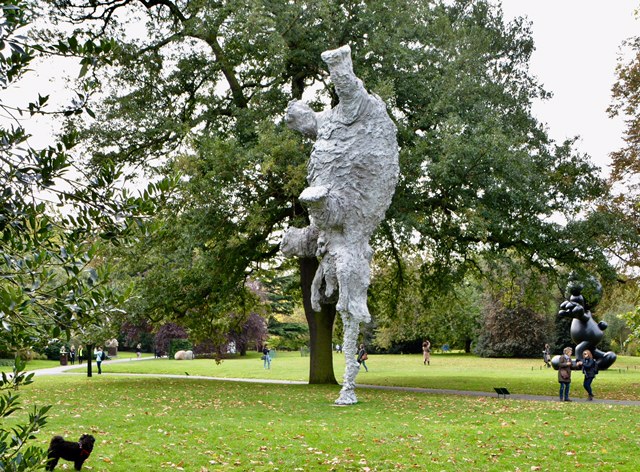
A few kms along the road I came across Regent Park and detoured through it. Well kept, with streams, ponds, and lots of different gardens and sculptures, it is well worth a visit.

Arriving at Pancras Station it was easy to get my internet booked ticket out a machine just by inserting my credit card. The station and surrounding buildings are impressive.

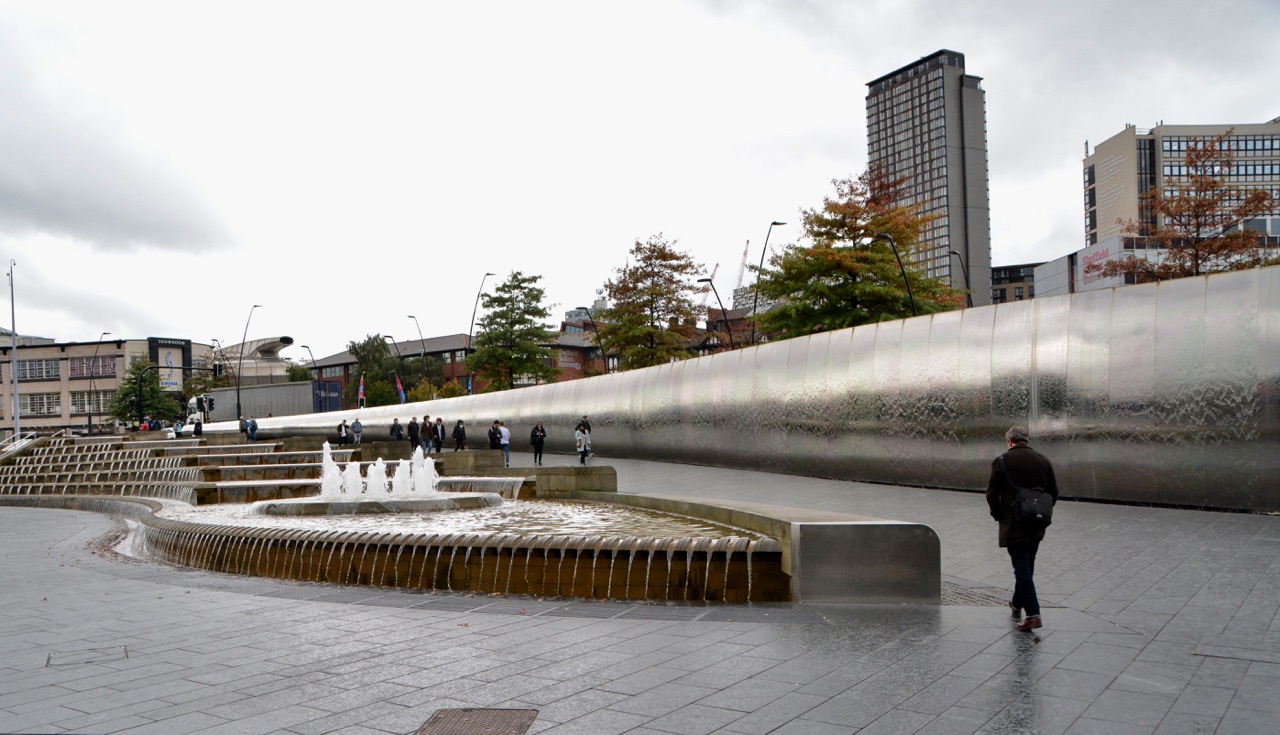
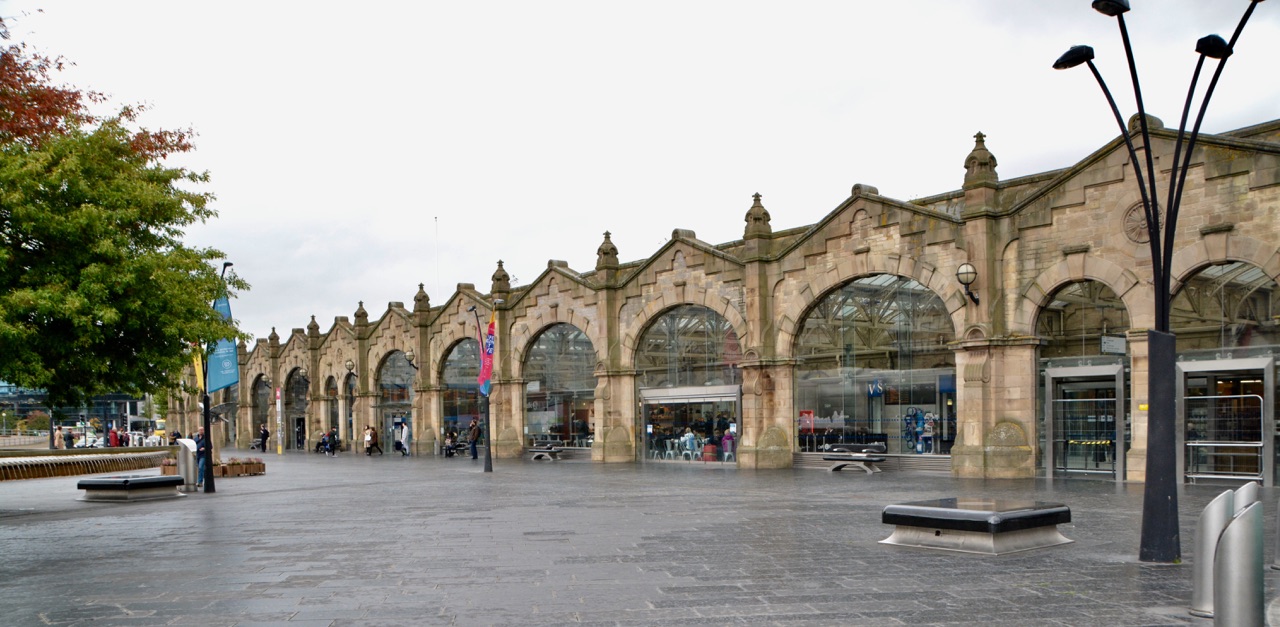
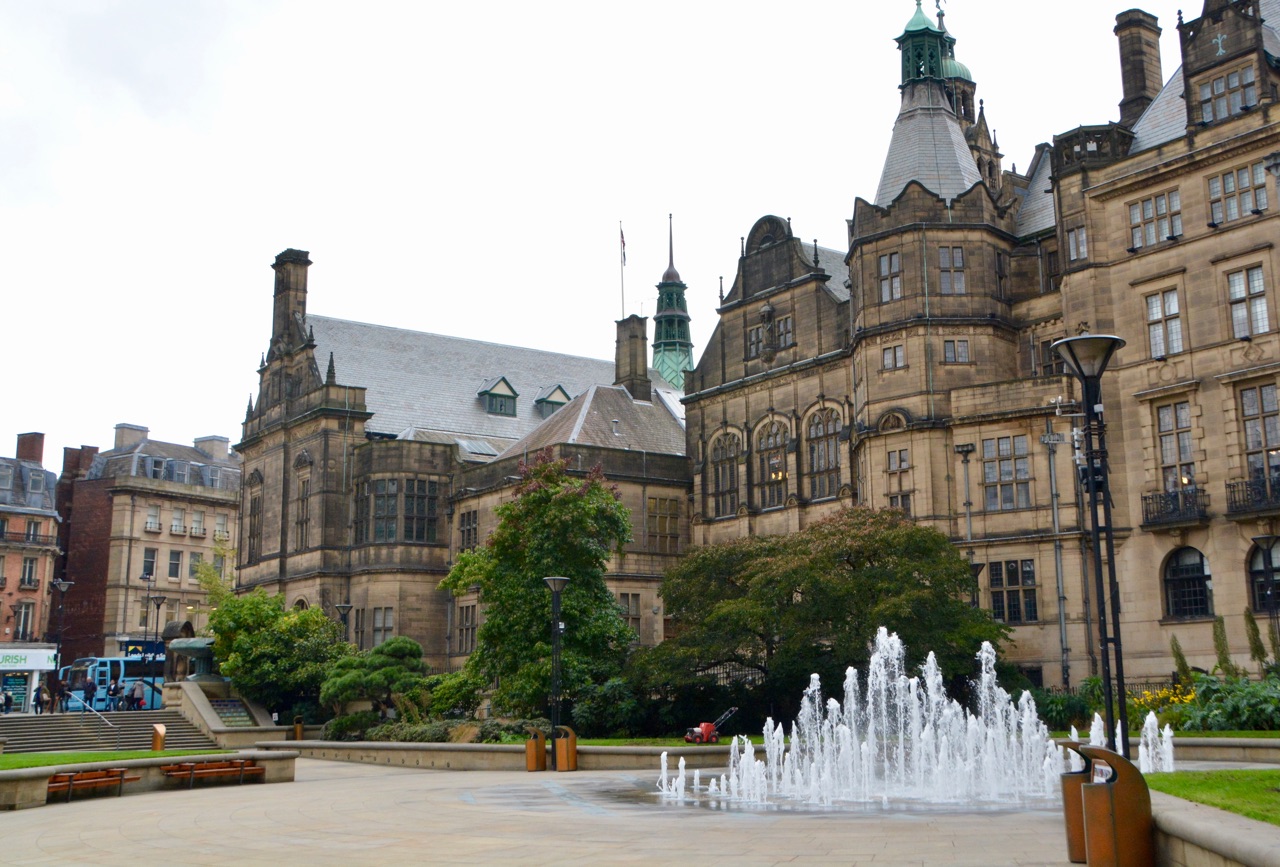
British rail has changed a fair bit over the past few years, the train left bang on time, and the carriage was clean and comfortable with a food trolley passing through quite a few times over the next few hours. Arriving at Sheffield I stepped out of the station to be greeted by a magnificent water feature.

The front of the old station was well preserved, blending in with the surrounding buildings.

Heading back into the station to Platform One, near the Sheffield Tap where we had arranged to meet, there was a strong smell of spilled beer as punters packed the bar waiting for the next train. As the bar emptied out Georgia arrived, followed soon by Gemma; unfortunately Gabbie  had to work and couldn’t make it. After enjoying a local pint I was led on a tour of the town.

Known for its steel manufacturing, I had not expected such a nice town where the old and the new have been blended together really well. We paid a visit to Gemma’s parent’s Butches shop, where NZ lamb is nearly half the price it is back home.  A gold painted post box was pointed  out to me; it has become a tradition in the U.K. that when a local wins a gold medal at the Olympics a post box is painted gold.

We then headed for a meal and a good catch up. All too soon I was back at the station saying goodbye.

On the trains and at the stations there are now constant warnings for people to be alert and notice anything suspicious – “don’t be the person that doesn’t speak up” – but in spite of the recent events life goes on as normal.


Thursday  5 October 2017

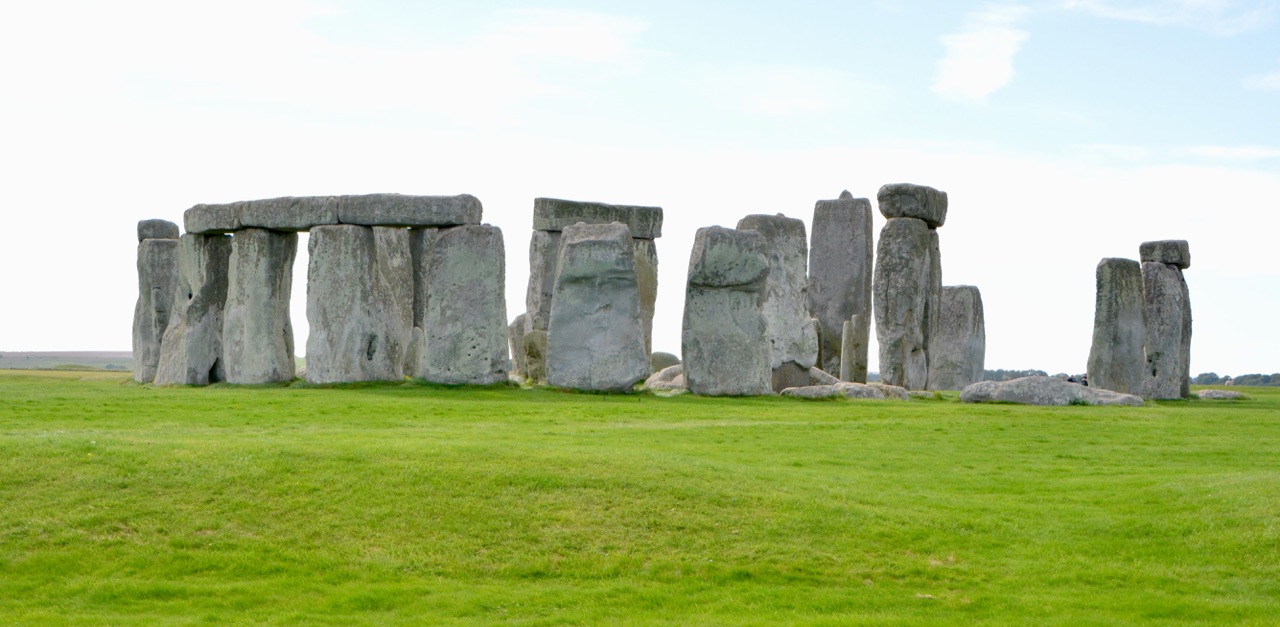
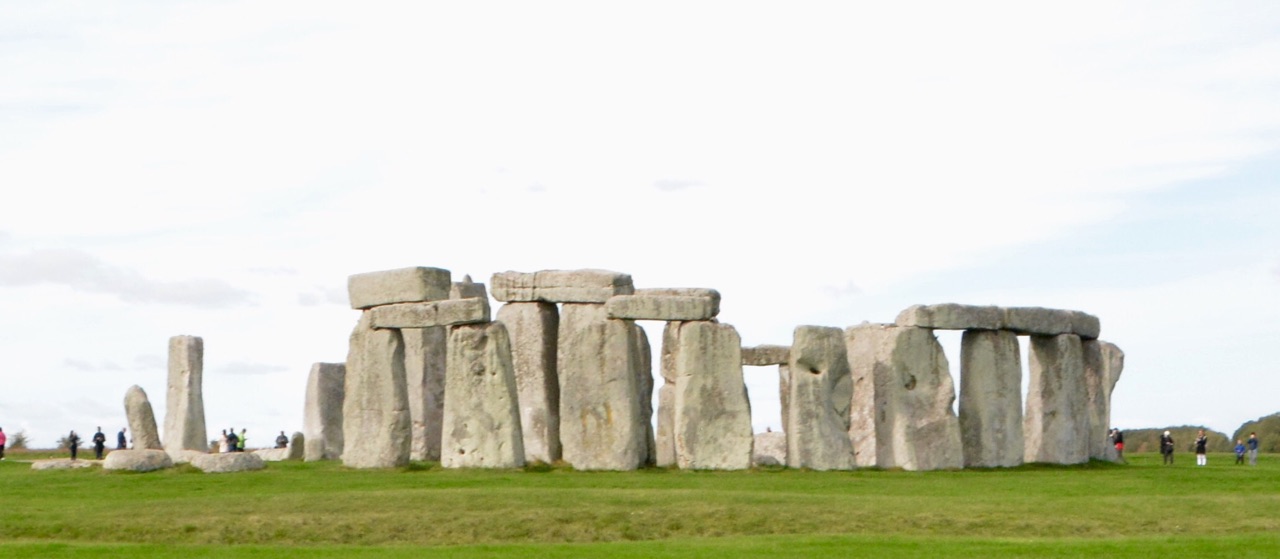
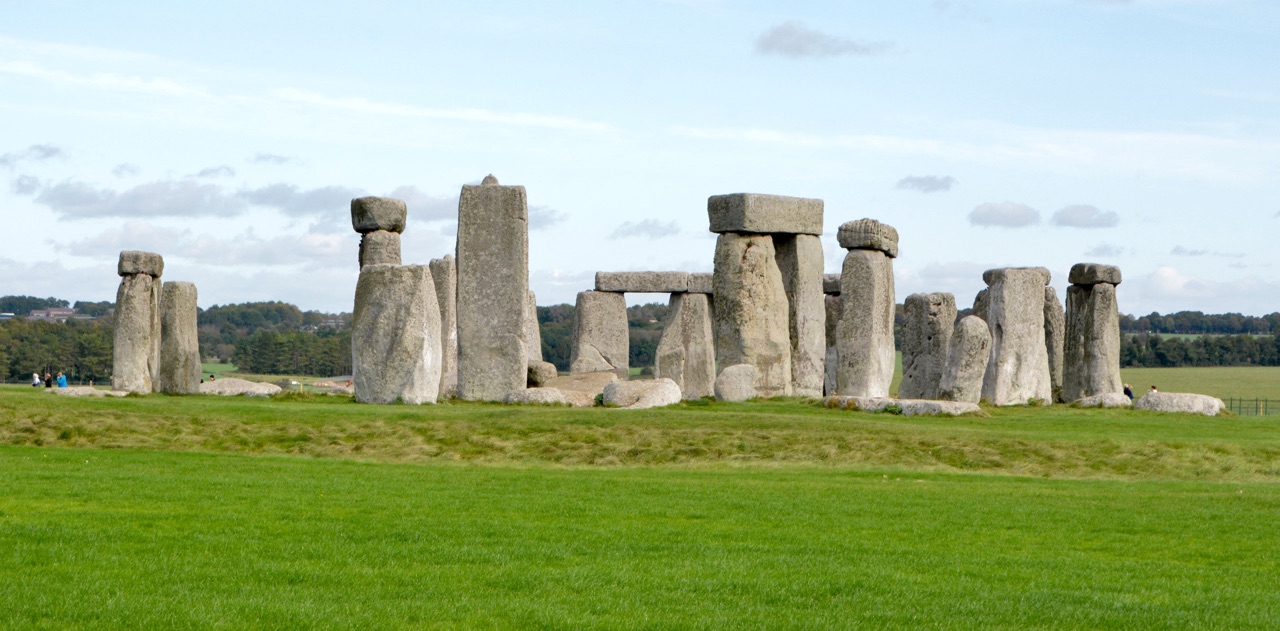
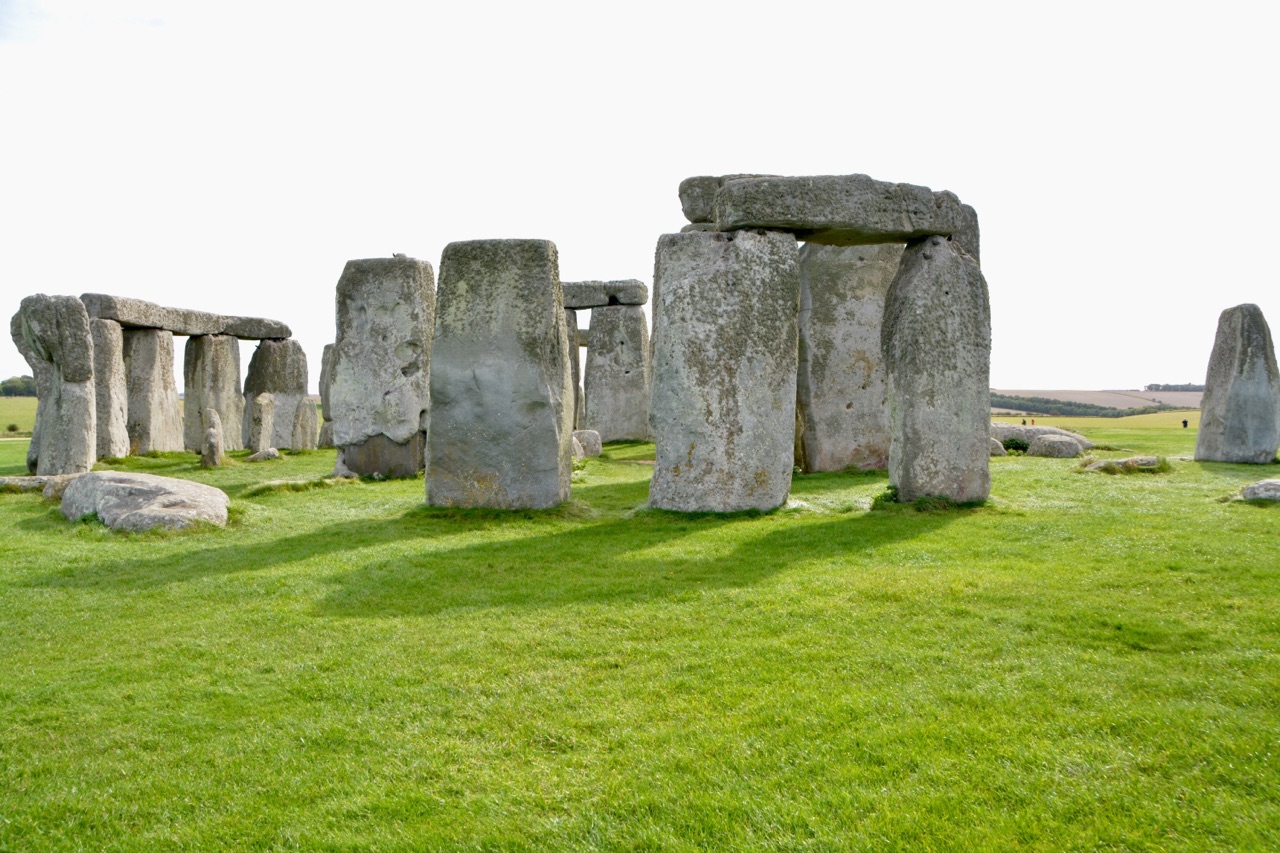
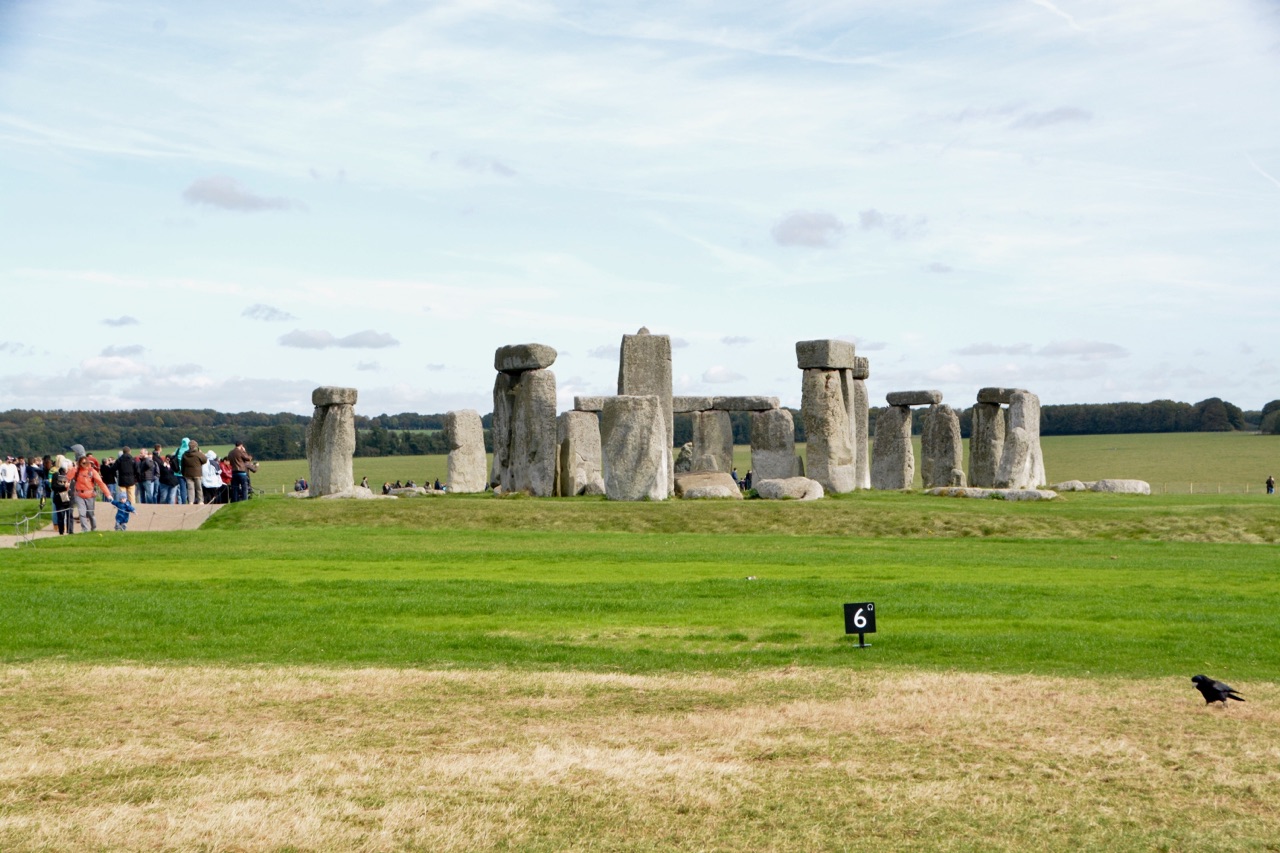
In the mid 80’s my mate Greg spent 6 months working in London and came back talking about the places he has visited. The one that stuck in my mind was Stonehenge. I have always thought I must go there one day. Finally today was the day. I booked a trip online with Evans Evens tours.

I took the Tube across town to Victoria station which left a short walk to the Victoria bus terminal. Only six years ago in London pedestrians used to mostly stick to the left side of the footpath; not any more it’s now a cluster!! Bit like playing dodgems on foot. Apparently it is caused by the huge influx of people from Europe over the past few years. Maybe Brexit will sort it.

The big red bus headed out of London with the driver pointing out lots of places and monuments along the way. Once out of the city we got a good overview of the pretty countryside with its green fields and trees many starting to turn golden brown. What really surprised me were the many large fields full of solar panels. I didn’t thing they got enough sun here to farm it!

In a little over two hours we arrived at the stones. With over a million visitors a year they have built a big tourist centre a couple of kms away from the stones. A stroll through a partially interactive museum leads outside to some period huts and a large stone set on rollers (logs) as if ready to be dragged somewhere. Buses ferried people up to the stones but one look at the queue and I decided to walk.

Apparently a bunch of people some 4,500 years ago dragged these huge stones from as far away as Wales. They were shaped and stood up to to align with the sun. Over the next few thousand years they were rearranged a few times. Nowadays one can’t get close to them as they are worried about all the foot traffic damaging the site.

One good thing was that from a distance as i walked around I got a good appreciation from all angles. At one point a Chinook helicopter hovered nearby.


Listing to the commentary on the headpiece as I strolled around, I came the the conclusion that despite of a lot of digging and research by many experts, no one really knows why the people of the day decided to make this stack of stones right here.

Arriving back in London I collected my bags and headed to the airport to meet Sylvia for our night flight to Singapore.

I am now back in NZ for three weeks then to the US for a couple of weeks on the 29 October.

A brief look at South Korea

Monday 25 September 2017

Landing at Incheon International Airport we were met by a driver to take us the 60-plus kms into Seoul. Well over an hour later we arrived at the Grand Intercontinental Hotel, where we showered and changed before Sylvia and her team headed off to a meeting. I took a wander down the street, tasked with drawing some local cash from a money machine.

By the hands I found an entrance to a huge shopping mall running for blocks below street level. With very wide corridors and plain shops, it looked quite sterile. After several attempts at an ATM, a friendly security guard stepped in and told me which buttons to push.


At noon I headed back to the Royal Canin office to meet Sylvia and the Korean team; from there we were driven to Suseo Station.

Soon we were speeding south through the world’s fourth longest rail tunnel. Only recently opened, this 50.3 kilometre tunnel heads south allowing the high speed train to reach speeds of 240kph in the tunnel. I don’t think they are up to full speed yet as it was thirty minutes later that we surfaced. I activated the speed app on my phone once above ground as the train accelerated to 297kph. We sped south through a combination of flat farm land and bush covered hills.

We stopped at once at a city that had been purpose-built to move some of the many government departments out of  Seoul.

In just under an hour we arrived at our destination, 170k south of Seoul. A van drove us to our hotel in Jeonju. As in Seoul, the air is thick with pollution. Apparently it is a combination of a dust that blows in from the Gobi Desert mixed with the local factory and vehicle fumes. Jeonju is a combination of the old and new; dozens of fifteen-plus storey apartment blocks have sprung up in clumps around the town.

A short stroll up the street revealed a tidy produce market operating on the footpath.

Small shops contained everything from workshops to washing machines – if the signage was removed these shops could be in any part of Asia or South America.

Several streets were covered over with a dome roof and traded as a huge supermarket-come shopping mall.

In the evening I was invited to join the team for a Korean BBQ dinner at a local restaurant. The meat is cooked on coals at the table and accompanied with lots of varied dishes including spices and vegetables – very very tasty it all is.


Tuesday 26 September 2017

A van picked us up and drove us to the site of the new Royal Canin factory, currently under construction at Gimgie. I was privileged to be invited to go on the tour with the team. After the safety training, Steven the Australian project manager lead us around the site. The building is 42 meters high with a vertical production process. The whole construction project is being done under the LEED Gold standard rules for sustainability, so everything coming onto and leaving the site is checked, weighed and separated for recycling. When manufacturing starts next year the plant will be zero waste to landfill.

After the tour Jimmy, the Korean General manager, had organised a guide to take me to the old village. Keven, originally from Idaho in the US, now lives nearby and with his wife runs an English language school.

Joenju Hanok Village is the old city of this area, consisting of largely restored old style buildings. Visitors flock here from all over South Korea, many hiring old style costumes and dressing up for the day.

School uniforms from the Japanese Occupation

The village also contains the restored 1392 Chosun Dynasty Palace. This Dynasty kicked off in 1392 when Chosun, an army general, overthrew the previous bosses. His family reign lasted until 1910 when the Japanese took over. In 1492 his grandson, King Sejong, changed the written language, which had previously been in Chinese, apparently making it easier for people to learn. The palace grounds have been well restored giving one a good feel for how the royalty lived.

There is also a small museum dedicated to royalty.

After the palace we headed to a restaurant for a lite lunch. I was glad I had skipped breakfast when suddenly the table was filled with very tasty food to go with the grilled beef. I bet there are few people in Korea lacking iron.

After a rather long “lite” lunch we strolled the streets looking at a variety of interesting places including pickle-making, beer-brewing and wine-making.


Too soon the day was over and we were on the train speeding back to Seoul.


Wednesday 27 September 2017

Last night I had tried to book a trip to the DMZ (Demilitarised Zone) and the JSA (Joint Services Area). For the JSA I discovered one needs to book at least 3 days in advance. Hence I set off this morning on a trip to the DMZ only.

A van picked me up at 0710 taking 45 minutes to cover the 15km to the museum, where I joined a bus tour. The 15 year veteran tour guide gave us a non-stop run down on the north-south war etc. She also kept telling us how dangerous it was to go to the DMZ. That sort of talk annoys me as they are just trying to hype things up. If it was dangerous they wouldn’t have stuck us on the bus in the first place. It does appear that tourist numbers are down two thirds since the war of words started between Trump and Kim.

Soon we were traveling alongside the Hangang River, which the first part of the border runs up the centre of. A high barbed wire fence runs along the bank with concrete pillboxes ever few hundred meters, some manned, some not.

The north apparently have some show-towns on the opposite bank where no one lives.

A bit of history….

Korea, for a thousand years or more, had been run under dynasties, and from 1392 under one dynasty until Japan took control in 1910. For the next twenty or so years factions, particularly in the north, fought the Japs and were successful in a number of battles. When the Japs surrendered in 1945, the Soviets occupied the north and the US, Brits etc., the south. Victorious nations envisaged an independent, united post-war Korea. By 1949, the United States and the Soviet Union had removed their forces from Korea. In an attempt to reunify the peninsula under communist rule, on June 25, 1950, with Soviet approval, North Korea launched an assault on South Korea. The United Nations Security Council, without the participation of the Soviet Union, which had withdrawn its delegate to protest the exclusion of communist China from the organization, formally condemned the attack. In July 1950, a U.N. coalition consisting mostly of American forces but including around 20 other countries entered the conflict on the side of South Korea. The Forces from the north were driven back, almost to the Chinese border. Then China threw in a few hundred thousand troops to assist them and in turn the UN forces were driven back.

An armistice was signed with all sides back where they started. 3 million Koreans had died along with 50 thousand UN troops. Over forty percent of all industrial buildings were destroyed along with millions of homes. In the end, the peninsula wound up divided into two ideologically distinct countries that have been hostile to each other ever since.

(Thanks Wikipedia and the Seoul war museum)

Our first stop was the Freedom Bridge with a large freedom bell on top of the hill near the bridge head. This is where the rail line linked the two states prior to the split.


There is a newer bridge rail bridge that is waiting to be used some day. This is also the boundary of the civilian access control area. This is an area prior to the DMZ where in places mines still lie. Only people with permits, such as farmers, can enter this area and the odd tourist that pays money to walk onto the bridge.

From here we headed to a small museum and the entrance to the third tunnel, discovered in 1978 after a tunnel engineer defected from the north. The south has dug an incline tunnel down to meet it. The guide wanted us to note the direction of the drill marks so we could see it was drilled from the north. 1.6 kms long one had to stoop to go through it. After about 400m it had been blocked off 170m short of the boarder. No cameras allowed. One claim by the north was that they were looking for coal!! Four tunnels have been discovered so far.


Back on the bus we drove a short distance to the DMZ boundary and check point. A young soldier boarded the bus taking less than a glance at our passports. No photos allowed here.

We headed up a hill to the Dora Observation point. From here we could see across the boarder into North Korea. Speakers blasted out rather bad music – apparently the north does the same thing.

Unfortunatly the smog was pretty bad so it was hard to see clearly.

A few kms down the hill we arrived at a relatively new train station. This place is pretty flash and is basically in place in the hope that the two states will reunite at some point. George Bush came to the opening and trains ran freight across the border in 2007/8. In 2002 the south had built a big joint manufacturing plant in the north, employing around two hundred thousand people, with about 600 managers from the south working there. In 2016 that was closed and the South Koreans sent home. The north hung onto the plant and stock.

Our guide points out the list of names of the people who donated over $1 million US to rebuild the station

.

Arriving back in the city I was just in time to see the changing of the guard at the palace entrance. This colourful process included horn blowing and the banging of a big drum.

In the evening we were taken to a very nice restaurant for another very tasty Korean BBQ, I really enjoy this food an especially the spices that go with it.

Jimmy, the Korean General Manager, with Sylvia outside the restaurant

After dinner we headed to the Lotte World Tower. At 555 meters and 123 floors this place is impressive. There is even a glass floor on the 120th floor one can stand on and look through to the ground, good fun.

By night the views across the city were spectacular.


Thursday 28th September 2017

I decided to take a stroll over to the War Museum. Heading down Teheran-ro I soon worked out why everyone around Seoul seemed to have shiny shoes. Every few hundred meters down the street in this business district is a shoe shine/repair kiosk.

In places I had to use an underpass to cross the road, each underpass contains shops and cafes.

Tracking the Hangang River, one side of the Banpo bridge had been turned into a fountain. There are lots of nice buildings around here.

Across the river I strolled past the US embassy grounds surrounded by a high wall that seemed to go on forever.

The War Memorial Museum turned out to be fantastic. I had intended to go on and look at some palaces but they will have to wait as the museum took up the rest of the day. Outside is a large display of many Guns tanks and aircraft used over the past 50 years by both sides.

Inside the museum gives one a great walk through the history of the dynasties, the Jap occupation, modern weapons and a brilliantly done, very large section on the Korean War.

Each of the many countries that came to help out with the UN have a display dedicated to them.

There is lots more to see in Seoul and South Korea. I feel I have only scratched the surface. As we fly back to Singapore tomorrow I am looking forward to returning.

A weekend in Suzhou

Saturday 26 August 2017: Sylvia

I had been in Shanghai for the week for work and needed to be there again next week. David, the Chinese GM, had kindly organised for me to spend a weekend in Suzhou in between as we would spend Monday there.

After a very busy week where I had been scheduled every minute from early until late it was a relief to have a slightly later start on Saturday morning. Stacey, one of my work colleagues, and I were picked up at the hotel at 9:30 and transferred to the Shanghai Pet Fair where we were able to mix and mingle with some quarter of a million others at the largest Pet Fair, certainly in Asia and most likely in the world.

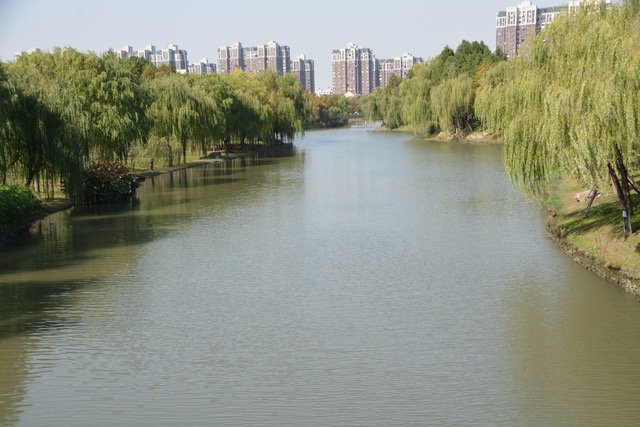
At 12:45 we were transferred to the train station and escorted through for our short, 25 minute ride to Suzhou, where we were again met and transferred to our hotel. Suzhou is a small scale city in China terms with a population of over 12 million. It is a beautiful city with canals, a large lake and lots of beautiful gardens, that in more recent times has also become a significant business hub. Apple, Bosch and Microsoft all have offices and R&D centres in the technology centre here.

Stacey and I decided to wander the canals around the hotel to the lake that we could see from our rooms. Despite the 34+ degree heat we were able to enjoy the scenery, and relaxing with drinks overlooking the lake area.


Sunday 27 August 2017

This morning we were met at the hotel at 10am by our guide for the day, Julia. The first stop on our itinerary was Tiger Hill, apparently the most scenic part of Suzhou, in the old city. The old part of the city has retained a lot of its original architecture with white houses with grey roofs with upturned eaves. Nothing in the old part of the city was allowed to be built taller than the Black Pagoda so it is predominantly low rise. This is in sharp contrast to the more modern parts of the city where a large upside down U shaped building (Julie said it looks like pants) has about 78 floors and another tower is under construction that will have more than 120 floors.

Tiger Hill was once the main palace area of the local king, who built a number of gates to protect the area from invaders. He was eventually buried in the area in a hidden tomb. Apparently the 1000 workers who built the tomb were all executed to ensure the location remained a secret. At the top of the hill is a large pagoda, which is the landmark for Suzhou. When they found the tomb several years ago (it was flooded to ensure it would not be found), the local officials had the option of opening the tomb to the public and likely losing the pagoda (which already has a lean on) or retaining the pagoda. They chose the latter and the tomb is still hidden from view in an underwater cave.

We were amused by some of the English signs in the area.

After exploring the pagoda area we wandered down the back side of the hill (and I should have mentioned it is really more of a hump) through beautiful bamboo gardens etc.

Our next stop was the Lingering Garden, once the private garden of a wealthy family in the area. It is a typical Chinese garden complete with corridors and hidden windows to tease and build anticipation of the garden to come. We decided that the Chinese must be more patient than us Westerners – or at least than Stacey and I. There was also a large walled courtyard area with numerous bonsai trees inside. I hadn’t realised that the bonsai tree (called something different in Chinese) actually originated in China, not Japan.

After a traditional Chinese lunch, sampling some Suzhou specialties we headed to the old part of the city with its narrow streets and canals. It was lovely to wander the narrow streets, hung with the ubiquitous red lanterns. We finished up in an old style tea house to watch some traditional Suzhou opera and ballads. To be honest, the music was not really my style and all sounded much the same but it was pleasant to relax for a bit in air-conditioned comfort.

I have now visited several Chinese cities and while I wouldn’t quite go as far as the Chinese saying that suggests that Suzhou is heaven on earth, it is certainly the prettiest Chinese city I have visited to date.

Some very fast bikers at Oulton Park

Wednesday 2 August 2017

We flew out of Krakow on Easy Jet around 1.30pm, landing at Gatwick around 3pm. Rob and Denine were there to meet us in a transit van. Rob had his 750cc Suzuki Thunder bike extreme in the back. We headed up the M40 for a very slow trip to Oxford. Checking into Vanbrugh Hotel, we headed out to catch up with Rob and Denine’s son Sam and his girlfriend Gabby. We met at the Turf Pub, quite an old place, first serving ale in 1831. With low ceilings and quite a few rooms it was quite busy  but we managed to find a table outside to enjoy a good meal and a few ales. A scene from one of the Harry Potter movies was filmed here.

Thursday 3 August 2017

After breakfast at a local cafe we took a stroll around the town, checking out some of the history and old attractive buildings. Our final stop was the bell tower of the St Mary’s Church built around 1200. This gave us a good view over this lovely small town famous for its universities and colleges. We were surprised by the number of beggars on the street.

Early afternoon we were on the road heading north. Around 5pm we arrived at Oulton Park. We unloaded the van into one of the many garages and headed to the wee town of Little Budworth. After checking in to the Red Lion Tavern we enjoyed an evening meal and a good chat over a pint of the pretty average local ale.

Rob and Denine, originally from NZ, have been living in England for over thirty years. They have known Steve for thirty plus years.


Friday 4 August 2017

Rob is at the track by 8am to start getting prepared for today’s practice races. The BMRC (British Motor Cycle Racing Club) runs ten events between March and October each year. There are ten different classes of bikes racing here, ranging from 250CC smelly, two-strokes up to the power bikes at 1000CC plus.

Steve and I stroll to the track around nine. The park is stunning with well kept grounds surrounded by pretty English countryside.

Steve and I spend the the day moving around the track watching the bikes being put through their paces. Rob, number 39, is practicing and racing in two classes to get more track time.

These guys wear a pad on the outer side of their knees, which rubs on the ground as they get the bike over as far as possible to take the corners. Rob makes a point of introducing us to lots of other very friendly riders. We met a chap called Talan, an ex Royal Navy Officer, who became a paraplegic after leaving the navy. He was knocked off his motorbike on the road and run over by a car. He decided he wanted to take up motor bike racing. He is basically strapped to the bike with velcro, held up by a couple of people at the start and caught by a couple at the end. Apart from that, watching him race one wouldn’t know he was disabled. He was telling us that after one crash he saw his leg sticking out to one side and realising his femur must be broken thought “I am really glad I can’t feel that”. He has a great little Video on vimeo called “The Little Person Inside”  https://vimeo.com/109999643

We had a ride around the track in the track car with Giles, a former bike racer. He drove us on the line a bike would take. “Along here I would be doing 120, braking for the corner here, accelerating here trying to to keep the front wheel down as I reach 160 here” and on it went. By the way they talk in miles per hour here.

It is really interesting to hear these guys talk as they feel everything the bike is doing in milliseconds and can spend a minute telling you how the bike felt going around one corner, which took a couple of seconds. Another nice chap I met, called Jason, was taking a couple of years off track cycling after winning 6 Olympic golds and a silver. His father was there helping him at the track.

After the practice was over we headed to a lovely town called Tarporley to dine at Pisce, a Swiss Restaurant. We were joined by some of the people from Rob’s garage. Left side: Mark, Ksenia, Jess, Ross, Micheal, Fabiene. Right side: Rob, Denine, Steve, Roger and Alex.


Saturday 5 August 2017

It’s racing day! Rob had put new tyres and new front brake pads on the bike at the end of yesterday. At dinner last night Ross was telling me about his 20 odd broken bones; Michae,l a former British Super Bike rider, only 15. Nobody takes chances with kit here – everything is kept in tip top shape. We watch Ross in the MRO 600 series.

Michael comes in second and third in his two power bike races; his brother Mark, on his Ducati, is a bit further down the field.

Rob places 4th in the  Thunder Bike Extreme race, which he is pleased with. He hasn’t had a broken bone in his five years of racing.

The day over, the garage is packed up and goodbyes said before we get on the road.


We head west and soon cross the border into North Wales. My father, originally from the Welsh Rhonda Valley, worked for a while in North Wales. He always said it was a pretty part of the world. We headed up a valley through trees alongside a river.

Large numbers of sheep grazed the paddocks, a bit like one used to see in NZ before the switch to dairy. At the top of the valley we arrived at the Hand Hotel in the village of Llanarmon. Rod and Denine had booked us in for the night. Originally a farm house built in the 1500’s with cow shed at the back, it later became a hotel to cater for drivers. It has a bar, pool room, restaurant and a few other rooms, plus, judging by the number of people at breakfast the next morning, lots of guest rooms.

We checked in then headed across the road to another pub, also with numerous bars and rooms. We had dinner at the Hand, three of us choosing the Welsh lamb, I think the best meal I have had since leaving NZ.


Sunday 6 August 2017

After breakfast we headed out for a stroll. Dr Who must be a regular visitor here as they still have a phone box here, complete with telephone. No cell phone signal around here.

The village is very pretty with its well kept stone cottages. There is a push bike race on; most of the riders say hi as they go past, some even stopping for a chat. A little way up the road a farmer rounds up a mob of sheep on a hill with a welsh border collie. The others watch in amazement how the dog works the sheep. I have great delight in explaining to Steve that this is what the new collie he just bought should be doing.

At the top of the hill Rob and Denine head back. Steve and I carry on enjoying the countryside and farm buildings for housing stock during the winter.


Soon after arriving back at the Hand we set out on the 5-hour trip back to Guildford, just out of London, where Rob and Denine live. After checking into the local Raddison Hotel Rob took us for a stroll around the town, which borders the Surry countryside, stopping at a couple of local pubs and a restaurant.

The remains of a King Henry the 8th castle are still there, with very well presented gardens.


Monday 7 August 2017

Rob very kindly runs me to the airport after dropping Denine off at work. Rob and Steve are heading off to Stonehenge and me back to the south of France. It’s been a brilliant few days with lots of laughs and banter. A big thanks to Rob and Denine, whom I had never met before, for showing us a great time.

Estonia to Poland

Friday 28 July 2017

After an 0430 ‘no answer’ call to Air Baltic, I headed back to Lufthansa. The woman on the counter said go and try some other numbers. They wouldn’t work so I went back to Lufthansa and struck a helpful woman who actually got hold of an Air Baltic supervisor in Lapland. “Sorry I can’t help – you will have to buy a fare off Lufthansa and write to us.”

Arriving in Tallinn around noon I caught up with Steve and we headed off around the old town.

Steve takes over todays story from here.

Last night I sent Roger the address:  Uus 26, Tallinn.  He’d been bumped in Frankfurt and was grateful to know he had a home to head for.  Uus 26 is not a big address but he turned up at reception the next afternoon.  We’d arranged to meet in Estonia to kick off a 4 or 5 day 1,300km road trip south through the Baltic States then exit via Krakow in Poland.

The plan was to spend this first day in the old town of Tallinn snooping around the tourist sights then head for Riga down in Latvia late afternoon.  But on recommendation from our friends The Finns, Karen and I took the kids from Helsinki to Tallinn on the ferry a week before I was due to hook up with Roger.  The Finns were right.  Tallinn is well worth a visit.  So I’d called Roger.  “Change of plan.  Tallinn warrants more than a few hours.  OK?”  He was at dinner in South Africa.  “Yeah, good one.  Book us a bed.”  I think he meant two beds.

I spent an hour in the morning before he arrived visiting the small museum of the Estonian Popular Front.  While not in English, it graphically portrays the rise of the independence movement, culminating in Estonia declaring independence on 20 August 1991.  After settling Roger into the apartment (and reminding management to find us a second bed) we hit the streets in the old town of Tallinn.

Dating from the 12th century, the Old Town in Tallinn has an authentic feel and is very well-preserved.  Like many such towns in Europe, tourism is its thing now.  “There’s no better place to get scammed than in the Old Town” quipped our apartment manager.  True of any tourist destination these days.  It’s high season and sure, there are a heap of tourists, but it is not crowded.  In fact, it is very agreeable.  Enough people to give the place some bustle but still easy to get a table.  We climbed the cobbled streets up to the medieval heart at Toompea and found the lookout points atop the old city walls.  We spent too long trying to figure out what the huge building was on the horizon beside the Soviet era 314m tall Tallinn TV Tower dominating the eastern horizon.  We could see Lennusadam seaplane museum at the coast in the other direction and decided to head there.


I’d been to Lennusadam the week before but was happy to go again.  The huge seaplane hangar was built early last century as part of Peter the Great’s sea fortress.  It is a very impressive structure housing a maritime museum, which includes the Lembit, a 1930’s era British designed submarine.  Docked outside is the icebreaker Suur Toll, the most powerful icebreaker in the world in the early 1900’s.  Both the old ships are worth a look.  It’s an easy walk through the local residential streets to get there.  We passed an inviting neighbourhood garden bar and noted it for the return trip.


I’d read that the tour of Patarei – a former prison in a bloody grim fort on the coast beside Lennusadam – was excellent so planned to go there.  Unfortunately, I’d not spotted the note that the prison tours were now closed.  A pity.  We’d have loved to get inside.

On the walk back into town we wandered over a huge dilapidated terraced structure on the waterfront.  We could not fathom what it was.  It seemed to have some now-defunct civic or ceremonial purpose.  Roger being Roger, asked the prettiest young blonde he could find nearby.  Turns out we’re standing atop the Linnahall, a concert hall built for the 1980 Moscow Olympics when Tallinn hosted the Olympic yachting regatta.  The plan, according to Roger’s “guide”, was to make it beautiful again.  Demolition might be more practical than renovation.  Linnahall looks like it was chucked together in a hurry by workers who did not want the work.

Back in the old town and thirsty, we stopped at two of the many watering holes to sample some very good Estonian IPAs while we built an appetite for dinner.  Tallinn offers excellent dining.  The Tallinn chefs have built a well-deserved reputation for new takes on local foods.  Rataskaevu 16 is a bit of a hipster joint.  It won an award or two this year so it’s booked out a week ahead.  But if you tell them you’re from New Zealand and don’t mind waiting outside while supping on one of their good craft beers then somehow a table just appears.  And the food is superb.  Roast elk with mushrooms eased down with a good Argentinian red.

I was pleased to see the second bed when we finally got back to our apartment in the wee hours of the next day.


Saturday 29 July 2017

We headed to the airport to pick up our Budget rental car, which Steve’s wife Karen had kindly booked for us to drop of in Krakow, Poland. Steve presented the booking to the guy at the counter. “We don’t have any record of it and you can’t take our cars out of the Baltic states!”Furthermore he said he didn’t have any cars! Eventually he found one and we agreed to to drop it off in Kaunas, Lithuania. “We don’t let cars go to Poland – they have to stay in the Baltic States. We let one go once and they left it down there for three weeks and we couldn’t get it back.” Maybe they should tell the booking people that.

Eventually we were on the road to Riga. The road heads cross country. The land is dead flat. It’s either crops or forestry. Even though in places freshly baled hay lay on the fields there was no sign of stock or fences.

We stopped at Parnu, a nice little town where the road met the coast. We sat outside a cafe and watched people going about their business.

Soon after that we crossed the now unmanned border  into Latvia. The road from here followed the coast down to Riga. At one point we stopped at a beach; with its white sand and only a few people on it it was quite an attractive place.

At a nice cafe we saw the only animals of the day, two goats in a pen.

Arriving in Riga around 5pm we checked into the Hotel Roma; old but well maintained with large foyers on each floor. I had visited Riga three years ago and noticed many buildings were being restored. We took a stroll through the old part of town down to the Daugava river.

Originally settled in the 2nd century it has, like most places in the Baltics, changed hands many times, gaining independence in 1918. In the previous 700 years it been ruled by Germany, Sweden and Russia. Riga was once the largest city in Sweden and later the second largest city in Russia after Moscow. The Germans took it back in 1941, then the Russians in 1944. It finally gained independence a second time from Russia in 1991 along with the other Baltic states.

We continued our stroll up the river where lots of people gathered on the edge or the river walkway.  An underpass  brought us next to the markets. Four big sheds here were built in the 1930’s to house Zeppelins.

We strolled back around the canal with its grassy banks to the hotel.

In the evening, Luke, a friend of Steve’s, met us and took us to a great little restaurant called 3pavari (the three chefs). We had paper table mats on which the waitress came and spread a combination of blackcurrant pesto and strawberry hokypoki which were the dips for our bread. The local trout was delicious. Deciding to stay local I ordered the “recommended by the waitress” local desert with its onion sponge, black sesame ice cream and fermented garlic biscuits. I will never order again.


Sunday 30 July 2017

We spent an hour or so over breakfast working out how to get past Kaunas in Lithuania where we had to drop the car off.  Eventually we booked a bus to Suwalki that would at least get us into Poland. Next we headed to Albert St in Riga to check out some Art Nouveau buildings, designed by Russian Architect Mikhail Eisenstein and completed around 1901. These are pretty unique and have mostly been restored. All the plaster features have been carved in place on the buildings.

We headed south through Jurmala passing lots of large holiday homes. After a brew at a roadside cafe we were intending to stop at the hill of crosses. As we approached the turn off we saw a long line of cars heading up the road towards them so gave them a miss.

The country was much the same as it had bean since Tallinn, flat fields trees and crops all the way.

Striking lots of road works along the way we were starting to run late. There was a flash from the roadside so I guess the ticket is in the mail. We arrived at Kaunas with minutes to spare. Dropping of the car we took a cab with a fat, smelly driver to the city bus terminal – yes he did rip us off. We boarded the rather nice Eco-Lines bus with a cheerful conductor who even confirmed how ugly Steve looked in his passport photos. We spent most of the two and a half hour journey on line and making phone calls trying to find a rental car to get us from Suwalki to Krakow.

Getting off the bus we strolled to the Hotel Loft 1898 ,which we had booked on line. At NZ$144  for the two of us we weren’t expecting what we got. Built in an old army barracks, the place was brand new and really well fitted out with excellent staff. It got better with beer costing only 9 zloty (about 2 euro).

We sat outside still trying to work out how we were going to get out of here. We then decided to see if we could find someone that did guided tours. We found one on the net and sent an email. To our surprise Anna from “Into Poland” came straight back to us. Two beers later we had a driver booked to take us to the Wolfs Lair and on to Krakow – around a thousand kilometre journey.


Monday 31 July 2017

Peter our driver is waiting in the foyer at 8am and we set of to the Wolfs Lair. Heading out through the suburbs of Suwalki we are impressed with the nice houses and tidy gardens. The countryside in this part of Poland is rolling with lush grassy fields, cows grazing and lots of crops with stands of trees.

Around 10am we arrived at the Wolfs Lair in the Masurian woods to be met by Javwiga, our guide for the next couple of hours. This place is an amazing piece of engineering built in stages between 1941 and 1944. As the allied bombs got bigger they made the structures bigger. There was a workforce of around thirty thousand employed during the construction period. The locals and others thought it was a chemical plant that was being built here. For the semi-bomb-proof buildings, precast beams were brought from Hamburg and laid next to each other to make the roof.

First stop was the remains of the 50m meeting room where in 1944 Stauffenberg left a briefcase with a bomb in to try and kill Hitler.

Close to there is a monument to the Poles who spent 10 years clearing the 54 thousand mines that had been placed to protect the site.

Next stop was the guest bunker, about 10m high with two layers of rooms inside surrounded by by several meters of concrete. Air filtration systems were in place in case of chemical attacks. Originally these bunkers were a bit smaller but after the British started using the Tall Boy bomb they added another 2 meters of concrete both on top and around the sides with an air gap to add additional protection.

We then moved on to Hitlers bunker, built the same way but with an area added on with windows for him to hang out and entertain people in.

Georing had a similar bunker with a large guest house including wine cellar next door. He also had air defenses on the top of his bunker with shafts for the gun crews to get access.

There were a few more bunkers of this style around the camp for communication and other operations that needed maximum protection. As the Russians approached towards the end of the war the Germans blew up all the big bunkers using up  to seven tons of TNT on each one. The blast was so powerful it tipped the several meter thick concrete roofs of the structures. Apparently the blasts were so big they cracked the ice in a lake some distance away. As a joke people have placed sticks under some of the tilted ones to look like they are being held up.

Javwiga had been an excellent guide filling us in on many details, not only about the development but also about the Russian occupation period.

The trip to Krakow was quite slow until Warsaw, where the roads improved and Peter gunned the Audi station wagon along at 160kps plus.

The journey southeast to Krakow revealed a lot more population than we had seen in the north.


Tuesday 1 August 2017

A guy in a Mercedes van picked us up from the Conrad Hotel in Krakow. I had booked the tour through Get Your Guide, thinking it was going to be a group of four or or five. We were dropped at a hotel and moved to a 36-seater bus. An hour or so later we were at Auschwitz. For some time Sylvia and I have looked at groups of people with head phones and radio receivers walking around tourist areas listening to the guide on their head sets. We are both very clear that is something we would not want to do. Yes you got it – soon with the thirty plus in our group we were wired for sound after heading through security. We grouped our way to the main entrance with the sign over the gate. “Meaningful work sets you free”.

This camp, the first one, was originally a single story complex for soldiers from the Polish army. When it became a POW camp they added an extra story and a loft to the buildings, which soon became a concentration camp housing thirty thousand people.

The large kitchens were the first thing we passed.

Now it is a museum with 1.5 plus visitors annually. We were lead through a number of buildings set up as examples of how people had lived and worked as slaves in this camp. We saw the two tons of people’s hair that had been piled up when the camp was freed, ready for sale for factory’s to weave garments from. We also saw cyanide cannisters, shoes, spectacles and pots etc that made the museum.

To get the numbers through we were squeezed into the building with many other groups, hugging the right side of the stairs on the way up as another group struggled past us on the way down.

We visited the Gestapo interrogation and death wall where prisoners were shot in the back of the head after interrogation. It was in the basement of this building where they did the first test on the use of cyanide, killing several hundred people. Electric, instant-death fences prevented people escaping.

We exited through a different gate, the double deadly electric fences still in place.

Last we visited the original gas and cremation block which had been rebuilt as a replica. The original oven doors are displayed there.

Handing in our head sets we got back on the bus and headed to Auschwitz Birkenau a few kms away. This camp was built later and housed around a hundred thousand.

Trains arrived here with 80 people in a carriage. People were separated into groups and many marched straight off to the gas chambers on the pretense of having a shower.

We looked at some of the accommodation, washing and toilet facilities in the women’s quarter of the camp. The bunks were three high with six catering for six people on each level.


I was chatting with the guide and she explained she lived only 15 minutes away with her parents who had been in the house for four generations. The house was taken by the Germans during the war but not occupied. Her grandparents, with a family of eleven, stayed with a relation in the old part of town sharing one room. Her great uncle was conscripted to work in a coal mine. He went on leave one day and did not come back. The gestapo tracked him down, took him to Auschwitz 1, put him face to the wall and shot him in the back of the head.

I think it is important to remember that it was not just the Jews that were interred, tortured and murdered here but also many Pols, gypsies, Russian soldiers and more. Apparently it was the Polish prisoners that asked for the place to stand as a reminder.

Back on the bus we headed for the salt mine passing factories that once used the labor from the camps and still operate today .

Arriving at the Wieliczka Salt Mine, our group of 36 went to the front of the queue, were handed head sets and entered the mine, heading down 53 flights of stairs 60m to the first level. This place is amazing. First mined in the 13th century, mining continued right up to 1996 when salt prices made it uneconomic. There are well over 200km of tunnels in the mine and thousands of caverns. Our journey today is a mere 3.6km descending to a depth of 130m.

We headed of through a tunnel, going through chambers where one door opened, we piled in, closed the door and only then could open the next door and continue. Apparently something to do with the ventilation system. We came out into a chamber where some of the equipment used in the mining was on display. Large rope winches, some man and others horse driven, were used to lower logs down for dunnage and shoring, while at the same time bringing the barrel shaped salt blocks up. Mined salt was shaped like this so it could be rolled like a barrel. The fines were brought up in wooden barrels.

The salt walls and ceilings look like grey granite, not bright and white as we were expecting. With brine pools, many large caverns and statues carved from salt this place is quite amazing. Visitors have been coming here since the 1400’s. Nikolas Copernicus is remembered in one of many statues of famous tourists over the centuries. I am not sure if they will be making statues of Steve and I.

We headed down more stairs, both of us impressed by the timber structures holding the caverns up in places.

We came to many more chambers and tunnels, lots with statues. Some of the caverns had been made into chapels.

Arriving at the end of one tunnel and looking over the ballast rail we can see a huge cathedral. The statues and other structures were carved by three men over many years. Even the salt floor had been shaped into tiles. The crystals in the chandeliers were also made of salt.

Not far along was another large chapel where many weddings are held. There is also a restaurant.

Green, clear brine shines in pools. The tallest cavern, at 35m high, has a lift to a deck so one can look down.

Some rocks from the mine on display glow in the dark.

Finally at the bottom we find out why we are in a group of 36. The guide got a bit worried at one stage as we lost a guy from the US for a while.

There is a two storey, four compartment lift that takes nine per compartment, shoulder to shoulder crammed in, that races us back to the surface.

The bus dropped us in the old city just on dusk. We headed to the very attractive, busy square and sampled some local beer before striking the five kms back to the hotel.

Wakkerstorm South Africa

Tuesday 25  July 2017

Linda (Louis’ wife) picked me up at 0630 and we headed southeast. As we reached the city limits we had to slow to a crawl to get through the thick smoke. Like in Madagascar, the indigenous people here love lighting fires. As a result the farmers every winter have to burn off fire breaks to stop fires spreading which then adds to the thick haze that hangs over the land.  Quite a number of coal fired power stations also add to this problem. It was not until about four hours later when we arrived at Wakkerstroom that the sky’s became clear.

I met Louis in Sweden nearly three years ago. I am now taking him up on his “if you are ever in South Africa come and pay us a visit” offer. Louis and his partner Mario own a twenty thousand hectare farm called Oudehoutdraai, trading under the name Hunt Essentials.

Arriving around ten, Louis took me for a drive around the edge of part of the property. It is mainly surrounded by a 3m high fence with electric wires on the inside. The farm is mainly a game park where between April and August hunters come in to hunt plains game. To help sustain the business during the off season they have diversified. A thousand fine soiled sheep have their breeding cycles synchronised so around a hundred lamb every month. They process and pack the lamb and sell direct to the market. There are also  2,100 white rabbits that breed like rabbits, their off spring providing a steady income.

A few hundred hectares are being set up with pivot irrigation to increase the lamb output. They mix their own stock food, most of which is home grown.

Dotted around the farm are illegal villages. Originally a worker was allowed to build one house for his family. In recent years they have added tin shacks and had relations move in.

Stock rustling, illegal grazing, theft, fire lighting and crime in general are a major problem here. The police are corrupt and incompetent when it comes to solving crime amongst their own. We stop and chat to another farmer; as we drive away Louis tells me how recently his fence was cut and bricks were being delivered to his land. He went to investigate to find one of the local police there. The bricks were his and he was going to build a house and as he was a policeman there was apparently nothing the farmer could do about it. The farmer later dumped the bricks and a few days later some detectives turned up wanting to arrest him for stock rustling.

At every access point there is a manned guard-house manned by people from outside the district. Apparently locals can’t be employed for this task as they just let their mates in to steal stuff. On two occasions lately guards have been attacked and seriously injured.

Fences are cut so not only can stock be stolen but the locals also run their illegal stock on the land.  We stop at one point as some goats are grazing illegally on the farm. Louis draws his Glock pistol and shoots one. He knows the goats will now be removed. The farm stock is tested disease free, even the 300 plus buffalo are foot and mouth, anthrax and TB free. Stock is quarantined when moving both on and off the farm. Illegal grazing is a big problem as it can bring diseases.

We stop and chat with some military looking guys on the roadside. These guys have been brought in to try and sort out the serious rustling and other crime going on just now.

The local village of Wakkerstroom has around ten thousand residents 600 of which are white. Eighty percent of the rest are unemployed. Unemployment across the country is nearly fifty percent. Crime is out of control. Last year around 52 murders and the same amount of attempted murders were reported each day. The government builds nice little bungalows for these people with power, sewerage and running water. They are given to the occupier.


Schooling and health care are also provided free. Standards of education have had to be lowered so people can pass.

Just now the land is brown and dry. When the summer rains come it will turn emerald green.

We call into the Wakkerstroom Country Inn for a beer. They have recently bought this to accommodate additional hunters.

We stop in and look at the breeding buffalo herd, which Louis is very proud of. Bulls are bred from this herd and when fully grown released to roam far and wide on the farm.

We then head up the hill where large mobs of springbok, black wildebeest and common blesbuck are grazing.

In the evening we head across to one of the lodges where Mario (the other partner) is gathered with a bunch of his mates, who have been here hunting for a few days. We had run into these guys a few times during the day as they cruised around with a chilly bin full of ice and splits to add to their whisky and gin – a bunch of hard case good guys continually giving each other a hard time. A cut drum full of embers was used to cook beef Portuguese style on sewers.

We sit around the dining room table and between the banter they tell me of their passion for this great country. They are concerned that they have begun to accept the murder and crime as just part of life. All have had friends murdered. They support the building of houses for the locals but are frustrated by the corruption that is rife throughout the government and civil service. They explain how game ranches such as this have helped bring back a lot of the game from near extinction. They even have 5 white rhino here they have reintroduced in the last few years.

Lying in bed I feel really lucky to have had the opportunity to come and see this magnificent place.


Wednesday 25 July 2017

It’s another stunning day. I haven’t seen a cloud since we left Madagascar. These are big bold blue skies.

We breakfast in the dining hall adjacent to the house. On the wall there are mounted heads of many of the species running on the land here.

Common reed buck, African bush pig, White springbok, Red hartebeest, Black springbok, Common springbok, Mountain reed buck, Common blesbuck, Black wildebeest.

After breakfast I chat to a few of the staff and enjoy the view in the valley.


Three young springbok wander in and feed on the porch. There is lots going on around here. There are over ninety staff employed.

Soon it is time to leave. Louis and Linda insist that I come back for a longer stay one day. Yes I will definitely be back.

Ron, who used to run a local hotel and now helps out on the farm, drives me back via Pretoria where we pick up a chap from Texas who is also heading out today. Around 7pm I am airborne with around 850 others on an Emirates A380 to Dubai. About six seats from the back in economy I was surprised by the comfort and really impressed by the crew. All looked fit cheerful and were eager to assist. What was even more impressive, on the next leg to Frankfurt the crew was exactly the same.

I sat in the Air France lounge waiting for my Air Baltic flight to Tallinn. The flight was delayed until 8.15pm. The guy in the lounge said get to the gate by 7.45pm. I went early and was told I had been bumped from the flight. I tried to find out what to do next from the staff member “I am new and don’t know what I am doing. Please just go away”. I spent the next two hours trying to find someone from Air Baltic with the help of a chap from the information counter. He couldn’t even fold find a phone number for them.

There was no option but to reserve a 900 euro Lufthansa flight for tomorrow morning and get a hotel for the night.