
Wednesday 7 January 2026 – Costa Maya: Roger
We were awake just after 0600, with breakfast being delivered by Franzer, our on the ball and very ready to help, butler. We left the ship around 0730 for the long walk down the pier to the small port town of Costa Maya. Originally a fishing village called Mahahual, with a population of around 100, in 2021 a wealthy family built the rather large jetty and called it Costa Maya. A walk through the pier’s tourist shopping centre, with its two pools, lots of sun loungers and many tourist shops, and we made it to the van parked by a miniature Mayan Temple.


We were given a wrist band and joined the other 10 people on the tour. Our guide, Joel, from a local village and and of Mayan heritage, stood at the front and gave us a rundown on the history of the area, including the 35-mile road that meets the Corozal-Cancun highway, built at the same time as the pier around 2001. Prior to that it was just a jungle track.
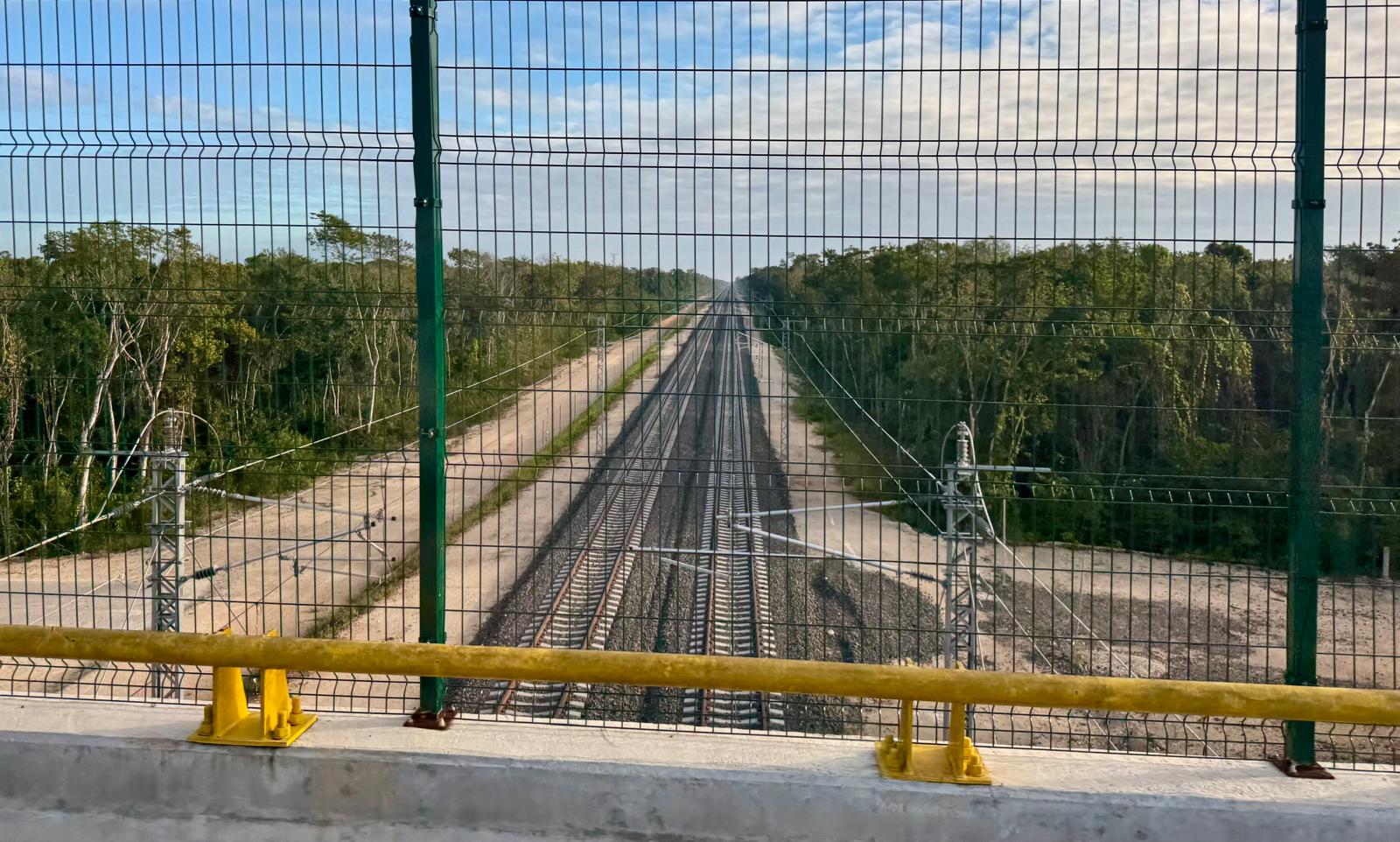
Reaching the highway we turned left, crossing the large railway that transports tourists around the Yucatan Peninsular, then heading south for a few miles, passing through a couple of local villages, before turning right on the road to Chacchoben (the place of the red corn).


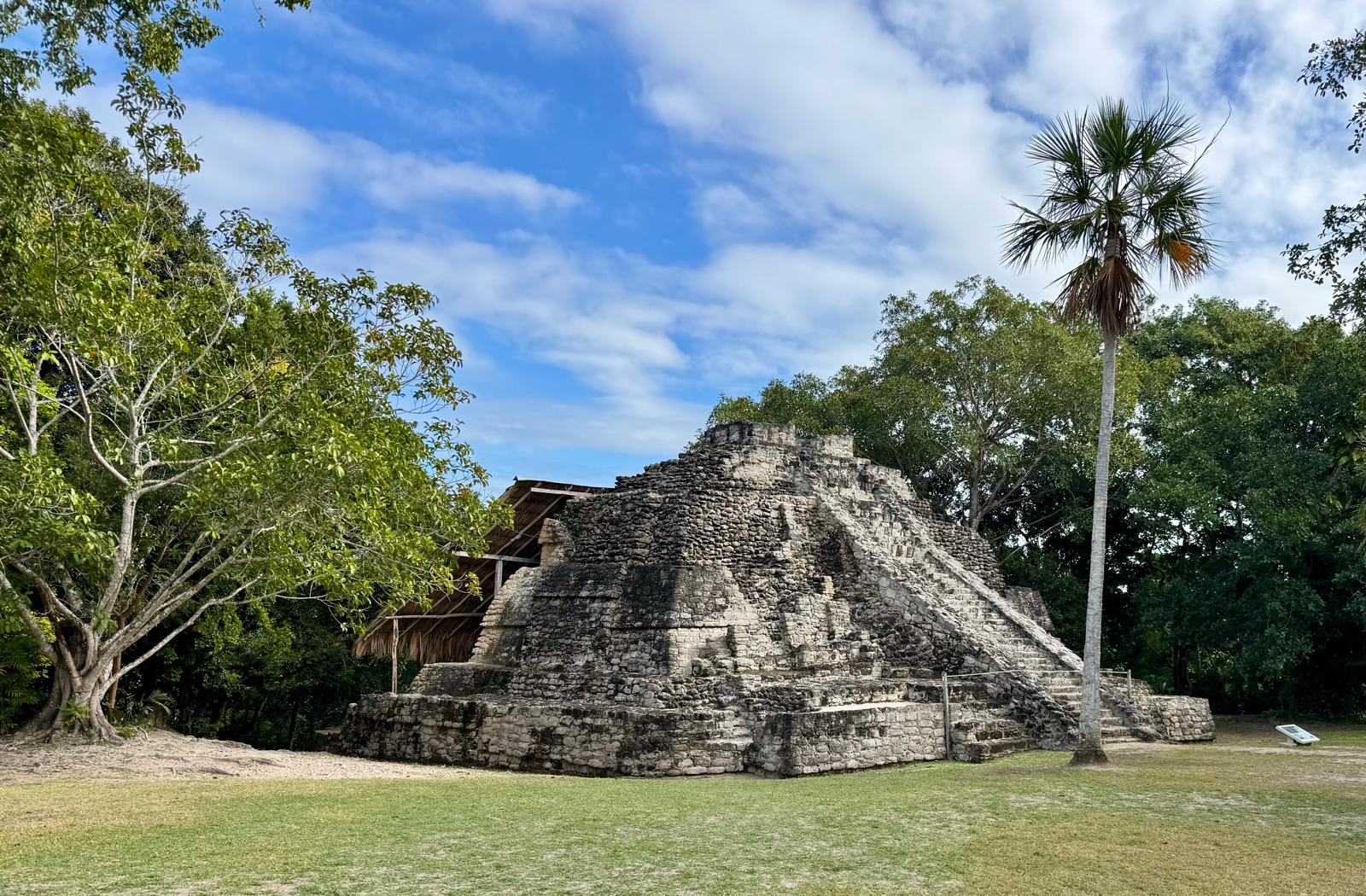
Parking up, we wandered down a path, past what was once a platform for a house, eventually arriving at the first temple. This one was dedicated to the soldiers and is mostly restored. We were lucky to be the first group to arrive, our ship having docked early. Later on there will be about 4,000 people streaming through.




Mayan history in Mexico goes back to about 2000 years BC. This settlement, as far as it can be established, started around 400 BC. When the settlement was first established they built small temples. As the community grew larger, newer, bigger ones were built, often over the top of the existing ones. The structures we see today were built in the latter part of its occupation when thousands of people lived here. The priest held his ceremonies from a structure on top of the temple platform that is no longer standing.
A short walk from this temple is a large pad 100 x115 meters and about 12 meters high. This had two more temples on top, one dedicated to the Sun and the other to the Moon. Human sacrifices used to take place here every year to sort out the weather for the next cropping season, not sure that it worked that well though.


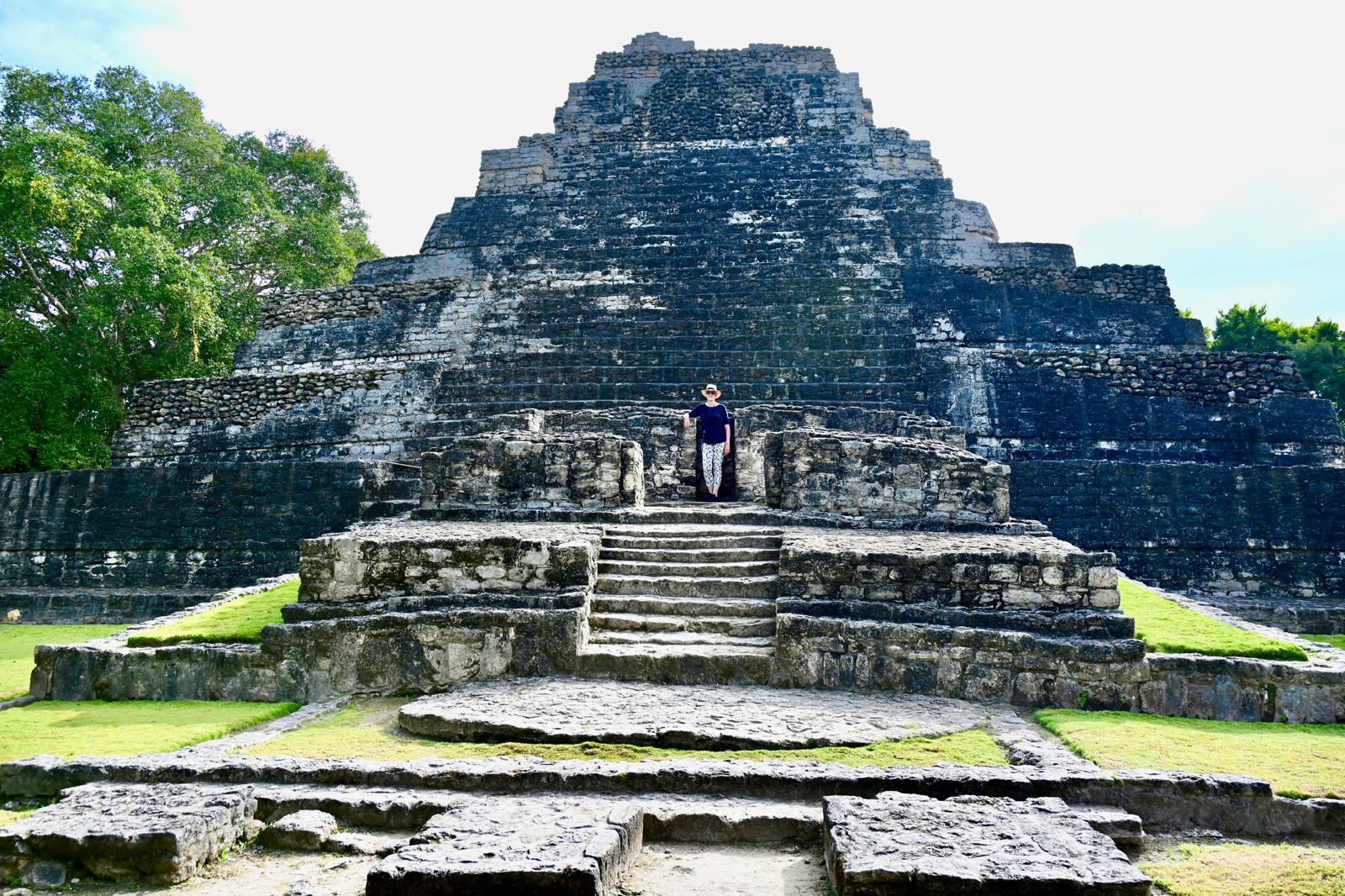

As the town grew, the houses near the centre were the expensive ones made of stone, and the outer houses were wood and thatch. The town centre also held a Pok-A-Tok court. This was a ritualistic sport played with a large rubber ball often ending in sacrifice.
This town survived until about 600AD, then for some reason ceased to exist. It wasn’t until the 1940s that a man decided to set up a farm here and discovered the ruins, although it is likely that the locals were aware of them. In the 1970s an archaeologist flew over the area and noticed the mounds in the flat, covered ground and decided to take a look. He, in conjunction with the farmer, reported the site to the Mexican authorities, who sanctioned it as a historical site, giving the farmer life time occupancy. In the 1990’s the site began being restored, as over several hundred years vegetation had grown over and disrupted the structures.
Like many of these sites I have been to in the past it has pretty much been rebuilt although there are still many more unrestored mounds visible within the trees. Interestingly back in the day the Mayans had their own version of cement, made from crushed limestone, which was baked in a furnace along with a few other additives.


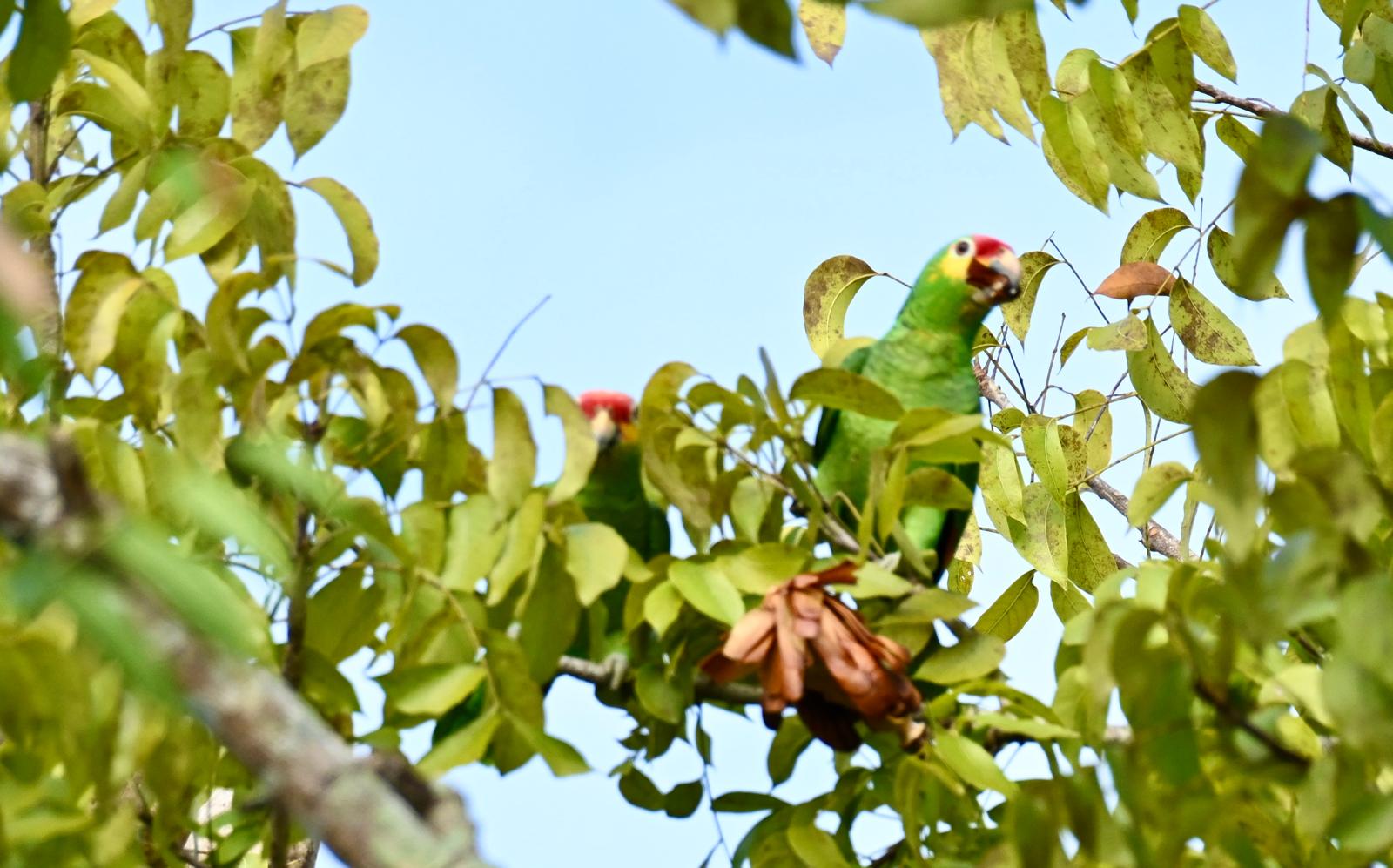
Tour over, and no one having being sacraficed, we headed back to the main road then to the Holy Margarita cafe, which is situated on the edge of Lake Bacalar and has lots of sun loungers, where we enjoyed a taco lunch and a beer. Sylvia went for a short kayak, spotting a colourful iguana in a nearby tree.


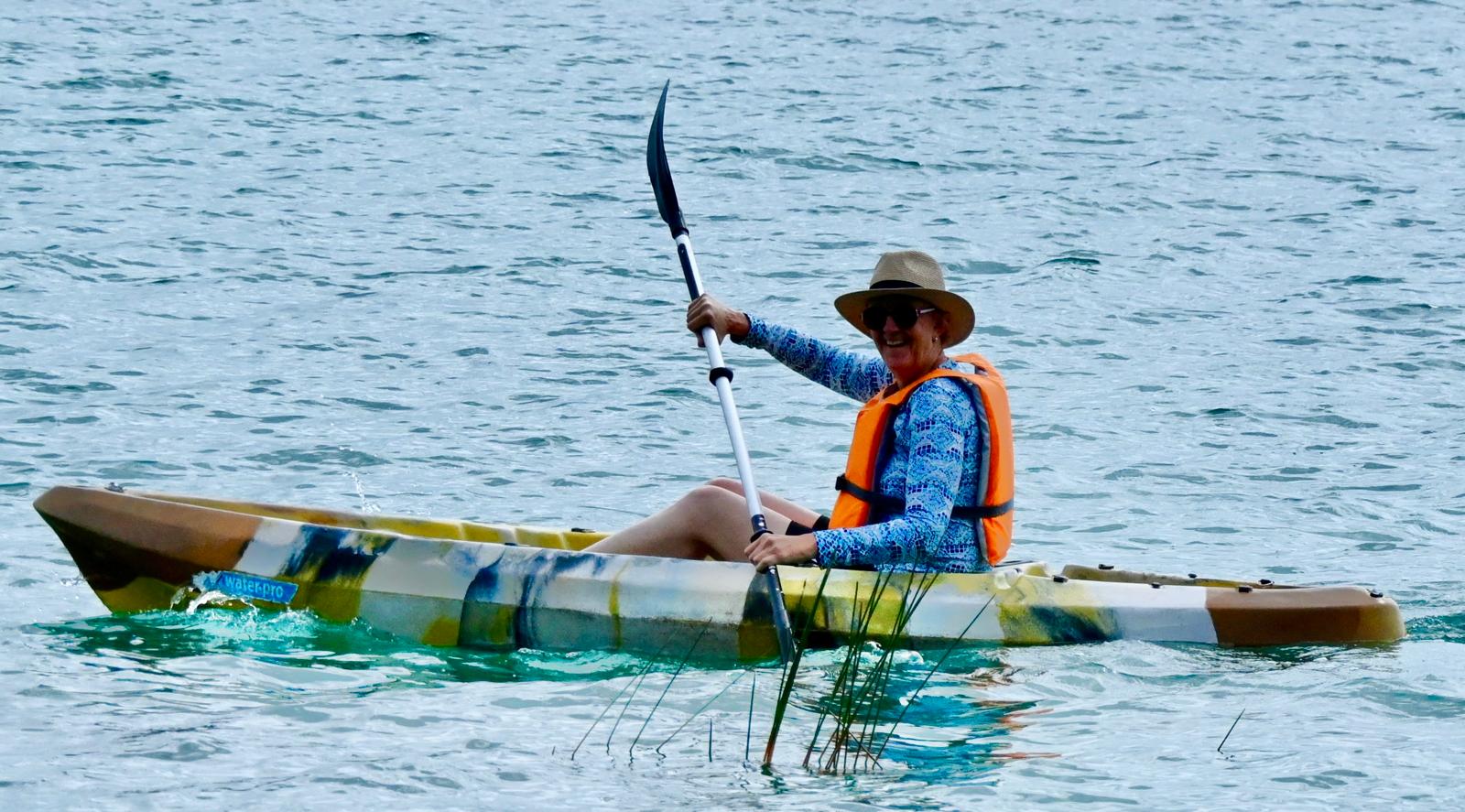

Not our photo but it was so pretty Sylvia wanted to show what it looked like…
Arriving back at Costa Maya we were overwhelmed by the number of people in the pier area. All the sun beds were occupied around the pools, people roamed around with large drinks in hand and most looked like they had come from very lush paddocks. The reason for all the people became evident as we headed down the jetty, just as a squall came through. Parked on this rather long jetty were another four cruise ships, including the Carnival Jubilee, the world’s largest cruise ship, carrying over 6000 passengers. Including our small boat there were around 15,000 people in this tiny town, many not making it past the local bars.

Back on board we headed up to the Creperie to try one of their waffle and ice-cream dishes – far from my favourite dish, although Sylvia did enjoy it. Next was a very relaxing massage at the ships Spa.

In the evening we enjoyed dinner at the Polo Grill specialty steak restaurant. Sylvia enjoyed a NY Strip Steak with lobster mac & cheese, and me the scallops. Both of us finished the meal with apple pie and ice cream. Yum!
Thursday 8 January 2026 – Belize City: Sylvia
Clocks went back an hour overnight and it was great to have an extra hour of sleep as we have been struggling a bit with the jetlag. We anchored up off the coast of Belize City at about 7am. The water is pretty shallow so we were quite a long distance from shore. This is the first time I have been at anchor that the ship has used local boats for the tender process rather than lifeboats. A fairly large catamaran motored out, and the loading of the first tender finally started at about 8:30am. It took about 20 minutes to load ~200 people on board, then about 30 minutes to get to shore – a slow process overall.
As with most of the other ports we have visited, the pier was a hive of activity with many vendors and brightly coloured stalls. We walked straight through and met our guide and driver, AJ, just outside the pier area as arranged. With a population of ~90,000 Belize City is the largest city in this country of only ~500,000. It was originally the capital city but after it was severely damaged by hurricane Hattie in 1961, the capital was moved to Belmopan, about an hour’s drive inland. Belize City is about a foot below sea-level and it is criss-crossed by large canals for drainage. At one point the main road out of the city passed right through a cemetery.


We drove southwest for about an hour through mostly very flat, swampy, jungle land. As we got further from the city we started to see a few mountains in the distance. Tourism is the main income earner for Belize, followed by agriculture – sugar cane, citrus, bananas, corn and beans.

We arrived at Nohoch Che’en, an archaeological reserve in Belize that draws thousands of tourists a day for zip-lining and cave-tubing adventures. The country is about 60% limestone and has a lot of cave systems. We had booked a five-mile cave kayak excursion and after changing and getting helmeted and life-jacketed up, we headed off for an easy 25-minute walk, first crossing the Caves Branch river. The rainforest was beautiful with a number of different species of trees evident. We saw several armies of leaf-cutter ants marching across the forest floor carrying their leafy prizes. Their large nests were dotted about the forest. They take the cut leaves to their nests and a fungus grows on the leaves that provides food for the ants.


We arrived at the kayak start point and headed off upstream into the cave system. Bats flew about overhead and mozzies swarmed in the beams from our headlamps. We even saw a couple of cave spiders. This cave system floods regularly during the rainy season so there were not many large stalactites or stalagmites but we did see a few. Mostly the river was running very gently but there was one short stretch where we really had to fight the current. As Roger put it, we’d have a fair bit of work to do to make the Olympic team… I’d say we zig-zagged our way up river, finding it a little challenging to hold a straight line in the current, but it wasn’t arduous.
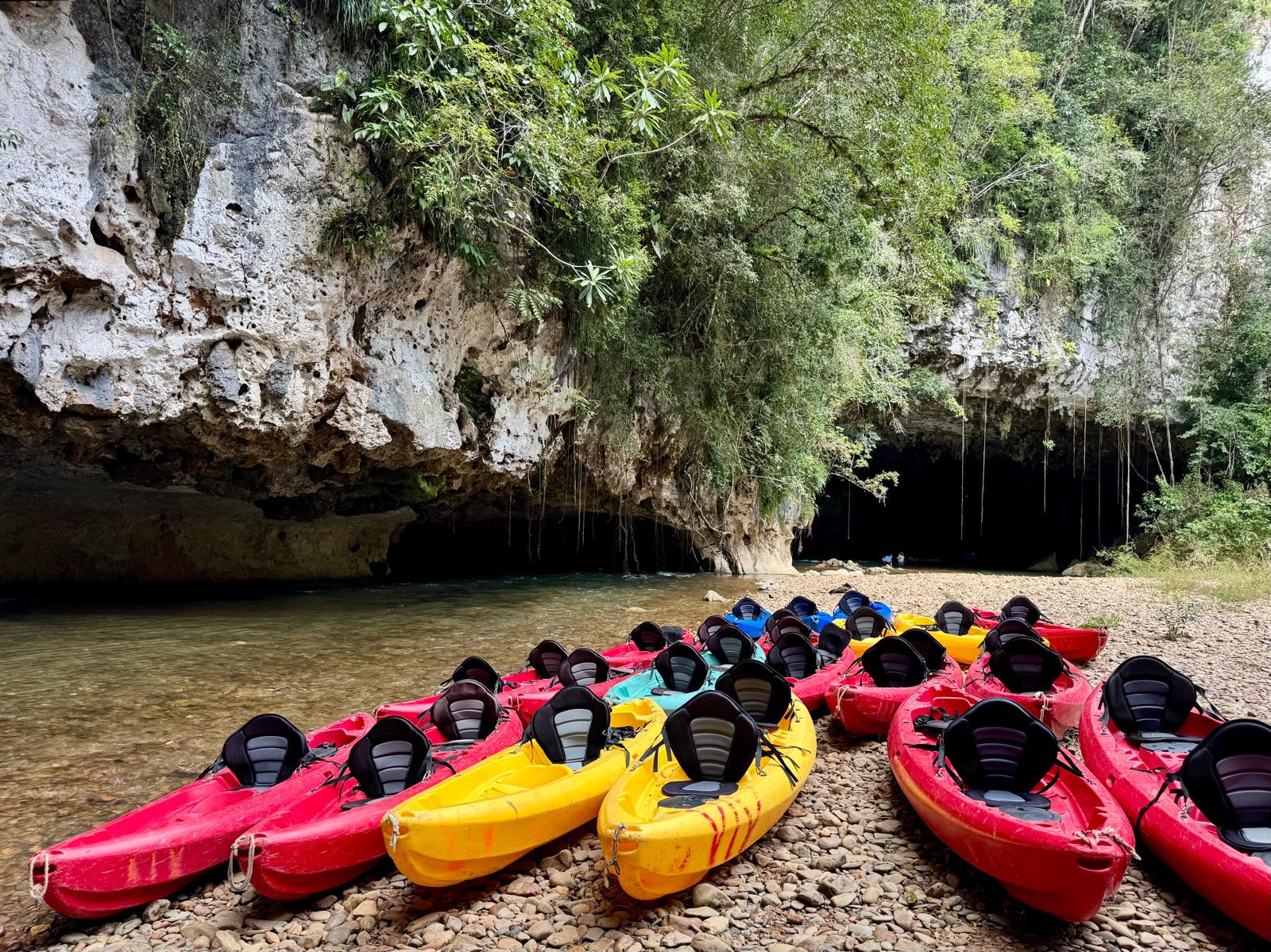

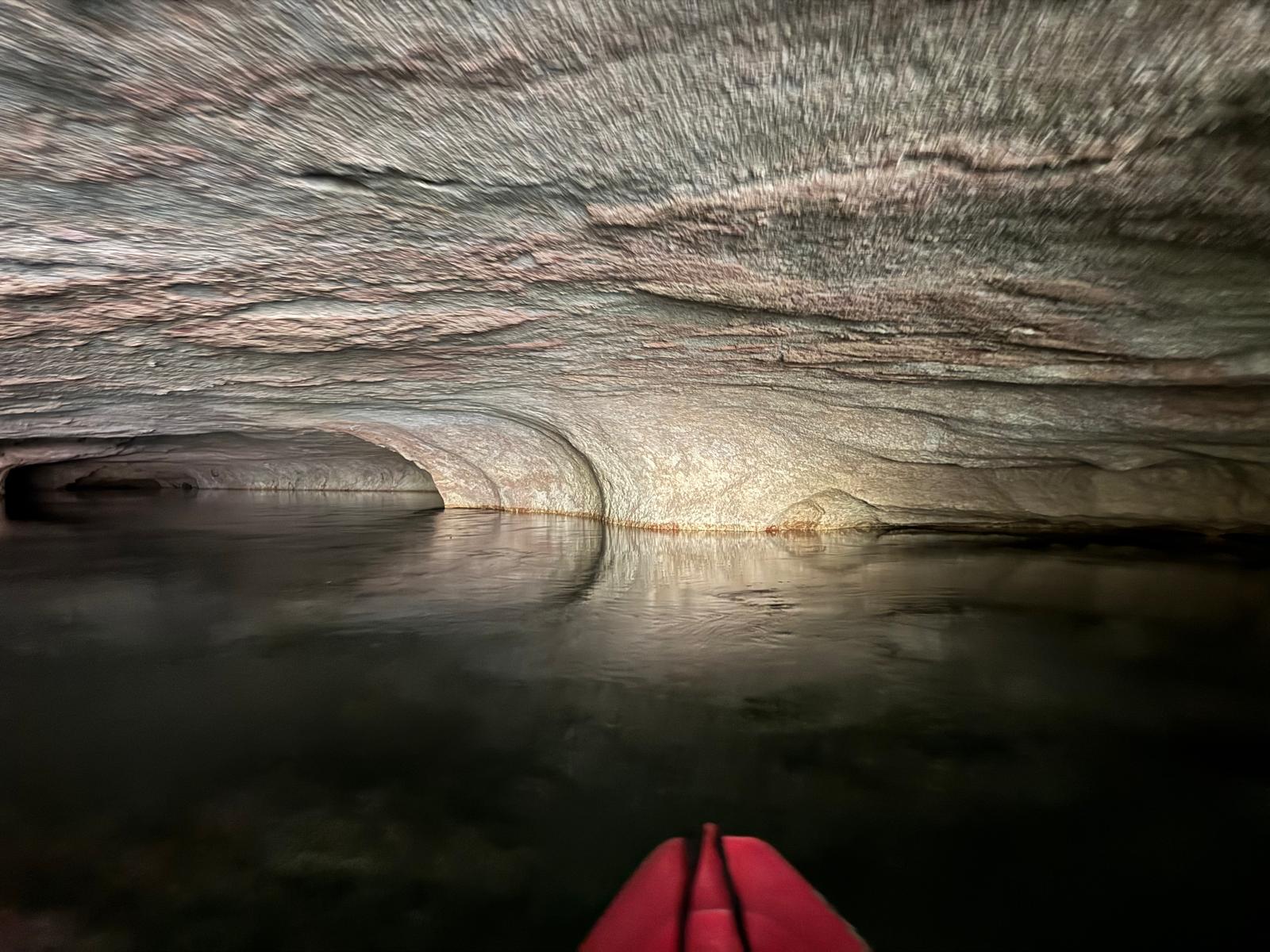


After going through a fairly small hole, we reached the end of the navigable cave and, after turning our lights off and sitting in the silent darkness for a few minutes, turned around for the gentle downstream return. We continued past the point we had entered at, which is where the cave tubers enter for their short ride. From there we encountered a few very gentle rapids as we made our way back to where we had crossed the river, passing several small groups of tubers, rafted together and making their way downstream as well.


Back at the gear point, we dismounted the kayak and, after returning our life jacket, helmet and paddle, and changing back into dry clothes, we enjoyed a very tasty lunch of rice and beans with chicken before heading back to Belize City. We boarded the tender catamaran and after about a 20-minute wait headed back to the Allura, arriving onboard just in time for afternoon tea.


Friday 9 January 2026 – Santo Tomas de Castillo, Guatemala: Roger
It was just after 0830 when we disembarked at the container port of Santo Thomas, not far from the town of Livingston at the bottom of the Rio Dulce, which I had visited 10 years ago with a couple of mates. Near the gate to the port we were met by our guide from Go with Gus, who, after greeting us, took us over to a nearby taxi, which we mounted and began our journey. It turned out that our guide had boated across from Livingston, where he runs a hotel for the guiding company.


As we made our way through the town, really more like an industrial area, there were hundreds of container trucks headed in both directions, this being one of Guatemala’s two ports. Puerto Barrios, the other, is only a couple of kilometres up the coast from this one. We were on the main road heading to Guatemala City, hence all the goods coming out of the country have to come through these two ports.

Guatemala is known for its export of bananas. In the 1950’s President Eisenhower and the CIA organised a revolution or coup here to overthrow the government, as they were trying to take some of the land back that was used for the American companies to grow bananas on. According to our guide much of the land that has been used to grow bananas in the past in the area we will pass through today, is now being planted in rubber trees, apparently to give the land a break from growing bananas. The rubber seedlings are imported from Brazil. Bananas remain a critical export for the country with Chiquita and Dole the main brands.

Heading southeast on the road to Guatemala City, we passed many small farms, some farming cattle and others growing crops like pineapples, along with many rubber plantations.
At the town of Entre Rios we turned right, heading southwest through more hills and small farms. Eventually the land flattened out and at one point we passed a huge pineapple farm with a large pineapple juice processing factory in the middle of it. It was interesting to see again that a lot of fence posts here are actually planted saplings that they staple the wires to. They eventually grow into small trees, which are kept trimmed at the top to stop them getting too big.


We reached the town of El Relleno, which 10 years ago we had stayed at before boating down the river to Livingston. We crossed what the guide told us was Guatemala’s longest bridge, before eventually arriving at the entrance to San Felipe castle. Here we dismounted and walked down a long driveway to the castle or fort, which is situated at the bottom of lake El Golfete. This is the narrow point where the lake feeds into the river. The first tower of the castle was built as a fort in 1595. The rest of the building was erected in 1661. It has been destroyed by fire and rebuilt a couple of times since. The prime role of the fort was to stop pirate boats entering the lake or leaving the lake, as on the shores some distance up the lake the Spanish had a large storage facility where they held supplies and items of value that were to be shipped back to Spain. To sort the pirate ships out they had a chain which lay across the channel and as a pirate ship came along it was tightened to slow the ship before engaging it with the cannons on the fort. We couldn’t really establish how well that worked but there are two or three holes in the fort where cannonballs from ships have appraently gone straight through the 400 mm thick stonewall.


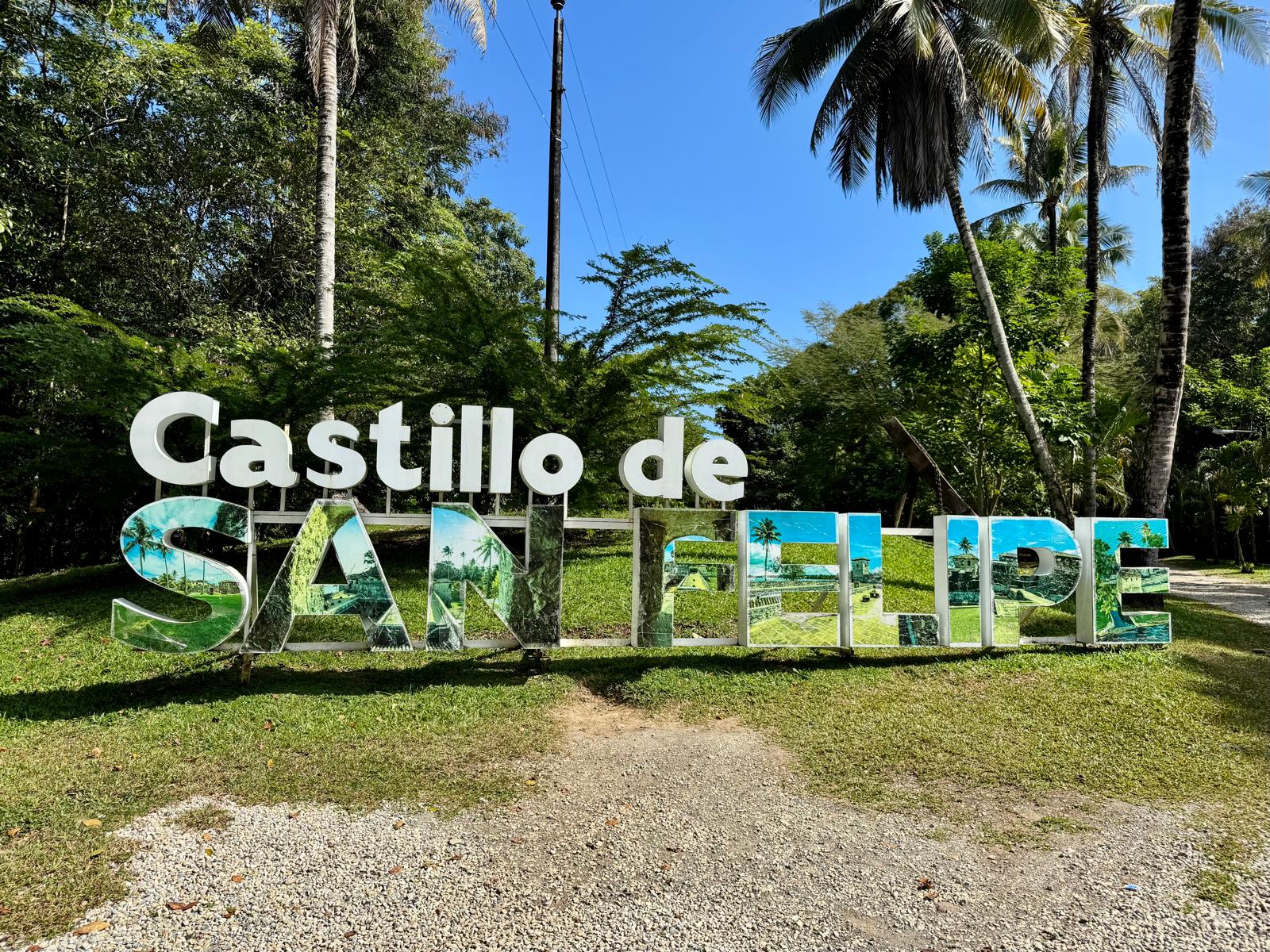

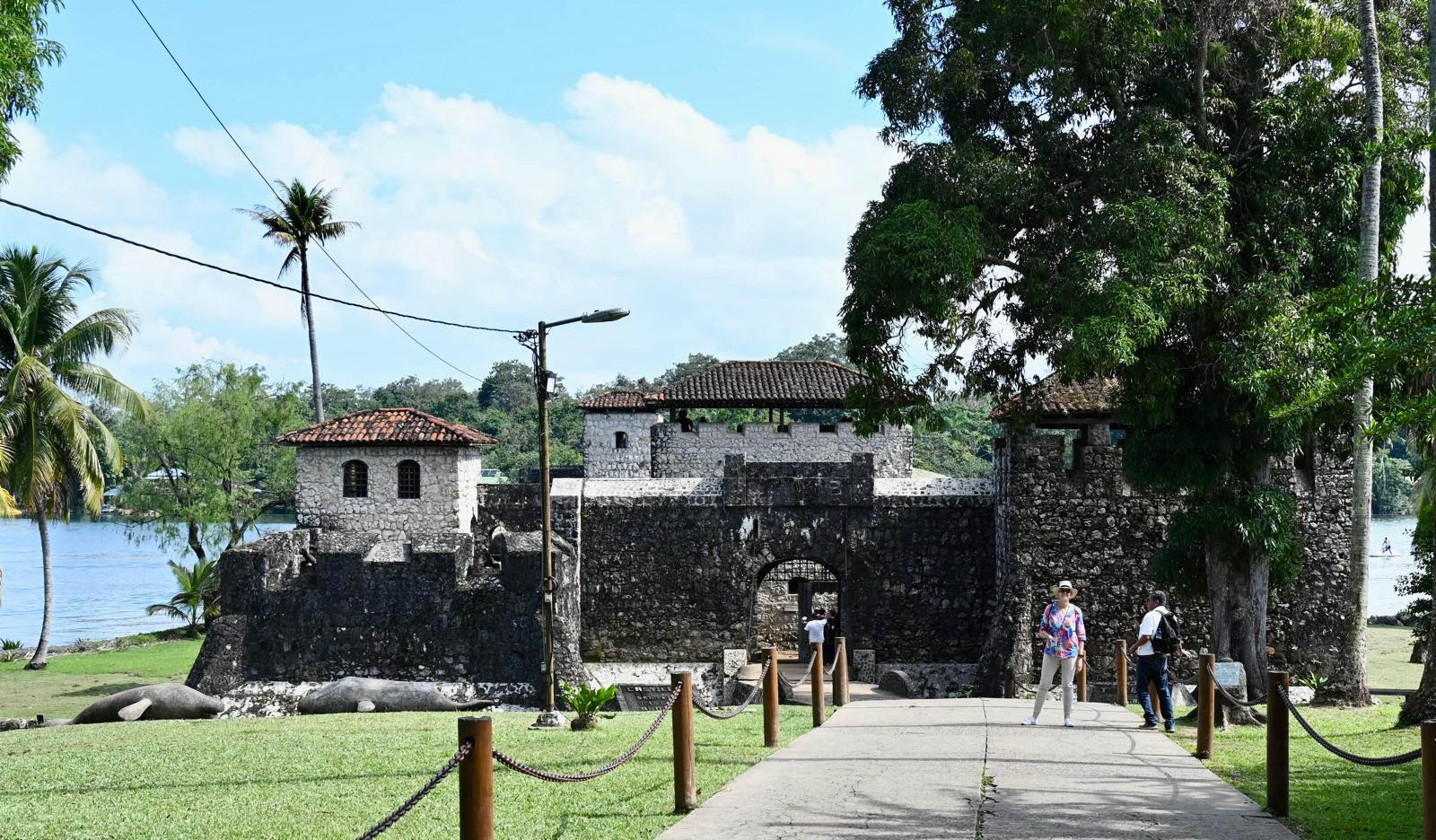


The fort was run by a priest, who was in charge of the soldiers and also acted as judge and jury in handing out sentences to pirates and other people in the district that had been naughty. For those sentenced to execution he also carried that out as well: quite a flexible priest. We were lead down to a dungeon where they used to hold those that weren’t being executed, who lived in their own excrement and apparently most of them died from disease while chained up in the little alcoves that would get flooded when it rained.


Next we took a short stroll along the grounds of the fort and hopped in a small boat and started heading down the river. We took a detour up a waterway where there were a number of large houses, many with large boat houses next door, housing what are pretty flash looking launches. There was even an Australian-named hotel/restaurant on this waterway. We also spotted turtles, a number of different birds and some nice flowers before heading back to the main river.


After passing under the bridge we pulled up at a restaurant. I ordered the local specialty, which consisted of a large bowl of a soup type mixture containing large shrimps and plantain, with a large crab floating on top. Next to that was a fish and some rice. I enjoyed a couple of local beers but was unable to finish this large dish. Sylvia had a dish consisting of a lot of shrimps and a few other delicacies. Lunch over, we were met by the taxi driver, who took us back to the boat along the same route.


We were back on the boat in time to enjoy the 1530 afternoon tea, serenaded by the string quartet. After this, Sylvia headed off to a massage, where I think they wrapped her in mud and flax or something like that, apparently good for aches and pains. I stood on our balcony and watched as the ship was backed away from the wharf and did a 180° turn, watched by a couple of ‘just in case’ tugs, before heading out to sea.

Saturday 10 January 2026 – Roatan, Honduras – At Sea: Sylvia
We leapt out of bed at 6:30am and were showered and ready to disembark for our day in Roatan by 7am, when an announcement came over the loud speakers. Unfortunately, because of high winds, our stop in Roatan would not happen. The ship went into the harbour and made a couple of attempts to berth but the wind was too strong and coming from side on, which would have caused damage to the wharf, the ship, or both, had the two connected at speed. There are no tugs available at this port so the Captain made the decision to abandon the attempt at docking and we headed back out to sea for the slow journey to Jamaica, giving us an extra sea day.
Other than walking the decks and doing a few gym classes, we took the opportunity to rest and catch up on a few things. Roger attended an AI class in the afternoon and even had a go at getting AI to write some of his blog but decided it didn’t sound enough like him so gave it up pretty quickly.
Sunday 11 January 2026 – At Sea: Roger
After attending the immersive yoga class (apparently the pictures on the big screen at the back of the stage made it immersive) with Sylvia, I headed to the entrance to Jacques restaurant on deck five where the “Below Decks” ship tour started. After a roll-call for those that had put their name down (and paid the money of course), we headed forward for a tour of the theatre back stage, where the two people who hadn’t put their clocks forward caught up with us. We had a look at the lighting control room and the dressing rooms. All the costumes are stored here and it was explained to us how sometimes the players have to have up to five changes of clothes, which are laid out in various places at the back of the stage. Two people help them slip into their new garment in as little as 10-seconds.


Heading back along deck five, we went to Jacques, the french specialty restaurant. Here we were introduced to the ship’s head chef, who conducted our tour. He heads up the 141 crew that work in the ship’s galleys. Jacques has its own galley, separated into two parts, one for the preparation of hot food and the other for the preparation of cold food such as salads, etc. Breads and desserts come through from the main galley, which is situated just behind the restaurant.


The main galley was our next stop. This is huge with a separate bakery area, which has 17 bakers manning the 24-hours of production. Here they produce everything from breadsticks through to the tasty croissants and baguettes that are all prepared fresh for each meal sitting. They consume around 3,000 eggs, 150kg of sugar and I forgot the amount of flour, which is imported from France of course, and used everyday in the preparation of the products coming out of the bakery.

Next we moved across to the other side of the galley where, in one section, all the hot food such as steaks etcetera are prepared and sent to a number of restaurants on the ship, apart from Jacques and one of the other specialty restaurants. Here we received a demonstration of how the orders are passed on when they come out on the printer. Basically the head chef yells out to one of the many chefs “ribeye steak, medium rare.” He responds with “yes sir’ and races off to prepare it.


The computerised ship’s menu, which comes from head office, even has a photo of how the meal is to be presented before it is sent to the passenger. Each day the head chef gets the chefs together and they prepare each meal that is on the menu for the day. They lay it out on the table and sample it to make sure everything is up to standard before the cooking process starts. Their attention to the detail is quite impressive.
Even more impressive is the cleaning of the place. I looked hard but I couldn’t find one bit of dirt or fat even in any of the mini gaps in the ceiling tiles or around the edge of the cooking units. There is a cleaning team that comes in after each cooking session and has a big cleanup to make sure the standard is maintained. Believe me it’s immaculate.
We had a look at the area where desserts are prepared before heading back to the galley entrance.
We then headed down a narrow stairway onto deck four, where a wide passageway, which they call I-95, runs the full length of the ship. In this part of the ship is the storage area with large doorways on each side for goods to come into the ship. Before any products are stored they are taken off wooden pallets and placed onto steel pallets for storage on the ship. This ensures no insects or pests get on board. We were met by the smiling crew who look after this area all in navy blue overalls.


We first entered the fruit storage room, which is in 3 sections, one for normal fruit, one for berries and the other for nuts. The cool rooms are kept at 5°C and the freezer at -18°C. These are where meat and other frozen foods are kept, the poultry and pork being kept separately from beef and lamb. Once again these areas were spotless. Gorica, the food and beverage manager explained that there are some much bigger storerooms but they are sealed behind watertight doors while the ship is at sea. We also entered the liquor store where large stocks of wine and spirits are kept. Gorica explained that it was fuller than usual because we weren’t drinking enough.


We headed along the I-95 and into the control room, which looks a bit like a smaller version of the control room in the nuclear power station we visited in France a couple years ago. The engineer explained that there are thousands of sensors on this boat and they all come back to this control room. He continued to say that things are a lot different than when he first started as an engineer 30-odd years ago. If there was a problem with an engine back then, you just did your best to keep it going until you got back to port. Nowadays if one sensor goes out on an engine, you have to shut it down because it simply won’t go. That’s technology for you. Luckily the ship has four engines, which drive the generators, which power the ship. At any one time only a maximum of three are required to run the ship and just now there are two running. Every 15,000 hours the engines require an overhaul. This happens while the ship is still operating as engineers come aboard, shut down the engine that requires an overhaul, and do the job as the ship carries on with its cruise. There are 55 engineers on board.


The four generators running off the motors generate 50,000 horsepower each, giving the boat a maximum speed of 23 knots. The ship can produce up to 400,000 litres of water every day through an osmosis system. She manages all her waste water so it’s treated to the point that it can be discharged to the sea anywhere in the world. Allura runs on what is called clean diesel, like you would put in your car, and runs so efficiently that you never see black smoke coming from the funnels like you do other ships. She uses roughly 100 tons of fuel per day and carries 2,200 tons in her bunker. As the fuel is of high-quality it can be refilled at any port. She has the ability to run with what’s called cold iron, which refers back to the old days of steamships when they shut the boilers down making the iron cold. Now many ports do not have the electricity supplies to allow the ship to be fed from the port, including Miami, which has up to 12 cruise ships in at a time, all having to run their generators rather than using shoreside electricity.
From there we carried on along I-95 to a lift, which took us up to deck 11. We continued along the corridor and through a door into the bridge, where we were greeted by the first officer. He welcomed us all to the bridge with a handshake and soon the captain turned up. Captain Pavle gave us a rundown on how things work while at sea. They always have four crew on the bridge, two officers and two look-outs, one lookout being on each side. The captain’s cabin is just behind the bridge and he said that if he’s needed, even if he’s in bed, he can be there in about 20 seconds. All the ship’s controls are now fully automated. There is no necessity to communicate with the engine room by phones or bells as all the systems are electronically connected to the bridge. While at sea the ship is normally on autopilot and if they see an obstacle such as another ship that they have to avoid this can be done by moving a tiny joystick to change the ship’s course as necessary. At the front and the centre of the bridge there is also a little control unit where one of the officers sits when entering ports or doing tight manoeuvres. He steers the ship, with instructions from the Captain, with a steering control similar to what you would see on an aeroplane nowadays.


There is something like 30,000 km of cables on the ship which keep everything going with signals coming from sensors all over the ship and signals being sent as necessary to various parts of the ship. This includes putting out the stabilisers and making the engines go faster or slower, along with turning the rudders to steer the ship. The Allura still has propellers and to stop it will take about a mile when running at a cruising speed at sea. The ship has large ballast tanks and in bad weather sea water is pumped into these to keep the ship stable. Along with the stabilisers this means there is very little roll from side to side on board but you still do get the up-and-down movements from the waves, although we haven’t struck any of those yet.

We headed back to the elevator and down to deck three to see the laundry. Here they have a number of huge washing machines with three chambers to keep them in balance as they hold something like 400 pounds of washing each. There are a number of large dyers that take 200 pounds of washing each. The other part of the laundry is the ironing and folding department. There’s a big machine that irons and folds the tablecloths, but a lot of the clothing is still ironed by hand. 24 people work in this department and it runs 24 hours a day.


The tour ended at the entrance to Red Ginger restaurant where we drank champagne and ate canapés while the beverage manager and assistant answered any questions we had.
I found the tour very interesting and everything was really well presented. I highly recommend it to anybody else that gets the opportunity. It was noon when the tour finished so I headed back to our suite, picked up Sylvia and headed to the Terrace cafe for lunch. After lunch Sylvia had another go at line dancing and then we had a pretty chill afternoon.
We enjoyed another delicious meal tonight, this time at Toscana, the specialty Italian restaurant aboard. I had scampi as an entree, followed by the pasta special of the day, with salmon and finished off with an apricot crisp, smothered in some sort of delicious cream. Sylvia had the tomato and mozzarella entree, followed by soup, then scallopini limone and finishing with pannacotta. We both ate way too much but it was scrumptious.


Another great blog. Thank you both. Love the wildlife photos, the kayak trip and the ships tour as well as the colourful venues you visited. Those Mayans sure know how to build! Glad you weren’t sacrificed along the way! Hope the weather improves for your next stops. Xx
Thank you! Have improved my geography as well as enjoying vicariously your experiences…. Those boats are certainly something to be on – appreciated the description.
You were brave to kayak in the tunnels! The ship tour was interesting and love all the food photos!