
Tuesday 25 – Thursday 27 November 2025 – At Sea: Sylvia
We have had three sea days in row. Lots of the same sorts of activities. Lots of different exercise classes and walking around the deck for me. The sea has been mostly fairly calm although the wind has come up a bit, which makes walking around the deck interesting. The wind has also resulted in a little more movement on board which makes balancing for stretch, yoga and Pilates classes extra challenging. I have also had bridge lessons every morning.


On Wednesday I joined the last line-dancing session for the cruise. It is always a bit of fun to engage in this activity and I wish they had done it a little more often on this cruise given the number of sea days we had.

On Thursday the crew held a ‘country fair’ on the pool deck with lots of different games for us to participate in – tying knots, ball tosses, guessing spices by smell etc. We won raffle tickets at each game station and the draw was held at the end for some Oceania-branded merchandise but we were unsuccessful in the raffle. It was a bit of fun and very well attended, even though Roger found the music a bit loud.


Our fantastic butler, Akshay, handing out tickets at the Ball Toss


We enjoyed afternoon tea every day up in the Horizon Lounge. There is something very decadent about being served tea, scones and cakes, with fine china teapots and a string duet playing. And all while looking out to sea. This has quickly become one of my favourite things. On Thursday we had a special Viennese afternoon tea. Usually they serve the cakes and sandwiches from trolleys but on special days they set up a buffet instead.


Roger has enjoyed his cigar and G&T up on deck 9 every afternoon/evening. He meets some very interesting people and always enjoys chatting with them.

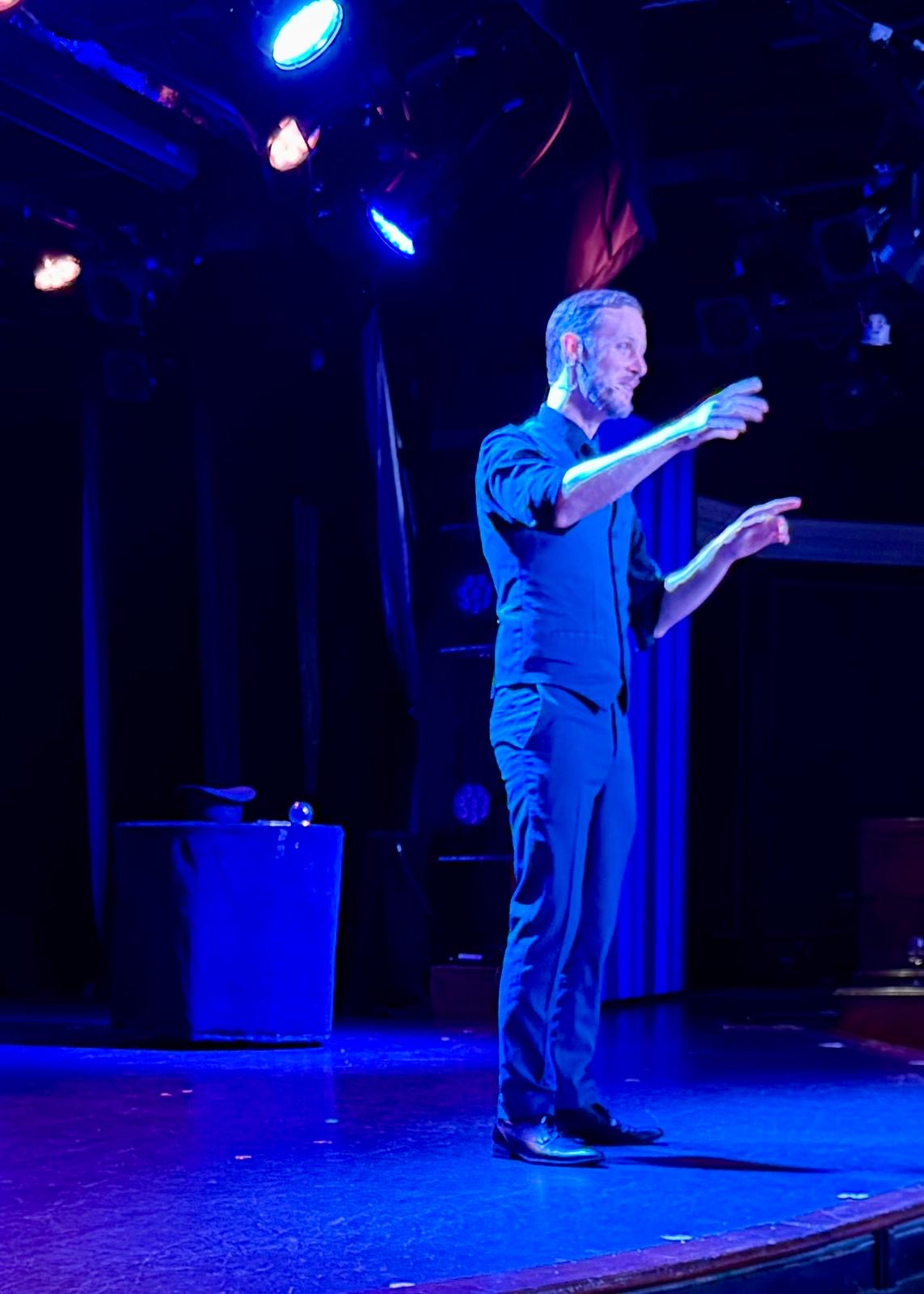
On Thursday evening we attended a Magician show in the Sirena lounge with Stuart Lightbody. He had done a show a few nights ago and people had been raving about it so we arrived early to ensure we had good seats. Just as well we did as the theatre was packed out. And it was well worth it. He is certainly an incredible magician and we both walked away completely gobsmacked by his illusions.


Tomorrow we arrive in Namibia.


Friday 28 November 2025 – Walvis Bay, Namibia: Roger
It was mid-morning when we sailed into Walvis Bay harbour, which was encased in a light mist. This time it was a face-to-face meeting with the immigration officers, who were seated in the Sirena lounge. We were called down in groups, our passports and visas handed to us as we moved along the queue. When our turn came the officer had a quick look and made a couple of stamps, then we handed our passports back to the Sirena crew on our way out the door.


Namibia, has a population of around three million. Its main exports are minerals, diamonds and uranium along with some gold, fish and petroleum products. Most of these are exported from the port here at Walvis Bay. Once again it was discovered by the Portuguese in the 1400’s, but over the years owned by the Dutch, then the English, and in the late 1800’s the Germans. After WWII it was controlled by South Africa until the seventies when it was recognised as a state by the UN. It gained independence in 1990. South Africa retained ownership of Walvis Bay, the country’s major port until 1992. With the Namib desert being the oldest in the world there is evidence of man roaming around here several thousand years ago.
About 1145 we headed down the gangway onto the wharf, where a gaggle of tour guides and taxi drivers ambushed us, wanting to sell us a ride or tour. After many “we already have one booked” they left us alone until our guide JP turned up. In a convoy of 3 vehicles we headed out of the port to our first stop along the waterfront, where large flocks of greater flamingos were feeding in the shallow waters, along with a few pelicans, cormorants and other sea birds.


After taking a few photos we headed to the next stop, being Dune 7, which is a ~140m high sand dune people get to look at and walk up. A couple from Portugal along with Sylvia headed inside the fenced off area to buy a ticket. At the ticket booth they asked if they could pay in USD, which should have been just under 27 USD. They wanted 45 but dropped the price to 40 after complaints and refused to drop it any further. The Portuguese couple were not prepared to pay that so we walked off and took pictures from outside the fence, until they told us we couldn’t do that either.

We moved on, heading north along a four-lane motorway for some distance, at one stage passing an oncoming freight-passenger train that apparently comes across Africa from Tanzania. We turned off, heading east along what is a salt road. It is common practice here to spray large volumes of dissolved salt on the road, which dries into a very hard surface but apparently becomes very slippery on the odd occasion they get rain.

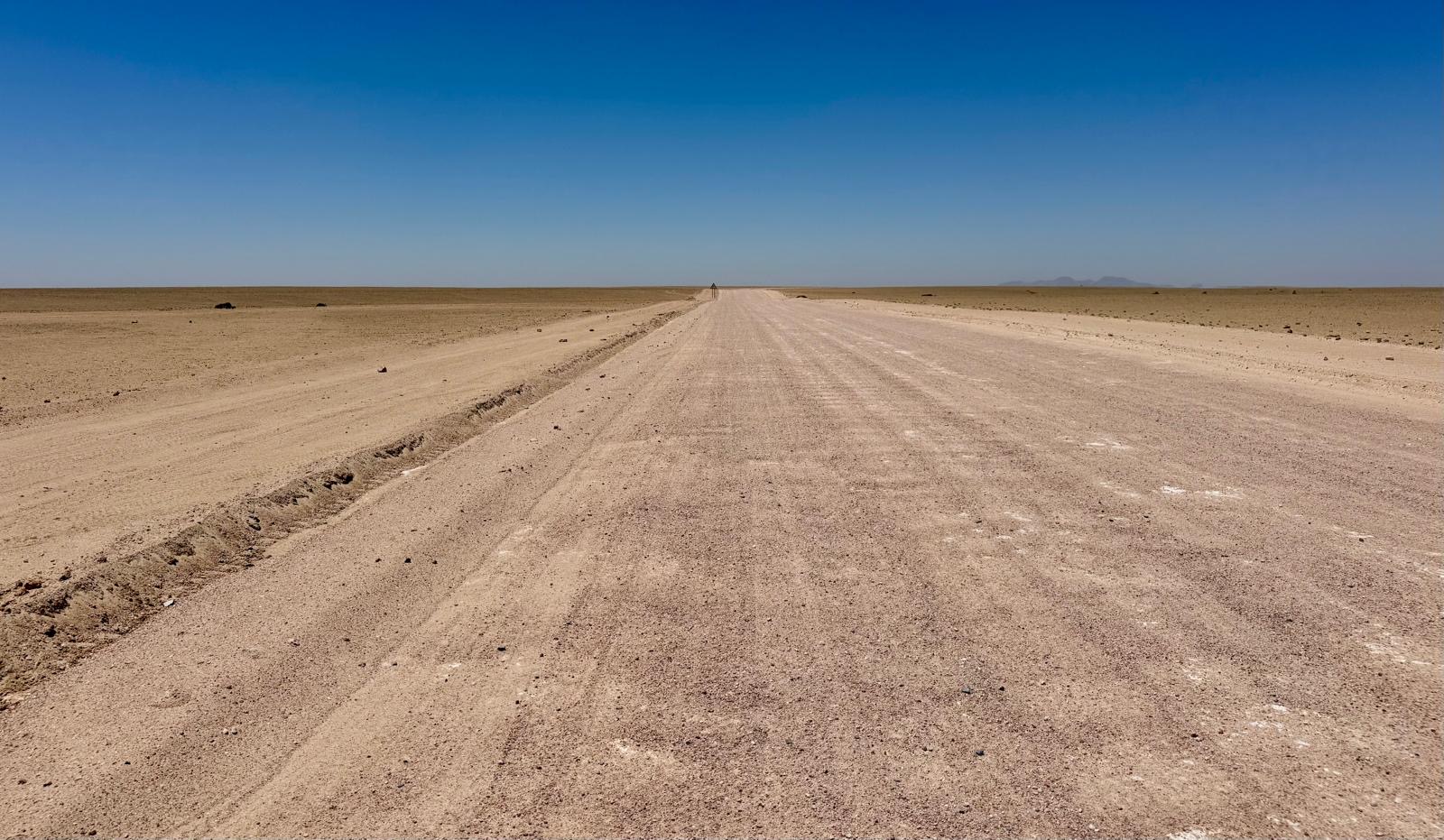
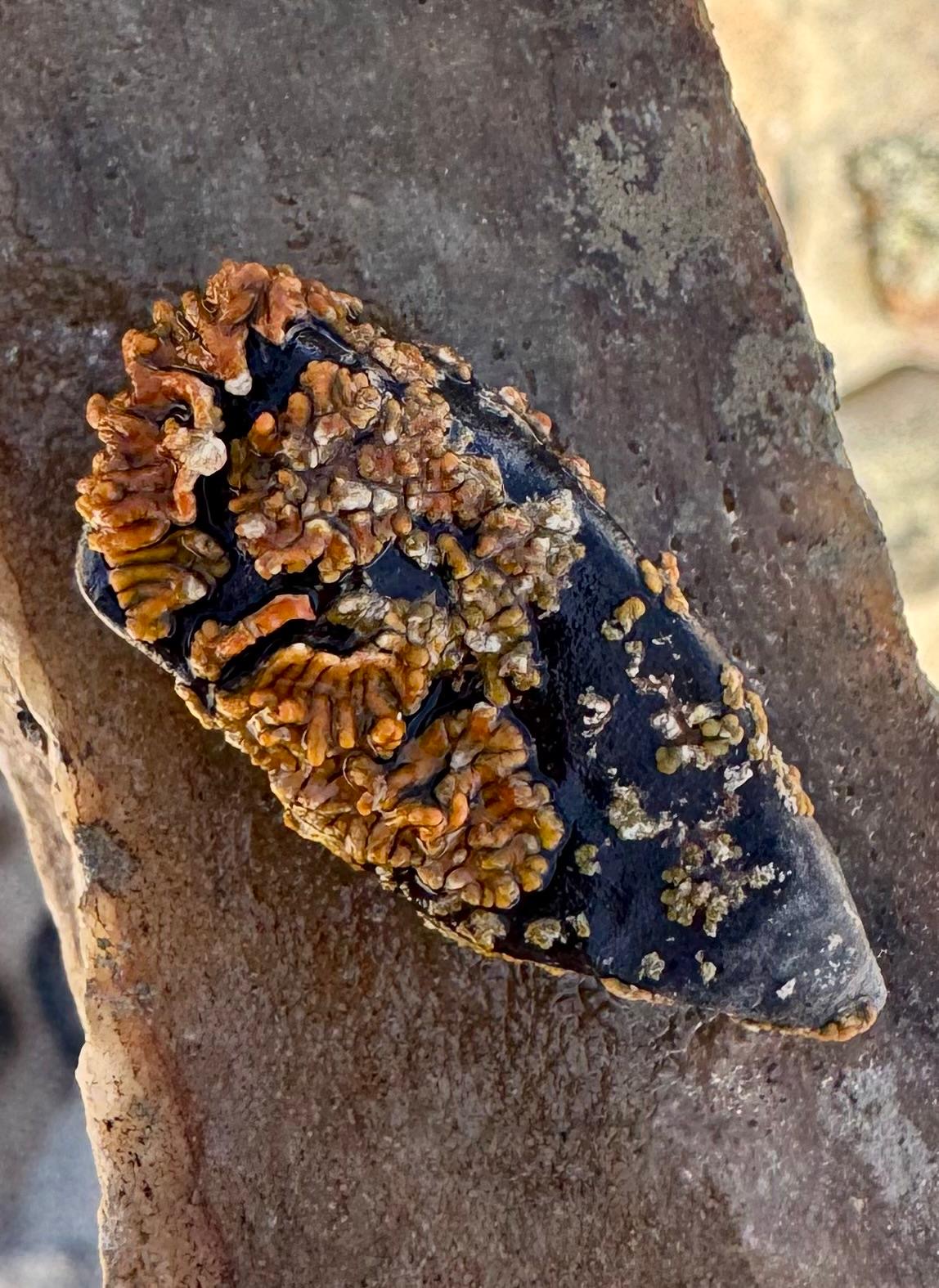
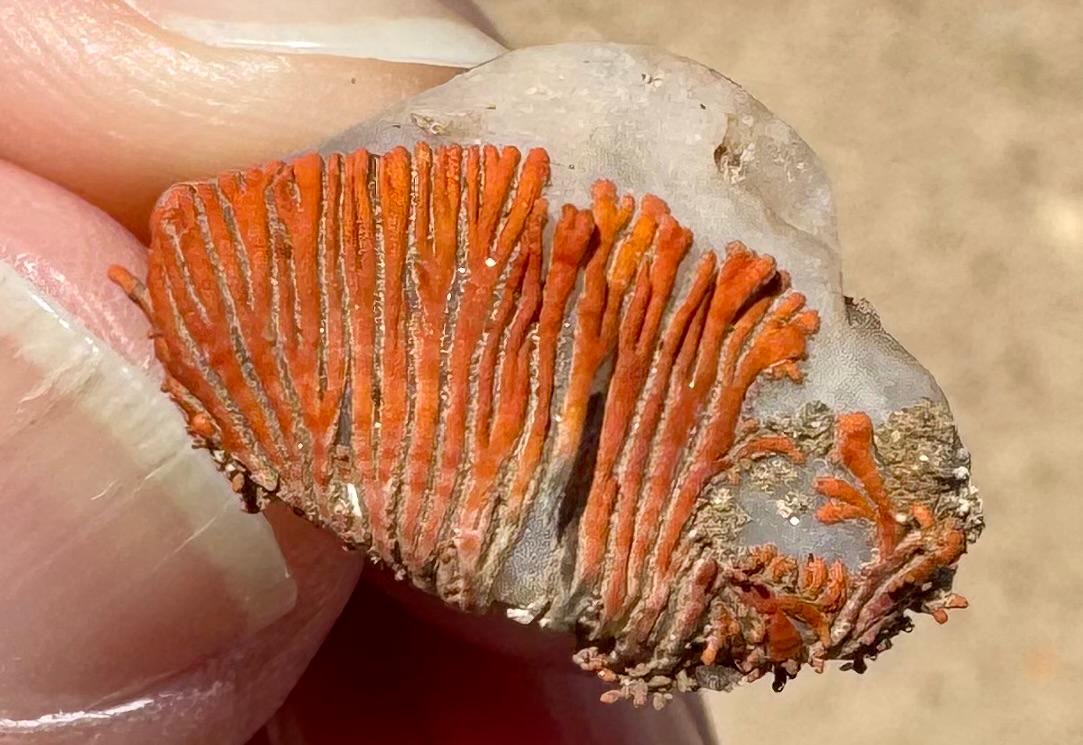
About 30 minutes along this road we came to a sign that said ‘dust free area’, which we couldn’t quite figure out; with all the sand around they must get dust. Not long after the sign we turned left onto a shingle road where the desert on each side had a slight green tinge to it, almost like there was very short grass growing on it. We pulled over at a lay-over and walked to a monument-type rock on the side of the road where JP explained to us that what we could see on the desert was actually a lichen that grows in this part of the world. There were a couple of them growing on two little rocks on top of the monument. He poured some water on them to highlight their colours and also pointed out that these ones are quite big because they get well watered. These lichens take moisture from the sea-fog that hangs here all the way from the coast most mornings. We had seen this when we arrived this morning, although it had now burned off. This moisture, along with the ~20mm of rain that falls here annually enables these lichens to grow and basically hold the ground together, which is not quite sand but a very fine shingle, almost at the sand stage, so that there is no dust.


Further down the road we stopped at a viewing point, which looked across some quite rugged country to some low hills in the distance.


The next stop was Goanikontes Oasis, a small camp where people come to holiday. With a bar, restaurant, museum, a couple of shops and a number of cabins it could be quite an idyllic spot for the city folk nearby to camp at.


After purchasing the mandatory fridge magnet and having a beer we headed out of the camp and up a dry river bed which apparently did have water in it earlier this year, to the point that the water actually reached the sea. As we bounced our way up the sandy track, which not long ago had been a river, we spotted the odd bit of bird life, including a swallow-tailed bee eater.

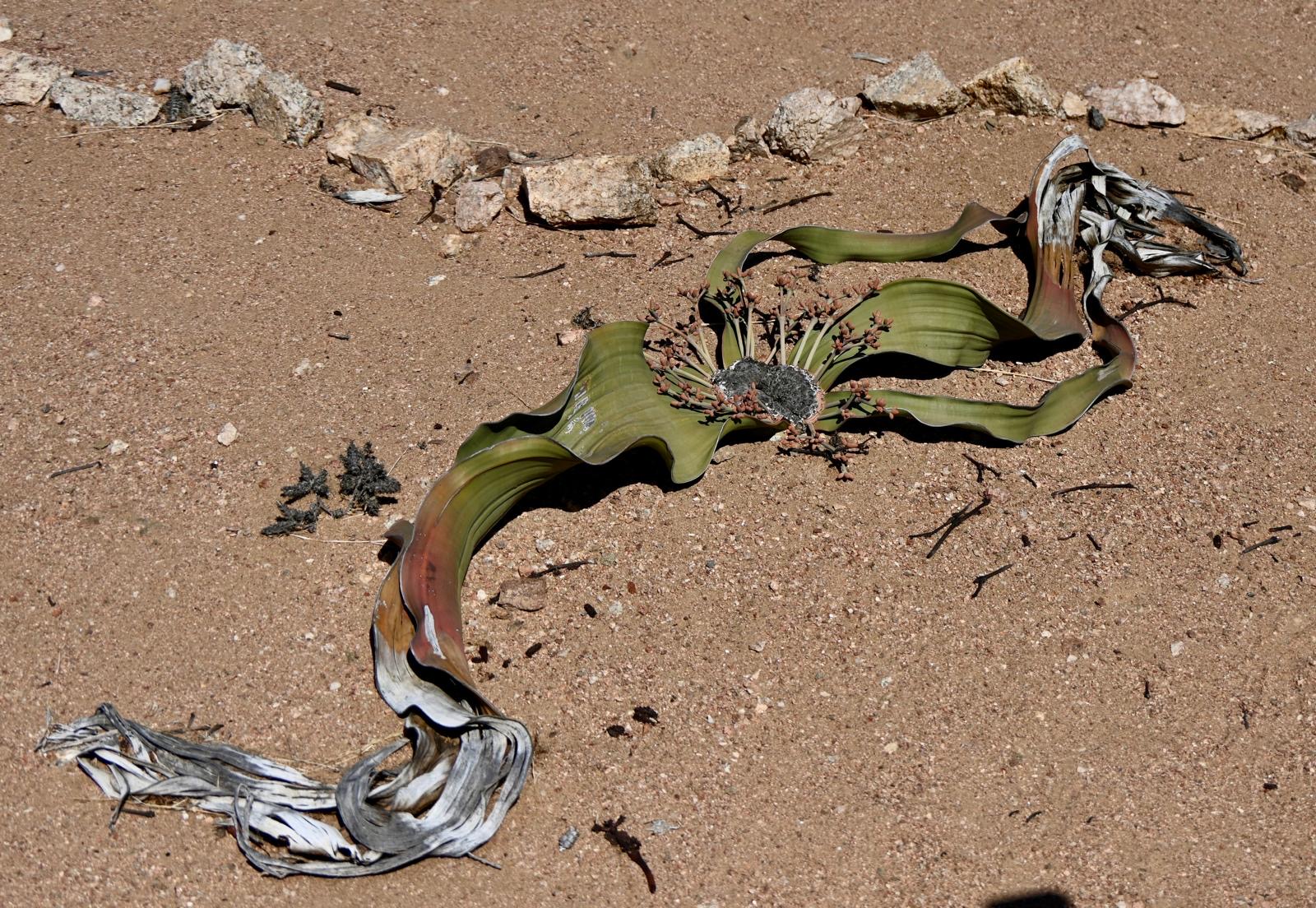
Some distance up the valley we took a left turn up another valley, eventually coming across some Welwitchia pine trees. These have two leaves, one on each side, which eventually get split by the weather. They have small cones; the ones on the female tree also have a little sail on the seeds so the wind can disperse them. They are pollinated by a sectopia beetle. These plants grow very slowly. The ones here ranged from about 100 – 600 years old. There was also a pile of dolomite rocks nearby which when hit with a rock made a musical noise.



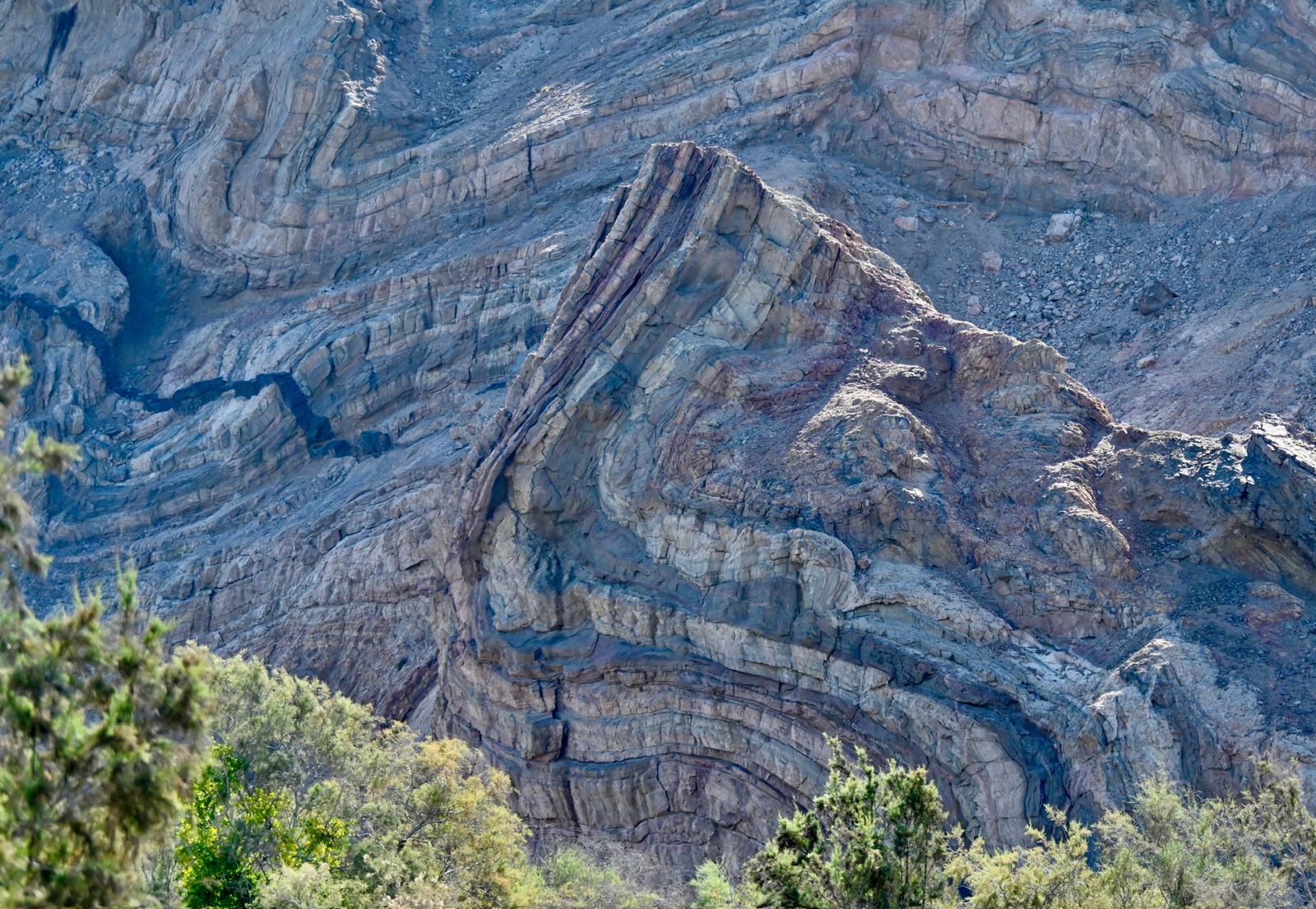
We headed down another valley looking at the many rock formations, which can only be described by picture.


Back on the road we headed back the way we came, then to the city of Swakopmund. With a population of around seventy thousand this town is immaculate. With its German origins, it is apparently the tidiest town in Africa. We enjoyed a pizza and a beer at a local restaurant, followed by a stroll to the beach near the lighthouse. Lots of locals were gathered in the bars and restaurants.


We took the coast road back to Walvis Bay, stopping along the way to walk up a small sand dune for some photos. As the sun was well down in the sky by now shadows made the ridges really stand out.


Saturday 29 November 2025 – Walvis Bay, Namibia: Sylvia
We had arranged a private tour today and, after breakfast in the Grand dining room (Roger has started enjoying their breakfast steak), we headed off the ship and met our guide, Martin. We headed south this time, passing the flamingoes we had seen yesterday and soon arriving at a massive salt mining area. The Walvis Bay Salt company was established in 1960 and now covers 40 square kilometres and exports 1.2 million tonnes of salt a year. Huge mountains of salt were piled up by a few buildings. We drove past massive lagoons, some still with bird life. As we drove further on the water became pinker and the bird life scarce. At one stage we came across a black-backed jackal. The scale of this venture was impressive to say the least.


Martin let a bit of air out of the tires and we headed about 50kms south along the beach to Sandwich Harbour. This used to be a whaling station until the 1970’s and got its name from the supply ship that used to visit. We started in a fairly flat area with a bit of scrub here and there. At one stage we stopped and Martin jumped out of the vehicle and dug in one of the dunes, coming out with a tiny, very attractive web-footed gecko. These well-adapted little animals sleep under the sand during the day, then come out to hunt at night.


A little further on we stopped again where we could see quite a dark reddish colour in the sand. This mineral-rich sand makes its way here via rain, wind etc from mountains in South Africa. Up close it is easy to see the many minerals that give it its red colour. Martin also waved a magnet over the sand, picking up heaps of small iron (hematite) shards. These are what give the desert in the Sossussvlei area its distinctive red colour. The sand there is 70-90 million years old and the hematite has rusted. The sand in this area is only 8-12 million years old and while it has a slight reddish hue, it has years to go to fully rust.


We rocked along, speeding down the beach with the dunes to our left getting gradually taller. Every now and then a small group of vehicles would emerge, shimmering out of the haze in the distance, as we got closer, revealing people fishing.
Sadly we also passed a decomposing humpback whale and many, many dead seals. With ~3-million seals in Namibia I guess it is to be expected that there will also be a lot of dead ones but I didn’t love seeing them. Every now and then we would see seals in the water, and at one point spotted a pod of dolphins.
Eventually we reached Sandwich Harbour, where the dunes meet the sea. It is truly a stunning landscape with the reddish dunes, blue sea and bright blue sky creating some fantastic contrasts. At this point we headed into the dunes, making for some quite interesting driving conditions. Every now and then we’d slide sideways a bit in some very soft sand but generally kept a pretty good line – slowly down the steep slopes then accelerating like crazy to get to the top of the next one. We had done some dune driving in Qatar earlier in the year but this was much more impressive.

Eventually we reached the end point, high up on the dunes with great views back over the surrounding landscape. Martin dropped us off to walk up to the end of the dune, then back down the other side to meet him again. I was a bit nervous about stepping off the top as I couldn’t see any footprints heading down. I decided to go Namibian-style and take my shoes off. (Most of the locals don’t seem to wear shoes). Roger headed off in the lead giving me the confidence to head down too. It was actually quite fun. I can see why there weren’t any footprints as the sand is so fine it covers them up straight away.


Back in the vehicle again we drove back through the dunes. The photos really don’t do this place justice and certainly don’t give a good sense of the thrill (for me anyway) of the driving experience. We kept an eye out for animals, hoping to spot an ibex or a springbok. Unfortunately they proved elusive today but we did see a few ostrich in the distance and some type of eagle. As we got back to the coast we also saw a few humpback whales not too far from shore, including one that was doing a lot of breaching and tail waving. Of course, by the time we got the camera out it had stopped.

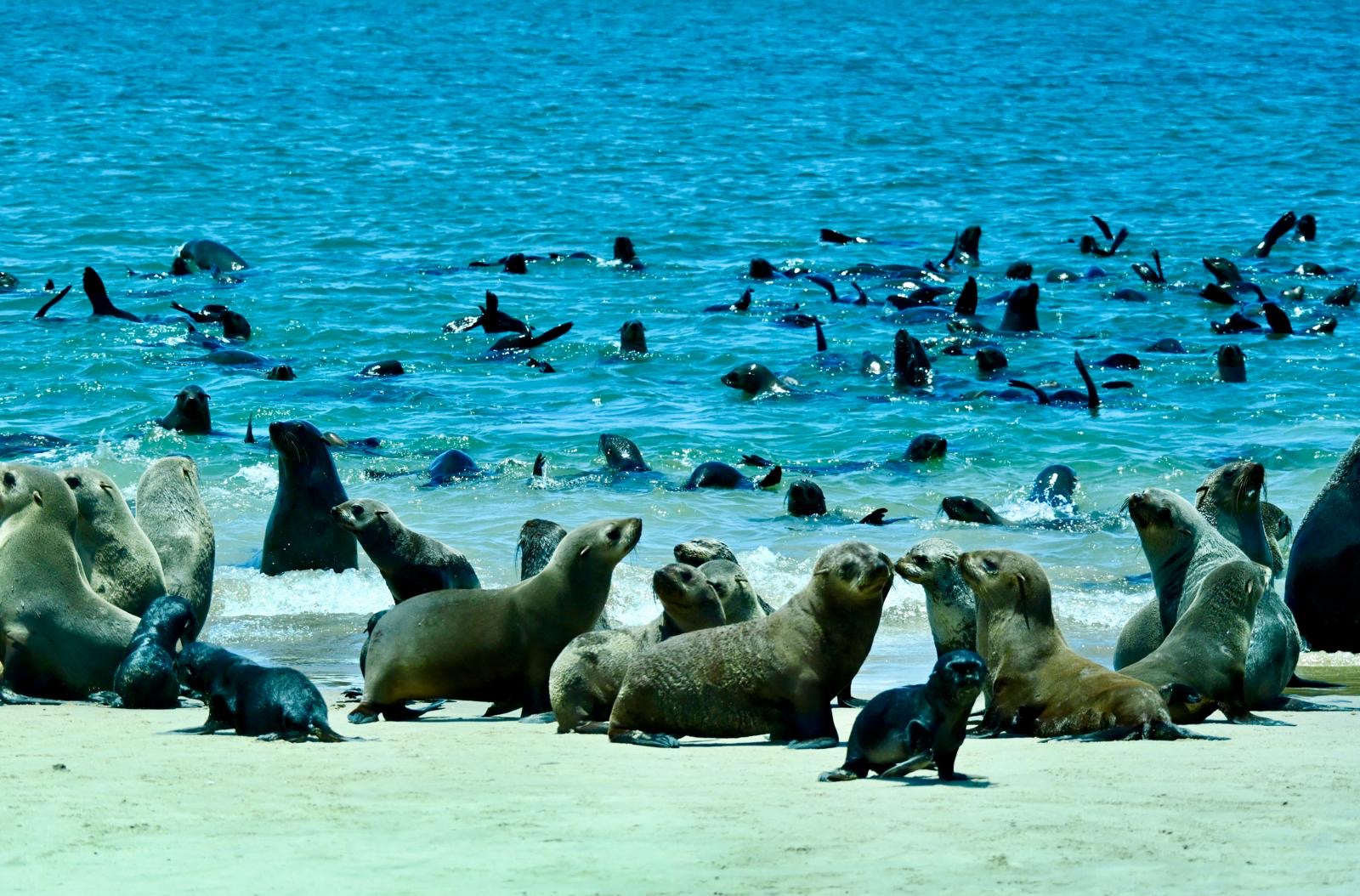
We continued further north along a rather bumpy sand track to Pelican Point. We passed thousands of cape fur seals, gathered in colonies, with lots of young. There were also many flamingoes, cormorants and other sea birds. Black-backed jackals sat in the sun near the colonies; there is obviously plenty of food for them to scavenge around here. There was a lighthouse and a small hotel towards the end of the peninsula. Heading back again we stopped at a rusty shipwreck and had a picnic. Martin had brought a delicious selection of different finger foods with him, along with beer for Roger and water for me.




We arrived back at the Sirena at about 2:45pm, completing our face-to-face, very straight-forward emigration process in the Sirena lounge. At 3:30pm we enjoyed another decadent afternoon tea, then I joined a Pilates class at 5pm as we sailed out of the harbour.
It has been quite windy today and there is a little more motion on the boat this evening… We will be rocked to sleep tonight.
Sunday 30 November 2025 – At Sea: Roger
It was a very quiet day at sea as the walking deck was closed due to the strong wind. After a gym session, Sylvia’s bridge lesson and lunch there was not much happening so it was good to relax. In the evening we were invited by a nice couple from Florida to join them for dinner at the Tuscan Steak restaurant. We had a very enjoyable evening with Mark and Julie, who had both travelled extensively all over the world and done lots of cruises.
Monday 1 December 2025 – Cape Town: Roger
After a coffee in the cafe Sylvia headed off for her final bridge session. She had seen a whale just near the ship while on the treadmill earlier in the morning. I headed back to the gym to try and work off some of the excellent cuisine we have enjoyed over the last 25 days.
It was around 1400 when we headed into the port of Cape Town, looking much more like a big city than what we had seen since leaving Lisbon. Passing Robben Island on our port side we entered the port. With Table Mountain towering a thousand plus’s meters above the city it’s quite an impressive site.


Once the ship was tied up, at right angles to the large 4000-passenger German ship we had seen at Walvis Bay, we were called down to disembark and front up to the immigration people in the terminal building not far from the ship. As we entered the terminal we were handed our passports then led by one of the staff to the front of the queue; a bit unexpected and embarrassing, apparently it related to the rather nice suite we were staying in. A nice smile from the immigration officer and a couple more stamps in our passport and we were free to roam the streets.
Not too far from the terminal is a really nice up-scale shopping area called the Victoria and Alfred precinct. With lots of very nice galleries, shops and restaurants it was a nice place to be. A local dance group performed in a square while a couple of guys played on a giant chess board with a crowd watching on. We headed into one of the many souvenir stores, purchasing some presents for the grandchildren before heading back to the ship.


I was supposed to catch up with Mark for a final cigar on deck 9 later but as we arrived at the ship they were heading off to walk up Table Mountain. Mark messaged me at 2100 to say they were still walking down the mountain.
We packed our bags and said goodbye to our Butler, Akshay, who was leaving the boat in the morning to fly back to his home in Mumbai, India for two months. He had done a great job, always with a cheerful persona and was excited for his break after 6-months on board. We also said goodbye to the service team when they came to do the turndown service. They both had 6 months to go on their contracts, working 12-hours a day, seven days a week, always with a cheerful smile on their faces.
Tuesday 2 December 2025 – Cape Town: Sylvia
We woke to a glorious day in Cape Town and, after enjoying our last breakfast in the Grand Dining Room aboard the Sirena, we disembarked for the last time at 8:30am. I had mixed feelings about leaving. I am looking forward to being home but have really enjoyed our time and could easily have stayed onboard longer.
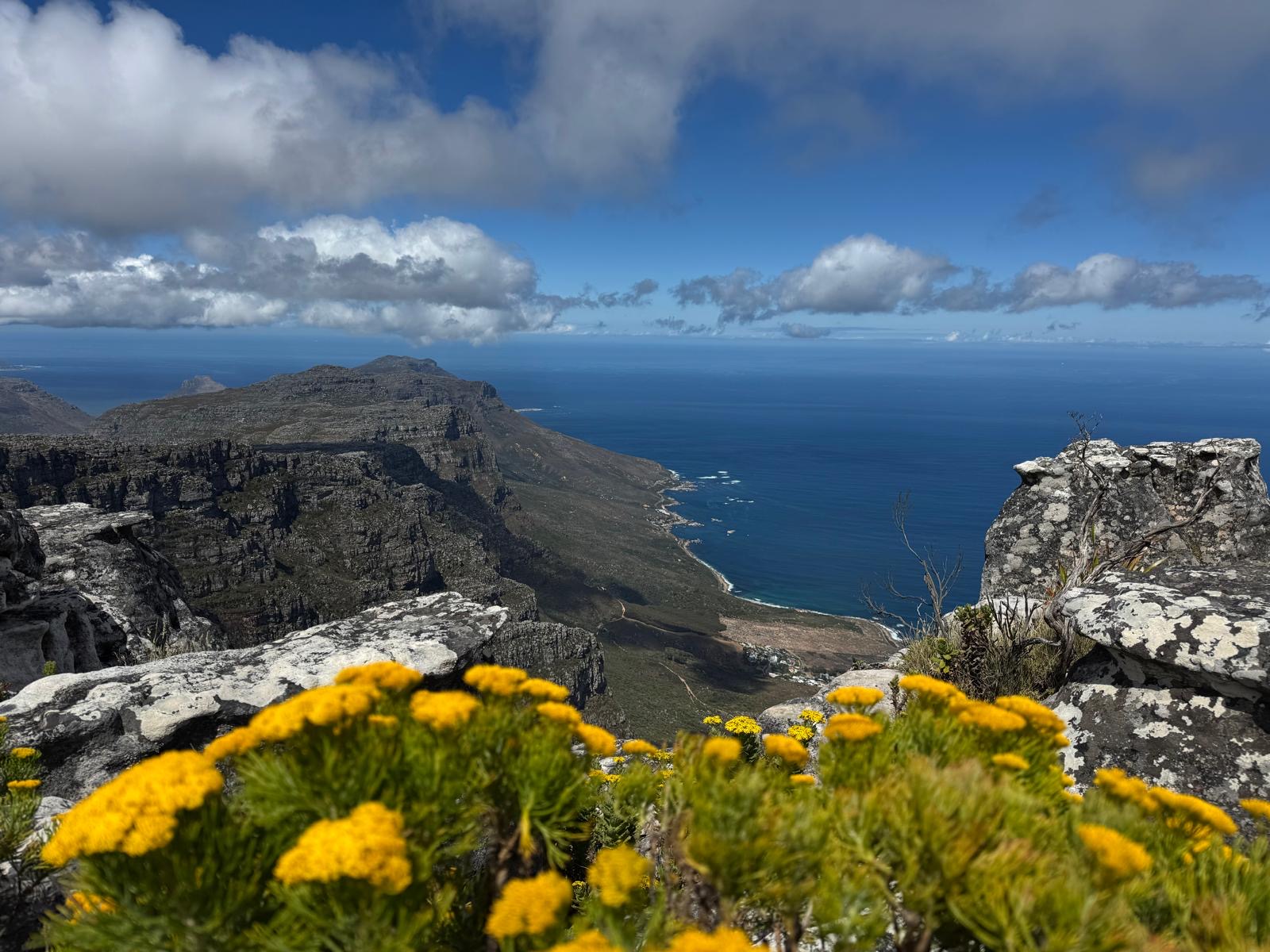
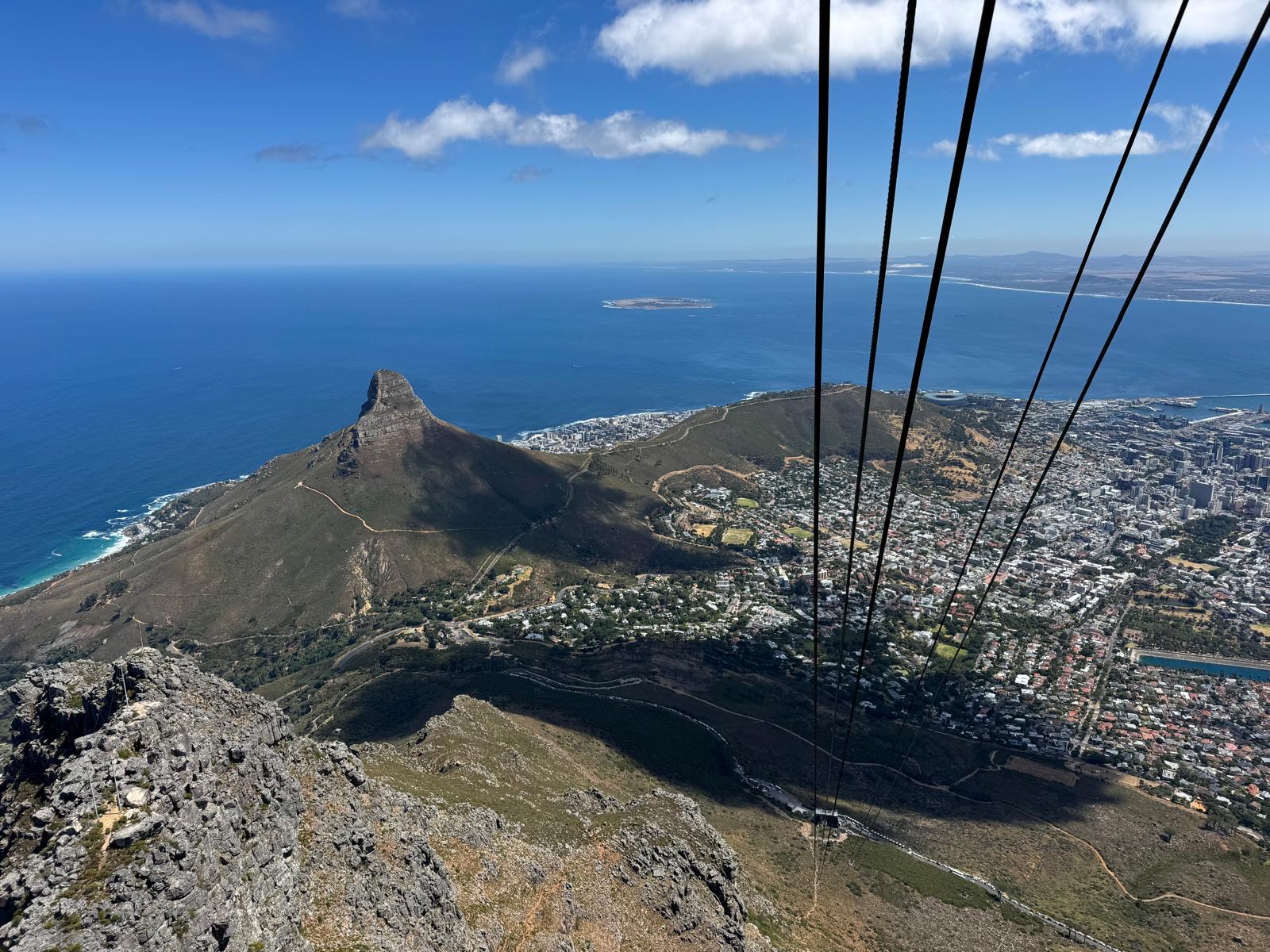
We wandered along the wharf to meet Rowan, our guide for the day. This being Roger’s first time in Cape Town, I had booked a full day Cape tour as a good way to get an overview of the city and surrounding area. We climbed into a very comfortable Mercedes van and headed off to our first stop, Table Mountain. This incredible chunk of primarily sedimentary rock dominates the skyline. We had fast pass tickets so were able to skip the ~45-minute queue and head straight onto the cable car. With its rotating floor this enables good views for all the passengers inside. We did just over a full rotation as we rapidly made our way up the mountainside, a much easier ascent than the few walkers and rock climbers we saw. At the top we were treated to clear views back over the city and surrounding countryside giving an excellent overview of the area we would be covering later in the day. About 7-million of South Africa’s 64-million inhabitants live in the Western Cape area, ~5-million of them in Cape Town. The top of the mountain is covered with fynbos, a group of plants endemic only to the Cape area. Some of the smaller proteas were coming into flower. After wandering around a bit and taking some photos, we leveraged our fast passes again and headed back down the mountain.




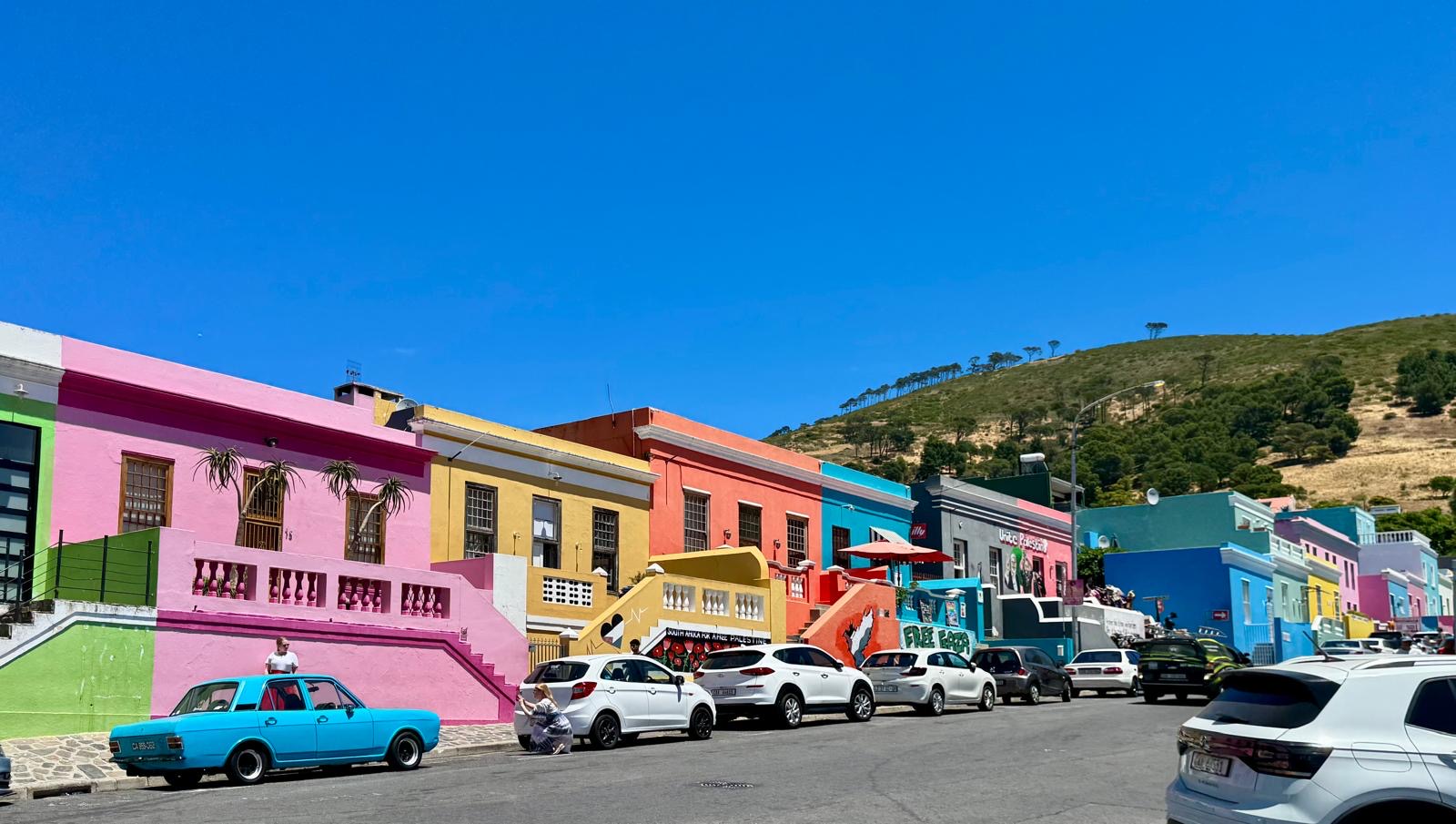
Our next stop was the Bo Kaap area, where we met a local guide, Sharyne for a walking tour of this colourful part of town. Sharyne has lived in Bo Kaap all her life and seemed to know everyone we passed, stopping to greet them and ask after their health and family. She gave us an overview of the South African history, and the apartheid era. Originally discovered by the Portuguese in the 1400’s it was not until 1652 that the Dutch, through the Dutch East India Company, started to settle in South Africa. They brought with them slaves from all over the world, including exiled religious leaders (any religious leader that did not change to the Dutch Reformed Church) from their various colonies. This included a lot of Muslim leaders from Malaysia and Indonesia. They were originally imprisoned on Robben Island (which is where Nelson Mandela was later imprisoned) and some were eventually freed and established a community in Bo Kaap. These people are known as Cape Malay and the area celebrates their unique culture and heritage.
In the late 1800’s the British took over the country from the Dutch for a few years, then the Dutch took it back again, then the British again. It became a separate territory under the Commonwealth in 1910. Apartheid was introduced in various forms from 1924 with increasingly divisive legislation being introduced. Sharyne explained that after WWII it really accelerated. The white leaders had watched Hitler try to rule by killing those that were different and be defeated. As minority leaders, they decided that they would try and rule by division without killing people and hoped they would be accepted. This was not the case and in 1960 they were kicked out of the Commonwealth and became an independent country, a different way to gain independence from the wars that happened in many other colonies.
Under apartheid there were strict rules and classifications for whites, Indians, coloureds and blacks. Groups were not allowed to inter-marry and were segregated into different areas. This further established Bo Kaap as a distinct Cape Malay area. The area now features brightly painted houses with a distinct architectural style. There are lots of art galleries and museums as well as several mosques. As the tour ended, Rowan showed up with a number of Cape Malay delicacies for us to taste as Sharyne explained how each one was made. I particularly enjoyed the donut-like breakfast one called a koeksister.


Leaving Bo Kaap we headed south out of the city, passing many beautiful bays with stunning beaches, expensive looking houses and high-end restaurants and cafes. These stand in stark contrast with the township areas scattered about. Anytime we neared a township we saw many people walking along the roads and a lot more rubbish around with dirt roads leading off the main road. We would soon come to the township itself with row upon row of tiny corrugated iron shacks stacked alongside one another seeming to fill every space. Most do not have running water or any toilet facilities.


At one stage Rowan pointed out a woman sitting beside the road in a car flying a rasta flag. This is apparently the sign she is selling weed. Although cannabis has been decriminalised in SA it is still illegal to sell, but this didn’t seem to be policed as this car was just down the road from a police station.
Eventually we arrived at the National Park leading to the Cape of Good Hope. This is the most southwestern point of Africa. The park itself is covered in fynbos and is home to numerous species of animals, although they are hard to spot in the heavy undergrowth. We saw several ostrich, including a couple right by the beach. A couple of baboon wandered right along the road edge, seemingly unperturbed by all the vehicles. We also saw eland and bontebok in the distance.


We arrived at Cape Point and caught the funicular up to the old light house. Apparently this lighthouse didn’t work too well as there were numerous shipwrecks in the area. It had been built too high and was often obscured by mist. Since a newer, more powerful, lighthouse has been built closer to the water there haven’t been any more ships wrecked in the area. The lighthouse though boasts impressive views over the cape and we saw a colourful rock agama lizard sunning itself on the rock.


We rode the funicular back to the base, then drove to the Cape of Good Hope for the obligatory photo in front of the sign. As we were driving back out of the park we spotted a smallish puff adder on the side of the road. Unfortunately (or perhaps fortunately as it is very venomous) it slithered off before we could get a photo.

We drove north along the east side of the cape to Simonstown where we stopped at Boulders Beach, which is home to a large colony of African penguins. These are sometimes known as Jackass penguins due to the braying noise they make as part of their mating process. We spent a while watching from the boardwalk. There were a few chicks, several ‘teenage’ baby blues and many adults. They do look quite hilarious waddling around and jumping up on the rocks.


There were also several dassie’s in the area. We had seen these small, rodent-like animals, which are apparently the closest living relative of the elephant, at Table Mountain as well but here they were right by the path creating some much better photo opportunities.

Leaving Simonstown we headed back to the west side of the cape and were dropped off at Tintswalo Atlantic, a boutique hotel on a secluded bay just outside Hout Bay. I had stayed there the last time I was in the Cape Town area and was very glad I had decided to go back again. The service was excellent, the views stunning and the room delightful. We relaxed on the terrace, enjoying the sunset while Roger enjoyed his welcome strawberry wine cooler and his last cigar for the holiday. A number of small fishing boats made their way into the Hout Bay harbour for the night.


We retired early; tomorrow we will start the long journey home, via Johannesburg and Singapore. It will be good to have time at home catching up with family and friends for the Christmas period before we head off on another adventure in January.
Great photos! And very informative blog. What a journey! You two sure know how to travel. Thank you for sharing. So good to be able to travel vicariously with you. Looking forward to the January blog. Xx
Pictures dont do justice, especially in when experiencing the expance of the dunes, but they are great memories.
Hope your joints are are holding up.